Arq. Bras. Oftalmol. 200063
| DOI: 10.1590/S0004-27492000000300002
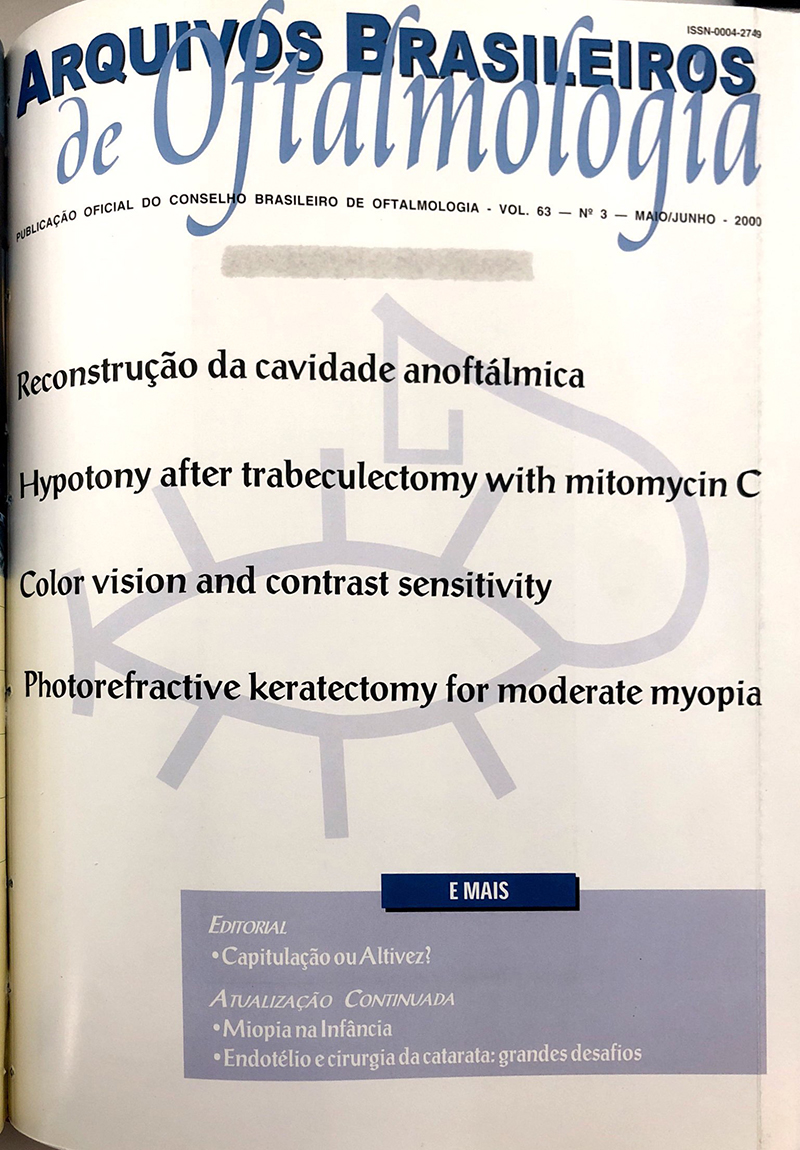
Purpose: To observe the complications with spheres of different types of material used in anophthalmic cavity reconstruction.
Methods: 117 patients with anophthalmic cavity were retrospectivelly studied. The minimum follow-up was 6 months. We correlated sex, type of used sphere, causes of eye loss, sphere diameter, surgery done and complications (dehiscence and sphere expulsion).
Results: Dehiscence occurred mainly with vegetal polymer spheres. The integrated implants had earlier sphere expulsion than those nonintegrated and the latter extruded more than the others. The polyethylene sphere (Polipore) presented less complications than the others.
Conclusion: Nowadays we consider the polyethylene sphere the best choice to fill the anophthalmic socket.
Keywords: Cavity implant; Dehiscence; Expulsion; Anoph-thalmic socket; Complications
Arq. Bras. Oftalmol. 200063
| DOI: 10.1590/S0004-27492000000300003
Purpose: To describe the clinical findings and treatment modalities of persistent hypotony following primary trabeculectomy with mitomycin C.
Methods: We retrospectively analyzed 9 eyes with persistent hypotony, which was defined as intraocular pressure less than or equal to 5 mmHg for more than 2 months.
Results: Mean hypotony duration was 7.4 months (standard deviation (SD) ± 6.7 months, range 2 to 23 months). Associated findings included choroidal detachment (2 eyes) and maculopathy (5 eyes). All patients who developed maculopathy were relatively young (mean age = 37 years old, SD ± 16, range 18 to 79 years). Treatments included bandaged contact lens, autologous blood injection, phacoemulsification, resuturing of the scleral flap, scleral patch graft, and Simmons' shell. After treatment, intraocular pressure (IOP) raised in all patients (mean final IOP = 11.1 mmHg, SD ± 3.5). On the first day of hypotony, the mean IOP was 3 mmHg (SD ±1.7). At the last follow up, visual acuity (VA) was unchanged in 3 eyes, worsened in 2 eyes (by 2 Snellen lines), and improved (by 1 to 4 Snellen lines) in 4 eyes. Of those eyes whose VA improved, 3 had undergone phacoemulsification.
Conclusion: Hypotony after trabeculectomy with mitomycin C can be reversed with possible improvement in vision.
Keywords: Glaucoma; Trabeculectomy; Mitomycin C; Hypotony
Arq. Bras. Oftalmol. 200063
| DOI: 10.1590/S0004-27492000000300004
Purpose: To determine the reliability of TwoDocs compu-terized test for the evaluation of color vision and contrast sensitivity in normal adults.
Methods: Thirty normal volunteers aged from 20 to 30 years (mean 23.3 years) had their color vision and contrast sensitivity tested by a new computerized test (TwoDocs test). Informed consent was obtained from all participants before testing. Inclusion criteria were: absence of visual com-plaints, absence of previous ophthalmic surgery, absence of family history of ophthalmologic diseases, best corrected visual acuity for near and distance of 20/20. Tests with the Farnsworth-Munsell 100-hue (FM-100) test for color vision assessment and the Pelli-Robson chart for contrast sensitivity measurement were also performed on the same visit, and both were considered gold standards for clinical validation.
Results: The results of contrast sensitivity obtained with the Pelli-Robson chart and TwoDocs test showed agreement of 100%. Color vision results obtained with the TwoDocs test showed a strong trend to overestimate color vision classification when compared with FM-100.
Conclusion: The new computerized psychophysical TwoDocs test showed a high sensitivity and specificity for contrast sensitivity measurement and can be a useful clinical tool in ophthalmology practice for this visual task. Color vision classification obtained with the TwoDocs test showed a low specificity when compared with FM-100. One possible reason for this overestimation is the computer monitor used to generate the color pattern. Additional studies in patients with disorders in color vision should be done for understan-ding the usefulness of this method better in clinical color vision assessment.
Keywords: Color vision; Contrast sensitivity; Clinical assessment
Arq. Bras. Oftalmol. 200063
| DOI: 10.1590/S0004-27492000000300005
Purpose: To present photorefractive keratectomy (PRK) results for myopia ranging from -4,00 to - 6,00 diopters performed with the VISX and Summit excimer lasers.
Methods: To be eligible for this study, patients had to be 20 to 45 years of age, have -4.00 to -6.00 diopters of myopia and have no more than 1 D of astigmatism. The Summit group was composed of 51 eyes. The baseline preoperative spherical equivalent of myopia was -5.22 ± 0.17 and surgeries were performed with the Excimed UV 200 LA Excimer Laser. In the VISX group, there were 53 eyes and the baseline refractive error was -4.85 ± 0.16 and surgeries were performed with the Twenty/Twenty Excimer Laser.
Results: At six-month examination, haze ranged from 0 to 1 (M:0.56 ± 0.07) in the VISX group and from 0 to 3 (M:0.58 ± 0.08) in the Summit group. Uncorrected vision at six months was 20/20 or better in 22% of eyes and 20/40 or better in 83% of eyes in the VISX group. In the Summit group, 25% of eyes were 20/20 or better and 71% were 20/40 or better at the six-month examination.
Conclusion: It is reassuring that PRK of patients with -4.00 to -6.00 D of myopia results in acceptable results.
Keywords: Excimer laser; Myopia; Correction
Arq. Bras. Oftalmol. 200063
| DOI: 10.1590/S0004-27492000000300006
Purpose: To assess the epidemiological profile of the ametropia cases attended at the University Hospital Nucleus (NHU) of the Federal University of Mato Grosso do Sul (UFMS) since ophthalmologic research in this are is extremely poor in our region.
Methods: A retrospective epidemiological surgery at the Section of Medical Files (SAME) was carried out, applying a research protocol to 2,361 charts of patients presenting some type of ametropia who were attended at the NHU between 1996 and 1998, with information on sex, age and type of ametropia (myopia, hyperopia, astigmatism or presbyopia). The data were analyzed and discussed.
Results: There was prevalence of females (60%) in all cases of ametropia, the greatest number of attended people being patients with presbyopia (987 cases), followed by hyperopia (701), myopia (434) and astigmatism (239). Myopia was present mostly in the age range of 20 to 29 years, hyperopia between 0 and 9 years and astigmatism between 10 and 39 years, while the highest incidence of presbyopia was in the age range over 40 years.
Conclusion: The number of female patients is higher than that of males, even considering each ametropia separately. Some hypotheses are proposed. Myopia is more frequent at ages between 10 and 39 years. Hyperopia occurs more frequently in children and newborns, tending to decrease with age because of eyeball increase. Astigmatism was characterized as a defect occurring in adolescents and young adults. Presbyopia was the commonest refraction error and its incidence occurred in the age range over 40 years, similarly to data found in the literature.
Keywords: Ametropia; Epidemiology; Refraction
Arq. Bras. Oftalmol. 200063
| DOI: 10.1590/S0004-27492000000300007
Purpose: Leucocytoclastic vasculitis is an immune complex-mediated, small vessel disease, that is characterized clinically by the presence of palpable purpuric lesions, most often in association with rheumatic diseases. Ocular manifestations are rare. We describe a patient with an unusual granulomatous pattern of EED associated with autoimmune keratolysis. Case Report: A 64-year-old man with decreased visual acuity and nodular lesions in both hands. Ocular exami-nation presented bilateral superior corneal melting with perfuration in left eye and conjunctival thickness in both eyes, in association with severe inflammatory reaction. His-topathologic examination of the conjunctiva revealed gra-nulomatous vasculitis with neutrophilic infiltrate, giant cells and fibroblastic proliferation. A punch biopsy from skin showed similar characteristics suggesting EED, however there was no giant cell.
Conclusion: To our knowledge, autoimmune keratolysis secondary to cutaneous leucocytoclastic vasculitis (EED) has not previously been described, neither did we find a des-cription about granulomatous reaction (from conjunctiva) in EED.
Keywords: Leucocytoclastic vasculitis; Keratolysis; Ery-thema elevatum diutinum; Ocular perfuration
Arq. Bras. Oftalmol. 200063
| DOI: 10.1590/S0004-27492000000300008
Purpose: To evaluate the action of Ferrara's Ring in the treatment of corneal ectasia after Excimer Laser.
Methods: Ferrara's Ring, that is already being applied in the treatment of keratoconus, high myopia and irregular astigmatism, has been used to stabilize and to correct the corneal ectasia of 2 patients submitted to PRK.
Results: After the surgical procedure, a flattening of the central cornea was observed, with approximately 6 D (first case) and 10 D in the second, with visual acuity improvement. The results have remained stable until this moment. The postoperative follow-up was of 3 and 8 months, respectively. Conclusions: Ferrara's ring has obtained success in the difficult treatment of this surgical complication, allowing delay of or even avoiding the evolution of these cases to a corneal transplantation with all its risks, slow recovery and dependence on the agility of the donation lines.
Keywords: Corneal ectasia; Refrative surgery; Ferrara's ring
Arq. Bras. Oftalmol. 200063
| DOI: 10.1590/S0004-27492000000300009
Purpose: To correlate the values of intraocular pressure (IOP) obtained by applanation tonometer (Haag-Streit, Bern, Switzerland) in patients with diabetes mellitus (with or without diabetic retinopathy), hypertension (with or without hyper-tensive diabetic retinopathy) and the normal population. Patients and
Methods: Subjects participating in the Glau-coma Project (n = 924, 40 or more years old) were examined according to standard protocols including IOP measu-rement, fundoscopy, blood pressure and glucose deter-mination. Patients were divided into seven groups: diabetic patients without diabetic retinopathy, hypertensive patients without hypertensive retinopathy, diabetic hypertensive patients without retinopathy, diabetic patients with diabetic retinopathy, hypertensive patients with hypertensive retinopathy, diabetic hypertensive patients with retinopathy and population-based control.
Results: Applying the one-way ANOVA test to a normal distribution at 5% significance, it was observed that IOP values were higher in the groups of hypertensive patients without retinopathy (mean = 16.10), hypertensive patients with hypertensive retinopathy (mean = 16.33) and diabetic hypertensive patients with retinopathy (mean = 16.95) when compared with the other groups.
Conclusion: The mean IOP value increases progressively with the evolution of systemic hypertensive disease and when it is associated with diabetes.
Keywords: Diabetes; Hypertension; Intraocular pressure; Glaucoma
Arq. Bras. Oftalmol. 200063
| DOI: 10.1590/S0004-27492000000300010
Purpose: To present a case of spontaneous extrusion of a calcified plaque of scleral focal senile translucency.
Methods: Case report of a 75-year-old female, referred because of a epibulbar tumor suspicion. She complained of foreign body sensation and had a white scleral plaque in front of the left medial rectus insertion. The lesion was exci-sed and a scleral graft performed. The histologic examination showed fibrous connective tissue, with calcification.
Conclusion: Spontaneous extrusion of senile scleral plaques should be included in the differential diagnosis of epibulbar tumors.
Keywords: Scleral focal senile translucency; Epibulbar tumors


 ABO is licensed under a Creative Commons Attribution-NonComercial 4.0 Internacional.