
Showing of 1 until 9 from 9 result(s)
Search for: ChatGPT; Writing; Authorship; Ethics; Data accuracy; Plagiarism; Students; Bias
01-tab01tb.jpg)
Abstract
OBJETIVO: Avaliar comparativamente o limiar de sensibilidade macular da microperimetria e a estabilidade de fixação entre o primeiro (direito) e o segundo (esquerdo) olhos testados de indivíduos normais.
MÉTODOS: Trinta pacientes saudáveis foram divididos aleatoriamente em 2 grupos. Os participantes foram submetidos à microperimetria no “fast mode” e no “expert mode” no grupo I e II, respectivamente. Cada participante foi submetido a um único teste e o olho direito foi testado primeiro.
RESULTADOS: No grupo I, o limiar médio de sensibilidade macular (± DP) foi de 24,5 ± 2,3 dB e 25,7 ± 1,1 dB nos olhos direito e esquerdo, respectivamente (p=0,0415). No grupo II foi de 26,7 ± 4,5 dB e 27,3 ± 4,0 dB nos olhos direito e esquerdo, respectivamente (p=0,58). Não houve diferença estatisticamente significativa entre os olhos dos dois grupos (p=0,1512). Em relação à estabilidade de fixação (avaliada no grupo microperimetria no “expert mode”), a média das porcentagens dos pontos de fixação dentro do 1 grau central da mácula (P1) ± DP foi de 87,9 ± 11,5% no olho direito e de 93,8 ± 6,6% no olho esquerdo. O teste t pareado não mostrou diferença estatística entre os olhos (p=0,140). O valor médio de P2 ± DP foi de 95,5 ± 4,9% no olho direito e 98,5 ± 2,1% no olho esquerdo. Foi demonstrado um aumento na porcentagem de pontos de fixação no segundo olho testado quando comparado ao primeiro (teste t pareado= 2,364; p=0,034). Houve correlação negativa entre o limiar de sensibilidade macular do olho direito e a duração do exame nos dois grupos (microperimetria no “expert mode”: r=-0,717; p=0,0026; microperimetria no “fast mode”: r=-0,843; p <0,0001).
CONCLUSÃO: O limiar médio de sensibilidade macular foi maior no segundo olho testado no grupo microperimetria no “fast mode” e foi semelhante nos dois olhos no “expert mode”. Nossos dados sugerem que a compreensão do exame pelo indivíduo pode impactar nos resultados da microperimetria.
Keywords: Macula lutea; Fixação ocular; Viés; Campos visuais; Acuidade visual
06-tab01.jpg)
Abstract
OBJETIVO: Analisar o perfil e a taxa de publicação em periódicos indexados de resumos apresentados na seção de córnea da reunião anual da Association for Research in Vision and Ophthalmology - ARVO, para identificar potenciais fatores preditivos com objetivo de obter melhores resultados.
MÉTODOS: Artigos que foram aceitos para apresentação no encontro anual da Association for Research in Vision and Ophthalmology - ARVO 2013 na seção de córnea foram pesquisados via PubMed e Scopus para identificar se haviam sido publicados como manuscritos com texto integral. Nome do primeiro autor, data de publicação, nome da revista e fator de impacto foram registrados. Foi feita uma regressão multivariada para estabelecer uma associação entre as variáveis e a chance de publicação e o fator de impacto da revista. Foi utilizado o método Kaplan-Meier para analisar o tempo da apresentação até a publicação dos artigos.
RESULTADOS: Dos 939 artigos analisados, 360 (38.3%) foram publicados em revistas com um fator de impacto médio de 3.4. O intervalo de tempo entre a submissão do resumo e a publicação do artigo teve como mediana 22 meses. Na análise multivariada, resumos tinham mais chance de publicação se tinham algum tipo de financiamento (OR=1.482, p=0.005), tinham grupo controle (OR=1.511, p=0.016) e estavam no âmbito da pesquisa científica básica (OR+1.388, p=0.020). O fator de impacto da revista era maior em estudos financiados (β=0.163, p=0.002) e mais baixo naqueles multicêntricos (β=-0.170, p=0.001). A análise Kaplan-Meier mostrou diferenças significativas na distribuição de tempo até a publicação de resumos de ciência básica vs clínicos (χ2=7.636), com grupo controle vs sem grupo controle (χ2=6.921) e financiados vs não financiados (χ2=13.892) (p<0.05).
CONCLUSÃO: Aproximadamente 40% dos resumos apresentados no encontro da Association for Research in Vision and Ophthalmology - ARVO foram publicados dentro de 5 anos da submissão. Financiamento, pesquisa no âmbito da ciência básica e presença de grupo controle foram fatores determinantes para melhores resultados em relação à chance de publicação.
Keywords: Resumos e indexação como assunto; Bibliometria; Congressos como assunto; Resumo de reunião; Publicações/estatística & dados numéricos; Córnea
Abstract
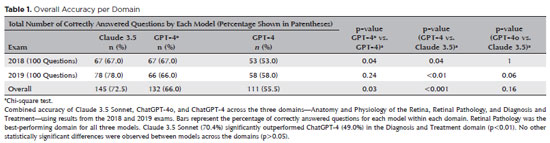
PURPOSE: Natural language models and chatbots, particularly OpenAI’s Generative Pre-Trained Transformer architecture, have transformed human interaction with digital interfaces. The latest versions, including ChatGPT-4o, offer enhanced functionalities compared to their predecessors. This study evaluates the accuracy of ChatGPT-4, ChatGPT-4o, and Claude 3.5 Sonnet in answering questions from the Brazilian Retina and Vitreous Society certification exam.
METHODS: We compiled 200 multiple-choice questions from the Brazilian Retina and Vitreous Society 2018 and 2019 exams. Questions were categorized into three domains: Anatomy and Physiology of the Retina, Retinal Pathology, and Diagnosis and Treatment. Using a standardized prompt developed according to prompt design guidelines, we tested ChatGPT-4, ChatGPT-4o, and Claude 3.5 Sonnet, recording their first responses as final. Three retina specialists performed a qualitative analysis of the answers. Accuracy was determined by comparing responses to the official correct answers. Statistical analysis was conducted using chi-square tests and Cohen’s Kappa.
RESULTS: Claude 3.5 Sonnet achieved the highest overall accuracy (72.5%), followed by ChatGPT-4o (66.0%) and ChatGPT-4 (55.5%). Claude 3.5 Sonnet and ChatGPT-4o significantly outperformed ChatGPT-4 (p<0.01 and p=0.03, respectively), while no significant difference was observed between Claude 3.5 Sonnet and ChatGPT-4o (p=0.16). Model responses agreed 74.5% of the time, with a Cohen’s κ of 0.47. Retinal Pathology was the best-performing domain for all models, whereas Anatomy and Physiology of the Retina and Diagnosis and Treatment were the weakest domains for Claude 3.5 Sonnet and ChatGPT-4, respectively.
CONCLUSIONS: This study is the first to assess Claude 3.5 Sonnet, ChatGPT-4, and ChatGPT-4o in retina specialist certification exams. Claude 3.5 Sonnet and ChatGPT-4o significantly outperformed ChatGPT-4, highlighting their potential as effective tools for studying retina specialist board exams. These findings suggest that the enhanced functionalities of Claude 3.5 Sonnet and ChatGPT-4o offer substantial improvements in medical education contexts.
Keywords: Artificial intelligence; ChatGPT; Retina; Medical education; Ophthalmology, Large language model; Natural language processing
Abstract
PURPOSE: This study aimed to evaluate the quality and reliability of YouTube videos as an educational resource about retinopathy of prematurity.
METHODS: Videos were sourced from YouTube using the search terms "retinopathy of prematurity" and "premature retinopathy" with the default settings. Each video was assessed on the following metrics: views, likes, dislikes, comments, upload source, country of origin, view ratio, like ratio, and video power index. The quality and reliability of the videos were evaluated by two independent researchers using the DISCERN questionnaire, the JAMA benchmarks, the Global Quality Score scale, the Health on the Net Code of Conduct, and the Ensuring Quality Information for Patients scale.
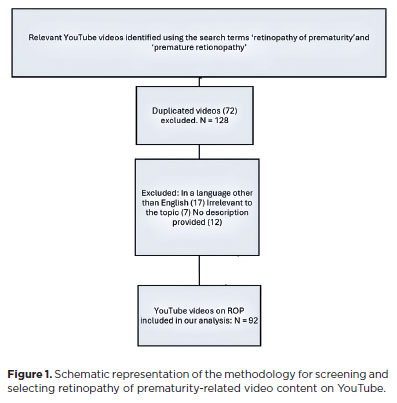
RESULTS: The study assessed 92 videos, the majority of which (42 videos, 45.7%) originated from the United States. Most of the videos focused on screening, pathophysiology, and diagnosis of retinopathy of prematurity (61.9%). The primary contributors were medical organizations (19 videos, 20.6%), nonacademic health channels (19 videos, 20.6%), and physicians (15 videos, 16.3%). Significant differences were found between the DISCERN (p=0.003), JAMA (p=0.001), Global Quality Score (p=0.003), Health on the Net Code of Conduct (p=0.006), and Ensuring Quality Information for Patients (p=0.001) scores among different video sources. However, the key video metrics did not differ. Using the DISCERN and Global Quality Score scales, the overall YouTube video content on retinopathy of prematurity was rated as moderate in quality. Using the Health On the Net Code of Conduct and Ensuring Quality Information for Patients scales, it was rated as high quality. Strong correlations were observed between the scores on all of the scales (p<0.001).
CONCLUSION: Videos from medical organizations and healthcare centers were of a higher quality than those from nonmedical sources. Despite the varied foci of each evaluation scale, the strong correlation between them indicates that they provide reliable and comprehensive assessments of the quality of informational content.
Keywords: Retinopathy of prematurity; YouTube; Information dissemination/methods; Online education; Internet access; Social media/instrumentation; Information seeking behavior; Internet/statistics & numerical data; Consumer health information; Social networking
Abstract
PURPOSE: To assess female participation in the Brazilian Congress of Ophthalmology.
METHODS: This retrospective, descriptive-analytical study examined the profiles of individuals involved in the scientific program of the Brazilian Congress of Ophthalmology from 2016 to 2023. Data were provided by the Brazilian Council of Ophthalmology and were categorized by ophthalmology subspecialty, participant role, and geographic region of origin within Brazil. Roles were grouped into three main categories: coordinator, speaker, and moderator/discussant.
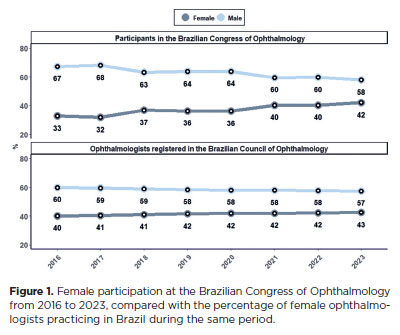
RESULTS: Female participation at the congress increased from 33% in 2016 to 42% in 2023, showing an annual upward trend of 1.33 (p<0.001). Around 64% of female participants were from the Southeast region, while 16% were from the Northeast. The coordinator role showed the largest increase in female participation, rising from 22% in 2016 to 40% in 2023 (Slope: 2; p<0.001), followed by the speaker role, which increased from 34% to 44% (Slope: 1.5; p<0.001), and the moderator/discussant role, which rose from 32% to 38% (Slope: 1.24; p=0.0586). Changes in female representation across ophthalmology subspecialties were not statistically significant.
CONCLUSION: From 2016–2023, female participation in the Brazilian Congress of Ophthalmology increased across most subspecialties and conference roles. Although gender disparity has narrowed, continuous efforts are needed to achieve greater gender equity and equality in ophthalmology conferences.
Keywords: Ophthalmology; Gender equity; Ophthalmologists/statistics & numerical data; Physicians, women/statistics & numerical data; Leadership; Congresses as topic/statistics & numerical data.

Abstract
PURPOSE: This study aimed to evaluate disparities in the distribution of ophthalmologists and the volume of cataract surgeries across Brazil, considering public and private health sectors and the country's federative units.
METHODS: Data on ophthalmologists were obtained from the National Medical Residency Commission and the Associação Múdica Brasileira. Information on cataract surgeries performed through the Unified Health System was collected from the DATASUS database, while data on procedures covered by private health plans were retrieved from the National Supplementary Health Agency. Population estimates from the 2024 Demographic Census of the Brazilian Institute of Geography and Statistics were used to calculate physician density and surgery rates per 100,000 inhabitants. Associations between the number of ophthalmologists and cataract surgery volume were analyzed using Spearman's correlation coefficient.
RESULTS: Brazil has 16,784 ophthalmologists, representing 8.96 specialists per 100,000 inhabitants. Marked disparities were observed: large cities (>500,000 inhabitants) had 18.75 ophthalmologists per 100,000 residents, whereas municipalities with <50,000 inhabitants had fewer than one. Across federative units, physician density ranged from 19.18 per 100,000 in the Federal District to 4.22 in Maranhão. In 2024, cataract surgery rates varied widely, from 1,012.61 per 100,000 inhabitants in the Southeast to 435.00 in the North. Nationally, Unified Health System performed 736.30 surgeries per 100,000 inhabitants, compared with 1,276.79 in the private sector. On average, each ophthalmologist performed 96.92 cataract surgeries annually.
CONCLUSION: Significant inequalities persist in the geographic distribution of ophthalmologists and in cataract surgery provision, with higher surgical volumes concentrated in the private sector. Targeted policies are required to address regional disparities and improve the equity and efficiency of cataract care delivery in Brazil.
Keywords: Ophthalmologists/supply & distribution; Ophthalmologists/statistics & numerical data; Cataract extraction; Health services accessibility/statistics & numerical data; Healthcare disparities; Health policy; Public health systems; Insurance, Heal
Abstract
PURPOSE: Diabetic retinopathy screening in low- and middle-income countries is limited by restricted access to specialized care. Portable retinal cameras offer a practical alternative; however, image quality – affected by mydriasis – directly influences the performance of artificial intelligence models. This study evaluated the effect of mydriasis on image gradability and AI-based diabetic retinopathy detection in real-world, resource-limited settings.
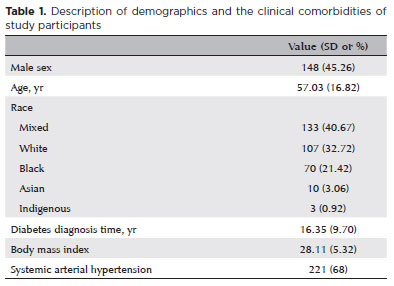
METHODS: The proportions of gradable images were compared between mydriatic and non-mydriatic groups. Generalized estimating equations were used to identify factors associated with image gradability, including age, sex, race, diabetes duration, and systemic hypertension. A ResNet-200d model was trained on the mobile Brazilian Ophthalmological dataset and externally validated on both mydriatic and non-mydriatic images. Model performance was evaluated using accuracy, F1 score, area under the curve, and confusion matrix metrics. Sensitivity differences were assessed using the McNemar test, and area under the curves were compared using DeLong's test. The Youden index was used to determine optimal classification thresholds. Agreement between macula- and disc-centered images was analyzed using Cohen's κ.
RESULTS: The mydriatic group demonstrated a higher proportion of gradable images compared with the non-mydriatic group (82.1% vs. 55.6%; p<0.001). In non-mydriatic images, lower gradability was associated with systemic hypertension, older age, male sex, and longer diabetes duration. The AI model achieved better performance in mydriatic images (accuracy, 85.15%; area under the curve, 0.94) than in non-mydriatic images (accuracy, 79.68%; area under the curve, 0.93). The McNemar test showed a significant difference in sensitivity (p=0.0001), whereas DeLong's test revealed no significant difference in area under the curve (p=0.4666). The Youden index indicated that optimal classification thresholds differed based on mydriasis status. Agreement between image fields was moderate to substantial and improved with mydriasis.
CONCLUSION: Mydriasis significantly improves image gradability and enhances AI performance in diabetic retinopathy screening. Nonetheless, in low- and middle-income countries where pharmacologic dilation may be impractical, optimizing model calibration and thresholding for non-mydriatic images is essential to ensure effective AI implementation in real-world clinical environments.
Keywords: Artificial intelligence; Bias; Diabetic retinopathy; Portable camera; Retina
Abstract
PURPOSE: To assess musculoskeletal symptoms, identify the most affected body areas, and investigate factors associated with the development of musculoskeletal disorders among ophthalmologists in Brazil.
METHODS: A survey was conducted using an online questionnaire and snowball sampling. Statistical analyses were performed using Jamovi version 2.3.28, and graphs were generated using RStudio version 2023.06.2 + 561.
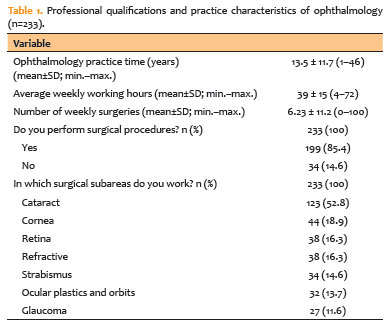
RESULTS: A total of 233 participants (42 ophthalmology residents and 191 ophthalmologists) were included, with a mean age of 40.4 years (standard deviation 11.3; range 25–73 years). Musculoskeletal symptoms were reported by 83% of participants. The cervical region (57.1%), upper back (54.5%), and lumbar region (53.6%) were the most frequently reported sites of pain. A high body mass index was identified in 54.9% of the sample, and 50.2% of participants reported using painkillers in the previous year for musculoskeletal symptoms. The mean duration of professional activity in ophthalmology was 13.5 years, and the mean weekly workload was 39 hours. A significant association was observed between weekly workload and the presence of musculoskeletal disorders (p=0.045).
CONCLUSION: This study demonstrated a high prevalence of musculoskeletal disorders among ophthalmologists in Brazil, particularly involving the cervical, lumbar, and upper back regions, consistent with findings reported in international studies. Important contributing factors include long working hours, a high patient volume, and repetitive or awkward postures during examinations and procedures. Preventive strategies and improvements in working conditions are needed to protect the health and well-being of ophthalmologists.
Keywords: Musculoskeletal Diseases/epidemiology; Back pain; Lumbar Vertebrae; Occupational diseases/epidemiology; Ergonomics; Ophthalmic practice; Ophthalmologists/statistics & numerical data; Brazil/epidemiology
Abstract
The paper starts discussing the teleological concept that eye motions - rotations and translations - serve to vision (which supports the notion that torsions are not voluntarily driven, since they do not contribute to expand the visual exploration of space). It proposes that the primary position of the eye (not "of gaze") , the standard condition to measure them, must be defined as the coincidence of the orbital (fixed) and the ocular (movable) system of coordinates. However this becomes only a theoretic concept, since practical operations to obtain it are almost unfeasible. Besides, even a "simple" horizontal or vertical ocular rotation, though always occurring around a (presumably) fixed point (the center of ocular rotation) may be defined by different trajectories and magnitudes, depending on the two systems of measurement of eye positions and motions. Hence, in a graphical (plane) representation of such spherical coordinates, the so-called "tangent screen", an ocular "tertiary" position - a combination of a horizontal and a vertical rotations - may be described by four different points. Or, conversely, a specific eye position may be defined by four sets of angular coordinates. The mathematical representation of variation of three special coordinates in a specific rotation is best made by a matrix disposition, so that, multiplication (not commutative) of three matrices (one for each specific plane) generates six different systems (permutations) of measurements. So, though , actually, there are multiple trajectories possible between two points in space, the order in which rotations are considered influences the final result. With different systems of coordinates for each rotation and different possible orders by which they may be considered, one reaches 48 alternative systems for their measurements. Unfortunately, up to now, there I is no an established convention to express ocular rotations. So, usually, people consider that a vertical prism superimposed to a frontally placed horizontal prism, or vice-versa, correspond to equivalent processes. The paper finishes discussing inconveniences of the clinically used unity to measure eye rotations (the prism-diopter) and proposes other unities as alternative solutions.
Keywords: Angular measurement unity; eye movements; eye position measurement; eye position measurement accuracy; Fick's system; Helmholtz's system; ocular rotation; primary position of gaze; prism-diopter referential systems; superimposition of prisms
 ABO is licensed under a Creative Commons Attribution-NonComercial 4.0 Internacional.
About
Issues
Editorial Board
Submission

Arquivos Brasileiros de Oftalmologia
Official publication of Brazilian Council of Ophthalmology - Conselho Brasileiro de Oftalmologia (CBO)
Rua Casa do Ator, 1.117 - 2nd floor - Zip Code: 04546-004
São Paulo - SP, Brazil
TEL: +55 11 3266-4000
E-mail: [email protected]