
Showing of 1 until 15 from 107 result(s)
Search for: Patient education; Glaucoma; Physician-patient relations
Abstract
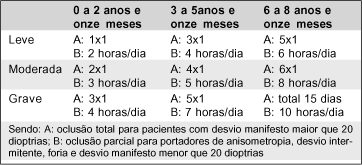
Objetivos: Ambliopia é o defeito visual mais comum em crianças e por mais de 250 anos a terapia oclusiva vem sendo o melhor tratamento. Sendo assim, propusemo-nos a determinar os fatores que influenciam no sucesso do tratamento da ambliopia por terapia oclusiva em nosso meio. Métodos: Foi realizado um estudo retrospectivo com 169 crianças amblíopes atendidas no Ambulatório de Ambliopia do Hospital de Clínicas da UNICAMP, Campinas (SP), entre janeiro de 1996 e maio de 1998. A população atendida foi classificada quanto ao sexo, idade de início do tratamento por faixa etária (3 grupos), olho afetado, tipo de ambliopia (estrabísmica, anisometrópica, por deprivação, associação de dois tipos), tempo de seguimento, gravidade da ambliopia (leve, moderada, grave), adesão ao tratamento (regular, irregular) e resposta obtida (cura, melhora, sem cura). Resultados: A adesão ao tratamento não diferiu entre as faixas etárias (p=0,68) e não foi influenciada pela gravidade da ambliopia (p=0,82). Dos pacientes estudados 52,67% curaram-se, 19,52% melhoraram e 27,81% não obtiveram cura. Os pacientes com adesão regular tiveram índice de cura significativamente maior do que os pacientes com adesão irregular (p=0,0009). O resultado do tratamento não dependeu da idade de início do mesmo (p=0,39) e da gravidade da ambliopia (p=0,30). Conclusão: Concluímos, assim, que, no nosso grupo de estudo, a adesão é o principal fator prognóstico no sucesso da terapia oclusiva.
Keywords: Ambliopia; Prognósticos; Estrabismo; Curativos oclusivos; Cooperação do paciente
10-fig01.jpg)
Abstract
Objetivo: Avaliar os resultados visuais, satisfação e qualidade de vida de pacientes atendidos em um hospital escola pelo Sistema Único de Saúde, submetidos a implante bilateral de lente intraocular multifocal difrativa.
Métodos: Estudo tipo série de casos com intervenção, incluindo 20 pacientes submetidos a implante bilateral da lente intraocular multifocal difrativa EyeDiff® (Eyeol UK, Dunstable, UK). Os critérios de exclusão foram astigmatismo corneano >1,5 dioptria cilíndrica, cirurgia ou doença ocular prévias e complicações intraoperatórias ou pós-operatórias. Os pacientes foram avaliados após 1, 3 e 6 meses da cirurgia. Foram avaliadas a acuidade visual monocular e binocular para longe, intermediário e perto sob condições fotópica e mesópica, sensibilidade ao contraste monocular sob condições fotópicas, curva de defocus e questionário para avaliação da qualidade de vida.
Resultados: A acuidade visual para longe corrigida monocular foi de 0,3 logMAR ou melhor e a acuidade visual para perto com correção para longe foi J3 ou melhor em todos os olhos, sob condições fotópicas. A acuidade visual binocular para perto com a correção para longe foi J1 em todos os casos. A sensibilidade ao contraste estava no nível mínimo de normalidade para frequências espaciais baixas e altas e abaixo dos limites normais para frequência espacial intermediária. O questionário de qualidade de vida mostrou que os pacientes apresentavam altos níveis de satisfação.
Conclusão: O implante bilateral da lente intraocular multifocal EyeDiff® proporcionou boa acuidade visual e qualidade de vida, e independência de óculos aos pacientes. A acuidade visual e a sensibilidade ao contraste melhoraram progressivamente entre um e seis meses de pós-operatório.
Keywords: Acuidade visual; Qualidade de vida; Satisfação do paciente; Implante de lente intraocular; Sistema Único de Saúde.
Abstract
PURPOSE: To analyze the quality of life and treatment adherence of patients with glaucoma at different disease stages, considering factors such as sex, visual acuity, disease severity, and treatment characteristics.
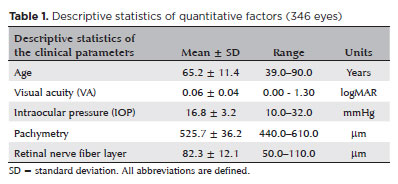
METHODS: This cross-sectional study included 174 patients (346 glaucomatous eyes) recruited from clinical records and routine follow-ups at a specialized ophthalmology center. Their mean age was 39–90 years, and 60.9% of them were women. Their quality of life and adherence were assessed using the NEI-VFQ25 and MMAS-8 questionnaires, respectively. Complementary tests included 24:2 visual field test, retinography, and optical coherence tomography. Patients diagnosed with glaucoma for at least 6 months were included, whereas pregnant patients and those with ocular diseases were excluded.
RESULTS: Among the participants, 59.2% adhered to the treatment whereas 40.8% showed low adherence. The mean quality of life score was 81.87. Patients with low adherence had slightly higher quality of life scores (mean 83.1) than those with good adherence (mean 81.0), but the difference was not statistically significant. Disease severity was associated with increased optic nerve cupping, reduced thickness of the nerve fiber and ganglion cell layers, and great visual field loss. No significant correlation was observed between adherence and quality of life, indicating the independence of these factors and the influence of psychological or social elements.
CONCLUSION: The absence of a correlation between quality of life and treatment adherence highlights the need for tailored interventions for psychological and social aspects. These findings indicate the importance of a comprehensive approach to managing glaucoma, preserving visual function, strengthening doctor–patient relationships, and considering psychosocial factors to enhance quality of life and treatment adherence.
Keywords: Glaucoma; Quality of life; Patient health questionnaire; Patient acuity; Antiglaucoma agents; Visual acuity; Treatment adherence and compliance; Surveys and questionnaires
05-tab01tb.jpg)
Abstract
Objetivo: Avaliar as razões para não comparecimento à clínica oftalmológica da universidade após triagem oftalmológica realizada usando uma unidade móvel oftalmológica que fornece exame oftalmológico para comunidades não assistidas em uma região do Brasil.
Métodos: Foi realizado um estudo observacional prospectivo no ano de 2017/2018 para avaliar as razões que fizeram com que os indivíduos triados usando uma unidade móvel oftalmológica e referenciados para a clínica oftalmológica da universidade não comparecessem à consulta agendada. A triagem foi feita em 10 municípios da região centro-oeste do estado de São Paulo, Brasil. Todos os 1.928 participantes fizeram o exame oftalmológico sem custo e 37,1% deles necessitaram de encaminhamento para a clínica oftalmológica da universidade para exames especializados ou cirurgias. O estudo usou duas ferramentas: (1) análise comparativa entre os dados dos indivíduos encaminhados que compareceram ao agendamento com os que não compareceram; (2) busca ativa dos indivíduos que não compareceram à consulta agendada, aplicando-se um questionário para avaliar os motivos para o não comparecimento.
Resultados: Fatores como idade, sexo, distância entre a cidade de origem e o hospital universitário, número de oftalmologistas na cidade de procedência, renda familiar média e acuidade visual não influenciaram no comparecimento ao encaminhamento. Catarata foi a maior causa para o encaminhamento (350 casos). O não comparecimento foi maior nos portadores de glaucoma/glaucoma suspeitos (54,1%), estrabismo (45%) e afecções do segmento anterior (33,6%). Muitos indivíduos que não compareceram ao serviço de referência procuraram por outro local para o atendimento oftalmológico.
Conclusão: O não comparecimento para tratamento oftalmológico sem custo depende de fatores relacionados ao paciente ou à falta de conhecimento das próprias condições oftalmológicas. Campanhas educativas nas comunidades assistidas devem ser feitas para alcançar maior comparecimento às consultas e melhor prevenir a cegueira evitável.
Keywords: Serviços de saúde ocular; Unidades móveis de saúde; Acesso aos serviços de saúde; Pacientes desistentes do tratamento; Promoção da saúde
05-tab01.jpg)
Abstract
Objetivo: Caracterizar a população com suspeita de glaucoma encaminhada a um centro público terciário no sul do Brasil e avaliar diferenças no dano dos parâmetros funcionais e estruturais entre os pacientes diagnosticados com diferentes tipos de glaucoma e aqueles classificados como normais e aqueles mantidos como suspeitos de glaucoma.
Métodos: Esta é uma coorte dos pacientes encaminhados para o setor de glaucoma suspeito do Hospital Nossa Senhora da Conceição, Porto Alegre - BR, no período de março de 2016 a dezembro de 2018. Os pacientes foram acompanhados até obterem exames confiáveis (exame oftalmológico completo, campimetria visual, tomografia de coerência óptica) para serem classificados como: normal, glaucoma suspeito, glaucoma com pressão intraocular elevada, glaucoma de pressão normal ou hipertenso ocular.
Resultados: Um total de 135 pacientes foram incluídos neste estudo, sendo que destes, 117 pacientes completaram todos os exames e foram incluídos neste estudo. A maioria dos pacientes foi considerada normal (36,8%), seguido por glaucoma suspeito (25,64%), glaucoma de pressão normal (18,8%), glaucoma com pressão intraocular elevada (12%) e hipertensão ocular (6%). A principal razão para encaminhamento foi escavação do nervo óptico aumentada. Pacientes com glaucoma de pressão normal eram em média mais velhos que os demais (p=0,03). Esses também apresentavam índice de campo visual e desvio médio da campimetria visual piores que sujeitos normal, com suspeita de glaucoma e hipertensos oculares, e tinham a camada de fibra nervosa medida pela tomografia de coerência óptica mais fina que normais e suspeitos de glaucoma (p<0,002). Os pacientes com glaucoma de pressão elevada não diferiram significativamente dos outros grupos.
Conclusão: Pacientes com glaucoma de pressão normal tendem a ser diagnosticados mais tardiamente devido ao fato da pressão intraocular não estar elevada, logo a escavação do disco óptico deve ser maior para gerar a suspeita de glaucoma. Neste estudo, paciente com glaucoma de pressão normal apresentaram doença mais avançada no momento do diagnóstico em comparação com os outros grupos.
Keywords: Glaucoma/diagnóstico; Hipertensão ocular; Glaucoma de ângulo aberto/diagnóstico; Glaucoma de ângulo fechado/diagnóstico; Atenção terciária à saúde; Padrões de prática médica
Abstract
PURPOSE: To describe the epidemiological and clinical profile of hospitalized patients with retinoblastoma in Brazil.
METHODS: Using data from the Hospital Cancer Registry of the , patients with the morphological codes of retinoblastoma who were diagnosed between 2000 to 2018, aged 0–19 years, and followed up in registered hospitals (analytical cases) were selected. The relative and absolute frequencies of demographic, clinical, diagnostic, therapeutic, and outcome variables were described. Hospital performance indicators were calculated and compared between hospitals qualified and not qualified to treat pediatric oncology cases and between hospitals with different case volumes (<20, 20–75, >75 cases).
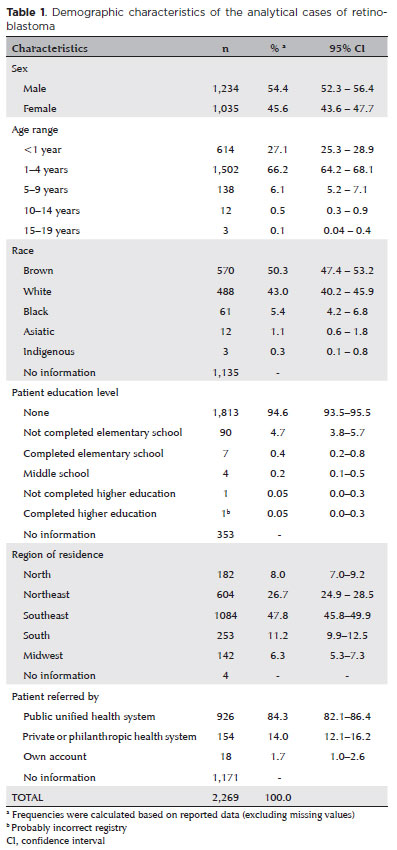
RESULTS: Of the 2,269 identified analytical cases from 86 institutions, 48% were from the Southeast, 54% were male, and 66% were aged <4 years. The proportion of missing data (NA) was too high for several variables. Approximately 84% of the patients were from the public health system, 40% had a positive family history, and 88% had unilateral involvement. The first treatment included surgery in 58.3% of the patients (NA=2), Approximately 36.6% of these patients achieved complete remission, 10.8% achieved partial remission, and 12.7% died (NA=59%). Hospital performance indicators were within the target in >90% of the patients. The median time between the first appointment and diagnosis (6 days, interquartile range [IQR] 1–14) was significantly lower and the median time to death was longer (343 days, IQR, 212-539) in high-volume hospitals (>75 cases) than in medium- and low-volume hospitals.
CONCLUSIONS: Despite the high proportion of missing data, we found that the delay in diagnosis is due to prehospital factors. Additionally, there is a need for educational programs for healthcare professionals and families that emphasize early identification and referral to specialized centers. Future studies should focus on the impact of Hospital Cancer Registry data completeness on outcomes, causes of delay in diagnosis, regional inequalities, and barriers to accessing specialized services.
Keywords: Retinoblastoma/diagnosis; Retinoblastoma/epidemiology; Patient care; Humans; Children; Adolescents; Brazil.
Abstract
PURPOSE: This study aimed to examine factors related to the professionalism of ophthalmology residents.
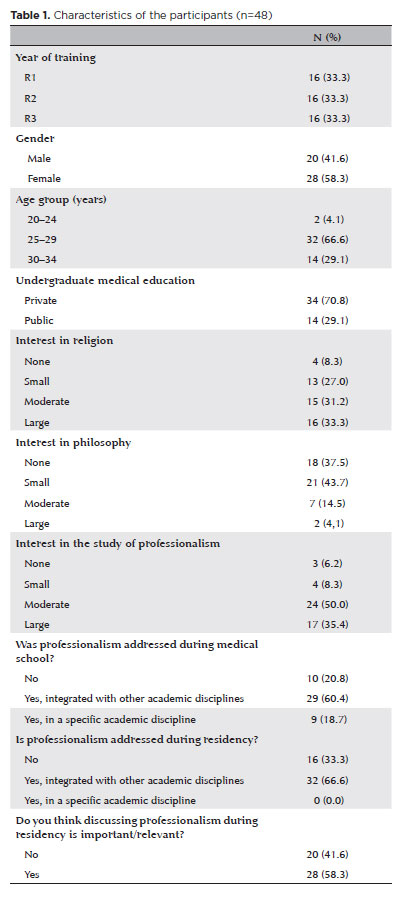
METHODS: A cross-sectional study was carried out involving 48 ophthalmology residents in Brazil. Professionalism was assessed using the professionalism mini-evaluation exercise, completed by both preceptors and residents, and the Pennsylvania State College of Medicine Professionalism Questionnaire, completed by the residents. The association between the professionalism score assigned by the preceptor through the professionalism mini-evaluation exercise and various sociodemographic and educational variables was assessed. The correlation between the residents’ self-assessment across both instruments and the preceptor’s assessments was measured using Spearman’s Rho.
RESULTS: All 48 residents were included, with equal representation across the 3 years of residency. The majority were female (58.3%) and between 25 and 29 years old (66.7%). The average professionalism score on the professionalism mini-evaluation exercise given by the preceptors was 3.0 (75%). A significant association was found between the year of training and the score in the doctor-patient relationship domain, with first-year residents showing lower scores (p=0.002). Male residents had higher scores in the “Interprofessional” domain (p=0.031). Graduates from private medical schools scored higher in both the “doctor-patient relationship” (p=0.015) and “reflective skills” (p=0.033) domains. Lower interest in professionalism was linked to lower scores in the “Interprofessional relationships” (p=0.033) and “time management” (p=0.003) domains. A strong correlation was observed between preceptor’s professionalism mini-evaluation exercise scores and residents’ self-assessed professionalism mini-evaluation exercise scores (r=0.917). However, the correlation between the self-assessed professionalism mini-evaluation exercise and the Pennsylvania questionnaire scores was weak (r=0.226).
CONCLUSION: Professionalism scores among ophthalmology residents were associated with year of training, gender, type of undergraduate education, and level of interest in the topic.
Keywords: Internship and residency; Ophthalmology; Professional competence; Education, professional; Physician-patient relations; Surveys and questionnaires
Abstract
PURPOSE: This retrospective study evaluated the safety and efficacy of real-world antiangiogenic therapy for ocular conditions in the private healthcare sector in southern Brazil.
METHODS: Medical records from patients who underwent intravitreal anti-vascular endothelial growth factor injections over the past 12 years were reviewed retrospectively. Data collection included the primary diagnoses, drugs administered, injection techniques, adverse effects, and treatment efficacy. Efficacy was assessed by comparing pre- and posttreatment visual acuity and central subfield thickness in eyes with followup exceeding 2 years.
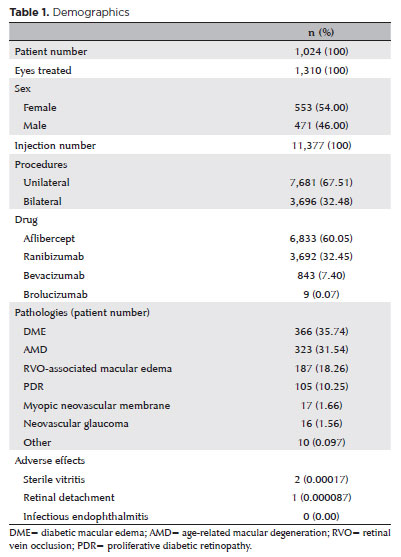
RESULTS: A total of 1,024 patients, 1,310 treated eyes, and 11,377 injections were analyzed. The injections included aflibercept (6,833), ranibizumab (3,692), bevacizumab (843), and brolucizumab (9), administered either bilaterally (3,696) or unilaterally (7,681). The most common diagnoses were diabetic macular edema, exudative age-related macular degeneration, retinal vein occlusion related macular edema, and proliferative diabetic retinopathy. No endophthalmitis cases were reported. Vitritis with transient visual acuity loss occurred in two cases following aflibercept injections. One retinal detachment case was successfully treated with vitrectomy. The median number of injections per patient was 6 (IQR [interquartile range], 3–13). Among 445 eyes from 328 patients with followup over 2 years (median, 4.05 years; IQR, 2.89–6.29), there was a significant improvement in best-corrected visual acuity from 0.3 to 0.4 (Snellen) (p<0.001) and a reduction in central subfield thickness from 361 to 267 microns (p<0.001). CST comparisons included patients with age-related macular degeneration, diabetic macular edema, and retinal vein occlusion related macular edema.
CONCLUSION: This real-world study, the largest of its kind in Brazil, confirms the safety and efficacy of antiangiogenic therapies in the southern Brazilian private healthcare system. The findings highlight a low incidence of severe adverse events and outcomes consistent with global studies, supporting the ongoing use of antiangiogenic agents as effective and well-tolerated treatments for various ocular conditions in developing countries.
Keywords: Antiangiogenic drugs; Macular edema; Age-related macular degeneration; Retinal vein occlusion; Patient safety
Abstract
PURPOSE: To assess the performance of a contemporary large language model (ChatGPT-5) against ophthalmology residents on a standardized set of glaucoma multiple-choice questions.
METHODS: We conducted a cross-sectional comparative study with 189 text-only glaucoma multiple-choice questions from the Cybersight question bank. ChatGPT-5 was tested under standardized conditions, with each item placed in a new chat and limited to letter-only outputs. Six ophthalmology residents from a Brazilian training program (two Postgraduate Year 1, two Postgraduate Year 2, and two Postgraduate Year 3) answered the same questions under supervision. Accuracy was calculated using the official key. McNemar’s exact test was used to compare items between ChatGPT-5 and residents, and matched odds ratios and 95% confidence intervals (95% CIs) were calculated using the Haldane–Anscombe correction.
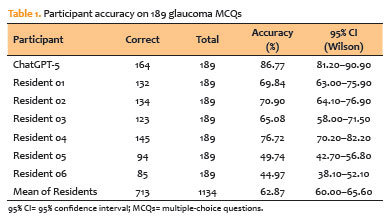
RESULTS: ChatGPT-5 received 164 of 189 correct responses (86.8%; 95% CI, 81.2–90.9). Residents’ overall accuracy was 62.9% (713/1,134; 95% CI, 60.0–65.6). The top-performing resident earned 76.7%. ChatGPT-5 outperformed all residents in head-to-head comparisons, with odds ratios ranging from 1.84 (95% CI, 1.10–3.08) to 13.15 (95% CI, 5.93–29.20), all p≤0.023. ChatGPT-5 correctly answered 17/189 items (9.0%), but fewer than half of residents were correct (“large language model-only wins”), whereas residents were more successful on items that ChatGPT-5 overlooked.
CONCLUSIONS: ChatGPT-5 outperformed ophthalmology residents on text-based glaucoma multiple-choice questions, indicating its potential as a subspecialty education and assessment tool. Generalizability is limited by the single question bank, text-only items, a small resident cohort, and the evaluation of one large language model version at a single time point. Before incorporating these findings into clinical decision-making, larger, multimodal, and longitudinal studies are required.
Keywords: Glaucoma; Artificial intelligence; Large language models; Education, medical; Medical staff, hospital
12-tab01.jpg)
Abstract
OBJETIVO: Nos últimos 20 anos, o número de escolas médicas no Brasil aumentou, mas as vagas para especialização em Oftalmologia não acompanharam a demanda crescente. Este estudo quer estimar a demanda por especialização e avaliar a oferta de oportunidades de aprendizado em Oftalmologia.
MÉTODOS: Estudo epidemiológico com pesquisa em banco de dados provenientes do Ministério da Educação e Conselho Brasileiro de Oftalmologia. Estes dados foram checados através de 120 editais publicados pelos serviços de Residência em 2021.
RESULTADOS: De 2002 a 2021, o número de vagas em faculdades de Medicina aumentou 370%, enquanto o número de vagas certificadas de especialização em Oftalmologia aumentou 64%. Houve um desalinhamento de 11.4% entre os dados do Conselho Brasileiro de Oftalmologia e do Ministério da Educação.
CONCLUSÃO: A proporção de graduados em Medicina aumentou muito mais do que a oferta de oportunidades de especialização em Oftalmologia, o impacto disto na busca por vagas de especialização não acreditadas é desconhecido, políticas de monitoramento das vagas de especialização em Oftalmologia devem ser estabelecidas.
Keywords: Oftalmologia; Ensino; Educação médica; Especialização
Abstract
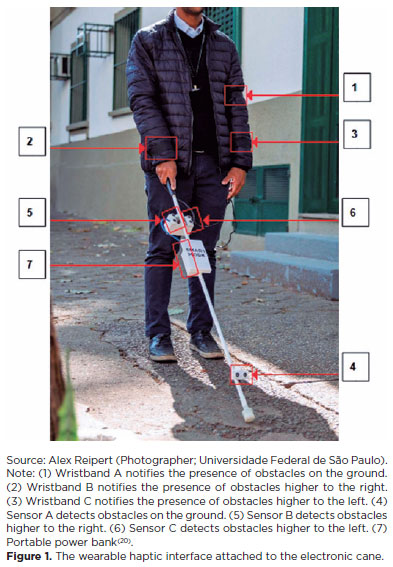
PURPOSE: This study aimed to evaluate the perception and degree of satisfaction of blind individuals regarding an electronic cane prototype with a wearable haptic interface.
METHODS: Two scenarios with different obstacles were created to conduct tests with the canes (the user's cane and the prototype one). The perception and satisfaction of participants regarding the electronic cane were assessed using a questionnaire, the number of collisions during the tests, and the time each individual took to complete the course in each scenario.
RESULTS: Ten blind individuals who used the white cane participated in this study. Eight were males, and two were females. Their age ranged from 23 to 43 (average 32.3 ± 7.13 years and median 32 years). There was a tendency for fewer collisions with ground obstacles when the electronic cane was used than when the white cane was used. However, there was no statistically significant difference between the number of collisions and the course completion time in each scenario with either canes tested.
CONCLUSION: Overall, the perception and satisfaction of individuals regarding the prototype used were positive.
Keywords: Blindness; Canes; Patient satisfaction; Perception; Haptic technology; Wearable electronic devices; Surveys and questionnaires
11-tab01.jpg)
Abstract
OBJETIVO: Associar os resultados refrativos a longo prazo da cirurgia de catarata e a função visual autorreferida pelo questionário Catquest-9SF.
MÉTODOS: Paciente recrutados no ambulatório de catarata da VER MAIS Oftalmologia, foram submetidos a exame oftalmológico completo. Após diagnóstico de catarata com indicação de tratamento cirúrgico com facoemulsificação e implante de lente intraocular, o questionário foi aplicado antes da intervenção, 30 dias após cirurgia e 1 ano após, novamente.
RESULTADOS: Foram recrutados 133 pacientes. No decorrer do seguimento, 32 pacientes foram perdidos e ao final foram analisados os dados de 101 pacientes, dos quais 48 foram homens e 53 foram mulheres. A variância bruta explicada por dados foi de 69,9% e a inexplicada em primeiro contraste por 2,39 eigenvalores, sendo maior que 2, o que nos mostra que são resultados diferentes dos esperados de dados aleatórios. O índice de separação de pessoas foi de 2.95 (>2) e o valor de confiança de pessoas foi de 0,9 (>0,8). Estes índices são os valores mínimos aceitáveis na diferenciação de níveis de habilidade. Acuidade visual foi a principal variável correlacionada com o score do Catquest.
CONCLUSÕES: O Catquest-9SF traduzido para o português se demonstrou unidimensional e uma ferramenta psicometricamente válida para avaliar disfunção visual em pacientes com catarata, além de ter tido sucesso para quantificar objetivamente melhoras após a intervenção cirúrgica. Essa ferramenta pode ser utilizada como preditiva e concordante da melhora da acuidade visual.
Keywords: Extração de catarata; Acuidade visual; Inquéritos e questionários; Qualidade de vida; Medidas de resultados relatados pelo paciente
Abstract
PURPOSE: To evaluate the current scenario of rehabilitation services for people with retinal diseases in Brazil.
METHODS: An exploratory study was conducted between February 2023 and June 2023 using a Google Forms questionnaire that was distributed by patient associations.
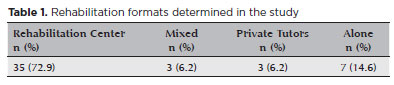
RESULTS: A total of 142 patients, aged 18-80 were included in the study. Forty-eight participants (33.8%) were undergoing rehabilitation, while 94 (66.2%) were not. The main reason for not undergoing rehabilitation was a lack of knowledge about the service (n=41, 43.6%). Healthcare professionals made the most referrals (n=20, 41.7%). Rehabilitation improved the quality of life in 38 (80.9%) participants, and 28 (62.2%) participants were satisfied with the process. There was a statistically significant disparity between patient satisfaction and the locale of rehabilitation implementation. Twenty-three (69.7%) participants who underwent rehabilitation at a specialized center reported satisfaction.
CONCLUSION: The rehabilitation process directly increases the quality of life of individuals with retinal diseases. However, despite the availability of rehabilitation centers in large parts of Brazil, most patients with retinal diseases are not acquainted with the rehabilitation process and do not receive referrals for it. Thus, healthcare providers should increase referrals to rehabilitation centers, and public policies should be formulated to raise awareness among the population regarding the availability of rehabilitation services.
Keywords: Rehabilitation; Quality of life; Retinal diseases; Personal satisfaction; Patient care team; Public policy; Surveys and questionnaires; Brazil
Abstract
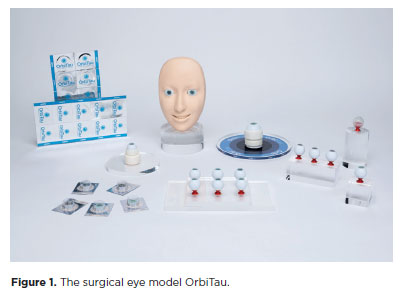
PURPOSE: The OrbiTau surgical simulator is a synthetic eye model developed to enhance cataract surgical training. Herein, we aimed to describe the perspectives of Harvard’s Ophthalmology faculty and residents regarding the effectiveness of OrbiTau.
METHODS: A cross-sectional study was conducted in which 11 surgeons from the Massachusetts Eye and Ear Infirmary, with prior experience utilizing simulated phacoemulsification platforms, conducted cataract surgery with the OrbiTau. Subsequently, they completed a satisfaction questionnaire using the Likert scale.
RESULTS: Regarding the various OrbiTau components, 90.90% of the participants reported that the OrbiTau lens capsule was comparable to that of the human lens during capsulotomy. Furthermore, 72.72% of the participants found that the OrbiTau lens consistency was analogous to that of the human lens nucleus. Approximately 63.63% of the participants reported that the model’s posterior lens capsule resembled the native posterior capsule, and 72.72% of the participants noted that the model’s red reflex was similar to that of the dilated human pupil. Most participants believed that the OrbiTau was easier to use and more realistic than other commercially available simulators.
CONCLUSION: Our single-institution survey of the Orbitau demonstrated that this model realistically replicates ocular structures and may be a viable option for cataract surgery training.
Keywords: Cataract extraction/education; Simulation training/methods; Ophthalmology/education; Phacoemulsification/education; Ophthalmologists/education; Surgeons/education; High fidelity simulation training
15-fig01.jpg)
Abstract
O reconhecimento sobre a comunicação de más notícias como mitigadora de conversas difíceis por outras especialidades médicas, incentiva o estudo desta temática na oftalmologia. Sendo assim, o objetivo deste estudo é revisar a produção de pesquisas científicas sobre a comunicação de más notícias em oftalmologia. Para isso, foi realizada uma revisão de literatura. As bases de dados utilizadas foram MEDLINE/PUBMED, EMBASE, LILACS, SCOPUS, COCHRANE e SCIELO. Dois revisores independentes leram todos os artigos e selecionaram a amostra final. Sete artigos foram escolhidos nos formatos de artigo original, revisão, editorial, comunicação oral e correspondência. Os oftalmologistas estão preocupados em comunicar as más notícias de forma eficaz, mas faltam estudos sobre o tema. No entanto, há uma crescente percepção de que o treinamento de comunicação de más notícias aumenta a confiança dos médicos na comunicação, beneficiando a relação terapêutica. Portanto, seria valioso incluir este treinamento no currículo das residências.
Keywords: Comunicação de más notícias; Comunicação; Competência Clínica, Relações médico-paciente; Oftalmologia; Revelação da verdade
 ABO is licensed under a Creative Commons Attribution-NonComercial 4.0 Internacional.
About
Issues
Editorial Board
Submission

Arquivos Brasileiros de Oftalmologia
Official publication of Brazilian Council of Ophthalmology - Conselho Brasileiro de Oftalmologia (CBO)
Rua Casa do Ator, 1.117 - 2nd floor - Zip Code: 04546-004
São Paulo - SP, Brazil
TEL: +55 11 3266-4000
E-mail: [email protected]