Arq. Bras. Oftalmol. 200972
| DOI: 10.1590/S0004-27492009000300002
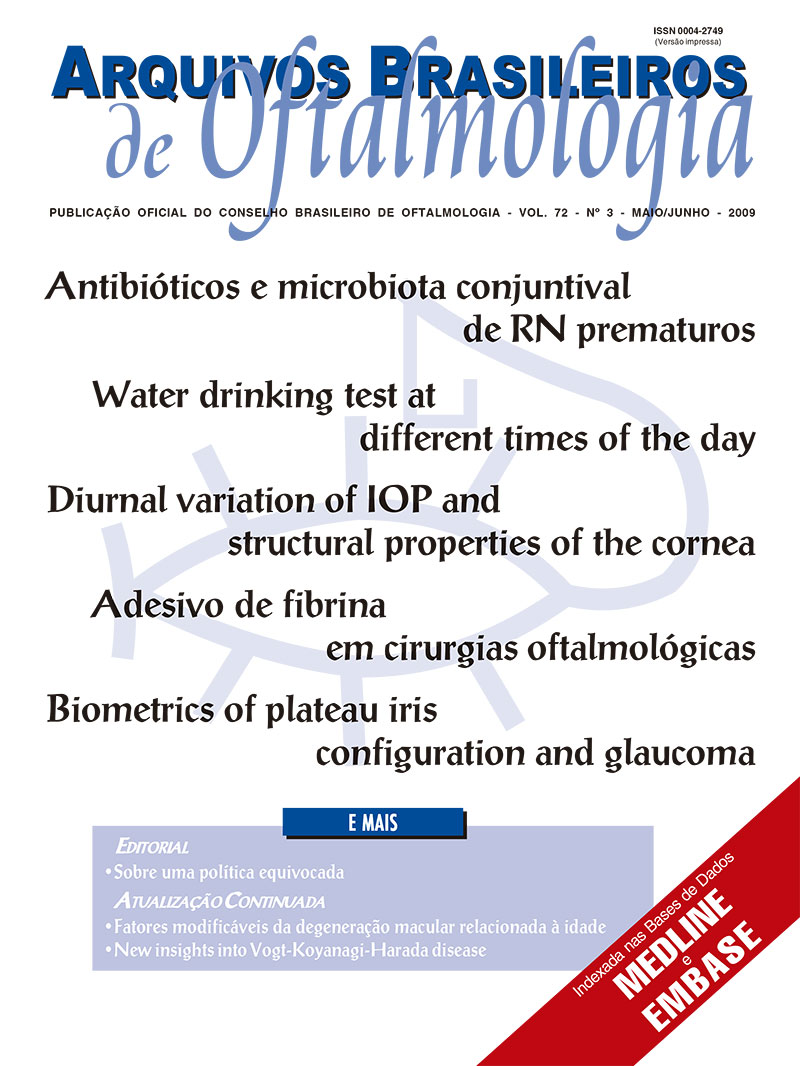
PURPOSE: To evaluate the reproducibility of water drinking test (WDT) performed at different times of the day, in primary open angle glaucoma (POAG) patients and normal individuals.
METHODS: Fifteen patients with POAG and 30 normal individuals underwent three WDTs at different times of the day (7 AM, 12 PM, and 5 PM) on 3 different days. Test results in POAG patients and normal individuals were compared. Agreement and correlation of intraocular pressure (IOP) baseline levels, peak levels, and IOP change (peak IOP - baseline IOP) on tests performed at different times were evaluated. Only right eye measurements were analyzed.
RESULTS: Mean baseline IOP, peak IOP and IOP change were significantly higher in POAG patients than in normal individuals, at all time intervals (p<0.05). The Bland-Altman analysis demonstrated limits of agreement for IOP peak levels and IOP changes larger than the clinically acceptable (>3 mmHg), even though Pearson's test revealed good correlation among the results.
CONCLUSION: The mean IOP peak and mean IOP change observed during WDT are significantly higher in POAG patients than in control individuals. Low levels of agreement among WDTs performed at different times of the day suggest a poor reproducibility of WDT, which may limit its applicability for the diagnosis and follow-up of glaucoma.
Keywords: Glaucoma; Tonometry, ocular; Reproducibility of results; Intraocular pressure; Diagnostic techniques and procedures
Arq. Bras. Oftalmol. 200972
| DOI: 10.1590/S0004-27492009000300003
PURPOSE: To analyze the conjunctival bacterial flora and the antibiotics resistance pattern in preterm newborns at the Neonatal Intensive Care Unit (NICU), in "Hospital das Clínicas da Universidade Federal de Pernambuco - UFPE".
METHODS: Material from the conjunctival sac was obtained from 48 premature infants eyes that stayed at in NICU more than 48 hours.
RESULTS: Culture analysis revealed that 40 (83.3%) were positive and the pathogens most commonly isolated included Coagulase-negative Staphylococcus (43.2%) and Staphylococcus aureus (25.0%), being 63.9% of the bacteria multiresistant. Antimicrobial test results demonstrated great sensitivity to gatifloxacin (97.2%), vancomycin (94.4%) and ofloxacin (94.4%). CONCLUSIONS: Conjunctival bacterial flora among newborns in NICU is varied, mainly Gram-positive, usually multiresistant to antibiotics.
Keywords: Conjunctiva; Drug resistance; Cross infection; Intensive care, neonatal; Infant, premature
Arq. Bras. Oftalmol. 200972
| DOI: 10.1590/S0004-27492009000300004
PURPOSE: The purpose of this study was to evaluate the fluctuation of intraocular pressure measurements obtained by Goldmann applanation tonometry, dynamic contour tonometry, and corneal compensated non-contact tonometry during office hours in glaucoma and healthy participants. This study also aims at correlating the intraocular pressure fluctuations with fluctuations of corneal hysteresis, central corneal thickness, mean central corneal curvature and ocular pulse amplitude.
METHODS: A total of 12 controls (24 eyes) and 21 patients (38 eyes) with open-angle glaucoma were recruited. Intraocular pressure measured by Goldmann applanation tonometry, dynamic contour tonometry and corneal compensated non-contact tonometry, ocular pulse amplitude, central corneal curvature and thickness, corneal hysteresis, and resistance factor were obtained at intervals of 2 hours, between 9 AM and 5 PM.
RESULTS: Intraocular pressure fluctuated significantly throughout the day in controls and glaucoma individuals with all tonometers (P<0.001). There was no statistically significant variation in mean corneal curvature (P=0.048 in controls; P=0.04 in glaucomatous) or hysteresis over time (P=0.12 in controls; P=0.36 in glaucomatous). The ocular pulse amplitude showed a significant diurnal fluctuation in both groups (P<0.001). There was a significant correlation between the intraocular pressure measured by dynamic contour tonometry and ocular pulse amplitude (P<0.001).
CONCLUSION: There was significant intraocular pressure fluctuation over office hours on measurements performed by Goldmann applanation tonometry, dynamic contour tonometry, and corneal compensated non-contact tonometry in normal and glaucoma individuals. Intraocular pressure varied independently of corneal hysteresis, central corneal thickness, and central curvature variation. However, there was significant correlation between ocular pulse amplitude and intraocular pressure measurements performed by dynamic contour tonometry.
Keywords: Intraocular pressure; Cornea; Corneal topography; Glaucoma; Tonometry, ocular; Circadian rhythm
Arq. Bras. Oftalmol. 200972
| DOI: 10.1590/S0004-27492009000300005
PURPOSE: To investigate biometrically the differences between plateau iris configuration (PIC) eyes and primary open angle glaucoma with narrow angle eyes.
METHODS: A comparative study involving a case series with 20 eyes of 11 plateau iris configuration patients and 45 eyes of 27 primary open angle glaucoma with narrow angle eyes patients was done. The following measurements were taken: corneal curvature, central corneal thickness, anterior chamber depth, lens thickness (LT), axial length (AL), lens thickness and axial length ratio, lens position (LP) and relative lens position (RLP).
RESULTS: The plateau iris configuration eyes presented a higher corneal cuvature value than primary open angle glaucoma with narrow angle eyes eyes but not with clinical and statistical difference (P=0.090). The plateau iris configuration eyes demonstrated a higher central corneal thickness, with statistical significance, when compared to primary open angle glaucoma with narrow angle eyes (P=0.010). Statistical significant difference between plateau iris configuration and primary open angle glaucoma with narrow angle eyes was found in axial length (21.69 ± 0.98 vs. 22.42 ± 0.89; P=0.003). No significant difference was found when anterior chamber depth (2.62 ± 0.23 vs. 2.71 ± 0.31; P=0.078), LT (4.67 ± 0.36 vs. 4.69 ± 0.45; P=0.975), LT/AL (2.16 ± 0.17 vs. 2.10 ± 0.21; P=0.569), LP (4.95 ± 0.25 vs. 5.06 ± 0.34; P=0.164) and RLP (0.23 ± 0.01 vs. 0.22 ± 0.14; P=0.348) were evaluated.
CONCLUSION: The eyes with plateau iris configuration presented statistical significantly shorter axial length and higher central corneal thickness than primary open angle glaucoma with narrow angle eyes.
Keywords: Glaucoma, angle-closure; Anterior chamber; Gonioscopy; Iris diseases; Intraocular pressure; Comparative study
Arq. Bras. Oftalmol. 200972
| DOI: 10.1590/S0004-27492009000300006
PURPOSE: To evaluate the use of fibrin glue and its complications in different ophthalmic surgeries.
METHODS: A retrospective and non-comparative case series study. 161 eyes were evaluated. The mean age was 51.8 years. Fibrin glue (BeriplastTM - Aventis Behring, Germany) was used in all patients for tissue adherence or incisional closure.
RESULTS: Main preoperatives diseases were pterygium (76 patients), superior limbic keratoconjunctivitis (4 patients), limbal tumor (4 patients), conjunctivochalasis (21 patients), bullous keratopathy (31 patients), limbal stem cell deficiency (7 patients), alkali injury (6 patients), Stevens-Johnson syndrome (2 patients), cataract (5 patients) and glaucoma (5 patients). Complications occurred in 28 patients (17.4%). Detachment of the fixed tissue and granulomatous foreign body reaction were the main complications. Detachment occurred in 10 cases (5.6%) (7 in amniotic membrane transplantation in bullous keratopathy, 2 in autologus conjunctival grafting for pterygium surgery, 1 in autologus limbal transplantation in a Stevens-Johnson syndrome). Granulomatous foreign body reaction was described in 9 patients (5.6%) (5 in amniotic membrane transplantation due to acute alkali injury, 1 in autologus limbal graft due to chronic burn injury, and 3 in autologus conjunctival transplant due to pterygium surgery). All the complications described occurred in the first week after surgery.
CONCLUSION: Despite the limitations related to the retrospective and non-comparative setting, this study suggests that the use of fibrin glue seems to be safe and effective for tissue fixation or incisional closure presenting low rates of complications in ocular surface and anterior segment surgeries.
Keywords: Fibrin tissue adhesive; Ophthalmologic surgical procedures; Suture techniques
Arq. Bras. Oftalmol. 200972
| DOI: 10.1590/S0004-27492009000300007
PURPOSE: To evaluate different diagnostic methods for high risk chloroquine retinopathy due to prolonged use of chloroquine (more than 5 years) by systemic lupus erythematosus patients.
Methods: Seventy-two eyes of 36 consecutive patients, followed in the Division of Rheumatology, School of Medicine, University of São Paulo, were analyzed from July 2007 to April 2008. Demographic and clinical data were evaluated in order to study risk factors and to compare the following different ophthalmological
methods: visual acuity, biomicroscopy, fundus examination, retinography, fluorescein angiogram, visual field test and, color vision tests.
RESULTS: From 36 patients, 34 (94.4%) were female. The mean age was 39.9 ± 9.8 years and the disease duration was 13.9 ± 6.6 years. Besides chronic use of chloroquine, patients also showed high daily and cumulative doses. These high risk factors were not related to a higher retinopathy prevalence. Visual field showed 38.9% of retinopathy prevalence. Other ophthalmological methods failed in detecting most cases.
CONCLUSION: High prevalence of retinopathy in high risk patients was observed by visual field test, but other ophthalmological methods failed in detecting alterations. Ophthalmological assessment of these patients should include visual field, even in the absence of clinical alterations.
Keywords: Retina; Retina; Chloroquine; Lupus erythematosus, systemic; Risk factors
Arq. Bras. Oftalmol. 200972
| DOI: 10.1590/S0004-27492009000300008
PURPOSE: To document the clinical features, systemic association, treatment and evolution of 23 patients with posterior scleritis evaluated in the Uveitis service of the Federal University of Minas Gerais.
METHODS: 23 patients were identified with the diagnosis of posterior scleritis. Signals and symptoms, visual acuity, B-mode ultrasonography signals, systemic associations, treatment and evolution were described and analyzed.
RESULTS: Sixteen patients were female and seven were male with mean age of 44,7 years. Posterior scleritis occurred in association with anterior scleritis in 10 patients, unilateral involvement in 17 patients and simultaneous bilateral involvement in 6 patients. Posterior scleritis in association with systemic disease occurred in 8 patients (Cogan's syndrome, TBC, Wegener, Herpes simplex and Zoster, Apergilosis, inflamatory bowel disease and Sarcoidosis). The main symptoms were ocular pain and decrease of visual acuity and the main signal was retinal serous detachment. Increase of thickness choroidal tissue was the main signal in B-mode ultrasonography in 18 patients and the principal kind of treatment was the use of systemic corticosteroids. Only 4 patients required systemic immunosuppressive drugs. CONCLUSIONS: Posterior scleritis still represents a diagnostic challenge and is often associated with life threatening systemic disease and vision threatening ocular complications. Knowledge of posterior scleritis may aid in determining timely and accurate diagnosis and treatment of both ocular and any systemic conditions associated, thus decreasing morbidity and mortality. Elevated suspicion rate is always required to detect this condition.
Keywords: Scleritis; Sclera; Retinal detachment; Pain; Prednisolone
Arq. Bras. Oftalmol. 200972
| DOI: 10.1590/S0004-27492009000300009
PURPOSE: To investigate the humoral immune response to dengue virus in patients with Möbius sequence and their mothers, assessing the relation between this infection during pregnancy and Möbius sequence.
METHODS: The medical records were reviewed, and a questionnaire was answered by each mother. IgG ELISA was performed in 35 patients and their mothers. A plaque reduction neutralization test was further done in the mothers who reported a viral infection during pregnancy and in their children for determining which dengue serotype virus had caused the infection.
RESULTS: Fever, headache and/or retrobulbar pain during pregnancy was referred by eighteen (51.4%) mothers. Three (8.6%) reported dengue during the first or second quarteers of pregnancy. When cross analyzing the mothers and their respective children serological results, 57.1% of them matched. Of the three mothers with clinical diagnosis of viral infection during pregnancy, one and its respective children had a positive plaque reduction neutralization test for dengue serotype three (DENV-3), this serotype reached Pernambuco in 2002, which excludes the possibility of a vertical transmission to the children.
CONCLUSION: The serology of the cases that had clinical diagnosis of dengue during pregnancy proved to be incompatible with the hypothesis of the disease vertical transmission. Therefore, in the present serie, the dengue virus infection can not be considered as a factor involved in the genesis of Möbius sequence.
Keywords: Möbius syndrome; Antibody formation; Dengue; Dengue virus
Arq. Bras. Oftalmol. 200972
| DOI: 10.1590/S0004-27492009000300010
PURPOSE: To evaluate eye care services from the user's perspective in a low income population from the east zone of the city of São Paulo - Brazil.
METHODS: A household survey was performed using cluster sampling in three low income districts of the city of São Paulo - Brazil. From July/2004 to January/2005, 1055 interviews with an adult household representative were carried and an eye care system responsiveness questionnaire was administered through individual interview.
RESULTS: 71.56% of the participants were women. Respondents' age ranged from 18 to 92 years (41.42 ± 15.67 years). Regarding schooling, 525 (49.77%) had four years or less; 489 (46.35%) between five and eleven years, 40 (3.79%) had eleven or more years of study. Eye care services need was reported as 712 (67.49%) declaring themselves or someone else of the household needing and obtaining services and 135 (12.80%) had never needed eye care. The most frequently cited barriers to obtain the eye care service by respondents was cost (77.29%), followed by unsuccessful attempt to obtain eye care (42.21%). General satisfaction for the criteria contained in the questionnaire was 63.37%. In the 36.63% dissatisfied respondents, the most frequently cited claim was the amount of time waited before consultation.
CONCLUSION: The main barriers to obtain eye care services were cost of medical appointment and lack of access to the services. 63.37% of the individuals in need who had received eye care in last 12 months were satisfied with the service provided.
Keywords: Patient satisfaction; Eye health services; Quality of health care; Quality assurance, health care; Eye diseases; Urban health services
Arq. Bras. Oftalmol. 200972
| DOI: 10.1590/S0004-27492009000300011
PURPOSE: To verify the association between two different types of strangling with intraocular pressure variation in jiu-jitsu athletes.
METHODS: An observational study was performed on 9 athletes of jiu-jitsu, with at least 6 month of training, male, aged 20 to 30 years, without any physical and eyeball lesions. Associations between intraocular pressure and Cross Choke from the guard strangling (E1), and E2 - Cross Choke from mount strangling were gotten. Intraocular pressure was determined by using Perkins tonometer, at first in the absence of physical exercise over the last 24 hours and after each strangling. Then it was carried out the intraocular pressure measure at each 3 minutes, during 12 minutes of exercise recovery (R1, R2, R3, and R4) keeping the athletes lied down. Statistical analysis was done using ANOVA test and Bonferroni post-test.
RESULTS: Meaningful reduction of both eyes intraocular pressure occurred at the E2 situation comparing to the E1 situation at all exercise recovery measures: R1 (OD: 8.22 ± 1.39 vs.11.33 ± 2.00 / OE: 8.55 ± 1.23 vs. 11.88 ± 1.90), R2 (OD: 8.44 ± 1.87 vs.10.22 ± 2.53 / OE: 9.00 ± 1.80 vs. 10.44 ± 2.35), R3 (OD: 8.44 ± 1.74 vs.9.78 ± 2.54 / OE: 8.55 ± 1.42 vs. 10.33 ± 1.93) all with p<0,01 e R4 (OD: 8.88 ± 2.08 vs.9.55 ± 2.87 / OE: 9.11 ± 1.53 vs. 10.44 ± 2.18) with p<0.05. Meaningful IOP reduction (p<0.05) was observed at the R1 moment of E2 strangling (OD: 10.77 ± 1.92 vs.8.22 ± 1.39 / OE: 11.44 ± 1.94 vs. 8.55 ± 1.23).
CONCLUSION: There is association between intraocular pressure and jiu-jitsu strangling exercises, with intraocular pressure reduction.
Keywords: Intraocular pressure; Athletic injuries; Exercise; Asphyxia; Neck
Arq. Bras. Oftalmol. 200972
| DOI: 10.1590/S0004-27492009000300012
PURPOSE: To determine calibration errors of Goldmann applanation tonometers in ophthalmic clinics of Brasília, Brazil, and correlate the findings with variables related to tonometers model and utilization.
METHODS: Tonometers from ophthalmic clinics in Brasília, Brazil, were checked for calibration errors. A standard Goldmann applanation tonometer checking tool was used to asses the calibration error. Only one trained individual made all verifications, with a masked reading of the results. Data on the model, age, daily use, frequency of calibration checking and the nature of the ophthalmic department - private or public - were collected and correlated with the observed errors.
RESULTS: One hundred tonometers were checked for calibration. Forty seven percent (47/100) were out of 1 mmHg range at least at one point checking. Tonometers mounted to slit lamp, with less than 5 years, used in less than 20 patients daily, that had a calibration check on a yearly basis, and those from private office exhibit a lower rate of inaccuracy, but only the first variable was statistically significant. Sixty one percent of tonometers on public hospitals were out of calibration.
CONCLUSION: Calibration of tonometers in the capital of Brazil is poor; those from general hospitals are worst, and this fact can lead to inaccurate detection and assessment of glaucoma patients, overall in the population under government assistance.
Keywords: Intraocular pressure; Tonometry, ocular; Calibration; Equipment failure analysis; Glaucoma; Quality control
Arq. Bras. Oftalmol. 200972
| DOI: 10.1590/S0004-27492009000300013
PURPOSE: To verify the intraocular pressure (IOP) after sub-maximal strength test.
METHODS: 145 Physical Education freshmen (22.04 ± 4.17 years old; female and male) from Superior Physical Education School of Jundiaí (ESEFJ) were evaluated in an observacional study. The exclusion criteria were: media opacity and eyeball absence or changes. All subjects agreed to take part in this research and signed up the Informed Consent. IOP was measured by Perkins tonometer: i) pretest: just before the submaximal strength test performance and ii) post-test: immediately after the strength test. The strength test consisted in the one-repetition-maximum-assessment through repetition until fatigue. Resistance training exercises such as bench press, pulley dorsal high, shoulder press, arm curl and leg press 45º were performed. Statistical analyses were obtained through paired Student's "t" test.
RESULTS: Decrease of IOP was observed after the strength test: 13.48 ± 3.32 vs.10.20 ± 3.72 (p<0.001) in the right eye and 13.13 ± 3.96 vs.9.74 ± 3.33 (p<0.001) in the left eye.
CONCLUSION: IOP showed relevant decrease after submaximal strength test performance in college students.
Keywords: Intraocular pressure; Exercise; Exertion; Weight lifting; Ocular hypotension
Arq. Bras. Oftalmol. 200972
| DOI: 10.1590/S0004-27492009000300014
PURPOSE: To define the detection rate of trachoma in scholars from Alagoas - Brazil.
METHODS: The sample included 6,424 children and adolescents. Scholar's clinical evaluation was performed by medical students under the supervision of professors of the Department of Ophthalmology, according to the World Health Organization guidelines. The clinical evaluation was characterized by eyelashes, eyelids, conjunctiva and cornea examination in both eyes. The scholars were cataloged and data of name, sex, age, clinical forms diagnosis and city were recorded. Regarding the age, the students were divided into three groups: group A (<10 years old), group B (10-14 years old) and group C (>14 years old).
RESULTS: The detection rate of trachoma was 4.5%. From 3,280 male scholars, 161 (4.9%) cases were confirmed; from 3,144 female scholars, 131 (4.2%) cases were considered confirmed. From the total scholars in group A, B and C; respectively 175 (5.3%), 113 (8.0%) and 4 (1.6%) were considered confirmed cases.
CONCLUSION: In this region, it seems that trachoma has not been eradicated and, therefore, must remain as a differential diagnosis of chronic follicular conjunctivitis in children and adolescents from this region.
Keywords: Trachoma; Trachoma; Prevalence; Conjunctivitis; Cornea; Entropion; School health; Students
Arq. Bras. Oftalmol. 200972
| DOI: 10.1590/S0004-27492009000300015
PURPOSE: To evaluate the prevalence of retinopathy of prematurity preterm newborn infants, associating it with its risk factors besides comparing the incidence of refractive errors like myopia and strabismus among preterm children who developed retinopathy of prematurity (Group I) and those who did not present this retinopathy (Group II).
METHODS: A cross-sectional, retrospective and documental study of records of 147 preterm children who were examined at the "Ambulatório de especialidades Jardim Peri Peri" (Ambulatory of Specialties Jardim Peri Peri) was used in this paper. These children were born between July 7th, 2004 and July 10th, 2008 at "Maternidade Mário Degni" (Maternity Mário Degni). Fundus examination with escleral depression was first carried out between the 3rd and 8th weeks after birth and repeated every 1 to 4 weeks depending on the retinal imaging findings, until retina vascularization was complete or retinopathy of prematurity was present and it was followed by an annual ophthalmologic follow-up comprised of fundus examination and refraction. International Classification of Retinopathy of Prematurity criteria was used to classify the retinopathy of prematurity. Analysis of the whole group of preterm newborns was made and classified in group I and group II, and the incidence of Myopia and Astigmatism in each group was analyzed.
RESULTS: This casuistry showed that retinopathy of prematurity was present in 35 preterm children (23%) and 112 preterm children (77%) did not develop this retinopathy. In Group I, 34 children (97%) were classified as stage I Retinopathy and had spontaneous regression and 1 child (3%) was in stage II Retinopathy and developed a threshold disease. CONCLUSIONS: In this study, the incidence of retinopathy of prematurity was similar to the international statistic data, since the threshold disease reached 3% of the cases. The clinical profile of group I showed that all the preterm newborn infants used oxygen support and presented Respiratory Distress syndrome, with the prevalence of stage I.
Keywords: Retinopathy of prematurity; Risk factors; Myopia; Strabismus; Infant, premature
Arq. Bras. Oftalmol. 200972
| DOI: 10.1590/S0004-27492009000300016
PURPOSE: To evaluate the influence of 2% ibopamine eye drops on the results of computerized visual field exams.
METHODS: Normal volunteers from CEROF-UFG were selected, with no variance in the ophthalmologic examination that could affect the visual field test. The volunteers underwent computerized visual field test before and after dilation with 2% ibopamine eye drop or cyclopentolate, with a minimum interval of three days between them and in a random order. Global indices and number of altered points were compared between the groups.
RESULTS: Thirty eyes of 30 normal individuals were selected. There was no statistically significant difference on Mean Deviation (MD) before and after dilation with ibopamine (MD: -1.05 ± 0.26 dB vs. -1.47 ± 0.20 dB, P=0.08). However, after cycloplegia (MD: -3.19 ± 0.29 dB), there was a significant difference on MD (P<0.001 for both ibopamine and pre-dilation). No significant difference was detected in the Pattern Standard Deviation when comparing ibopamine with pre-dilation and cycloplegia values, but it was statistically significant comparing pre-dilation to cycloplegia (P=0.04). The number of altered points in the Pattern Deviation graphic were not significant comparing all pairs. There was a statistically significant difference in the number of altered points in the total deviation graphic before dilation and after cycloplegia (n: 8.86 ± 1.51 vs. 25.72 ± 2.96 points, P<0.001), and comparing cycloplegia with ibopamine (ibopamine: 9.75 ± 1.85 points, P<0.001).
CONCLUSION: Ibopamine 2% eye drops seem to not modify the results of visual field tests in normal individuals.
Keywords: Cyclopentolate; Glaucoma; Ocular hypertension; Intraocular pressure; Perimetry
Arq. Bras. Oftalmol. 200972
| DOI: 10.1590/S0004-27492009000300017
PURPOSE: To evaluate the epidemiology, possible etiologic factors, complications and treatment of a group of patients with ocular complications secondary to Stevens-Johnson syndrome.
METHODS: Twenty-two consecutive patients with Stevens-Johnson syndrome were studied. The patients were examined according to the following protocol: identification, previous clinical history, systemic and ophthalmologic manifestations and possible etiologic factors.
RESULTS: A total of 22 patients with Stevens-Johnson syndrome were identified. Fifteen patients (68%) were female, 7 (32%) male. Ten patients were caucasian (45.4%), 9 brownish (22%), 2 black (9%) and 1 yellow (4.5%). Mean age was 27.1 (8 to 62). Medications were the most commonly identified etiologic factor (90.9%), followed by skin herpetic infection (4.5%) and idiopathic (4.5%). Dipirone (36.3%) was the most frequently identified agent, followed by seizure medications (22.7%), non-steroidal anti-inflammatory drugs (13.6%), sulfonamides (9.0%), penicillin (4.5%), spironolactone (4.5%) and dihydroprogestagen and stradiol (4.5%). Twenty-one patients (95.4%) had ophthalmologic complications and sixteen patients (72.7%) underwent ophthalmologic surgical procedures. CONCLUSIONS: The results of this study show important epidemiological aspects of Stevens-Johnson syndrome in our environment, specially related to age, etiology and ocular complications.
Keywords: Stevens-Johnson syndrome; Drug hypersensitivity; Corneal opacity; Visual acuity
Arq. Bras. Oftalmol. 200972
| DOI: 10.1590/S0004-27492009000300018
PURPOSE: Cataract is considered the main preventable cause of blindness and visual impairment mainly in poor countries. This study was done to evaluate if cataract is still an important cause of blindness in Central-West region of State of São Paulo, Brazil.
METHODS: A cross-sectional study was conducted with a systematically randomized sample of households in five cities located in Central-West region of São Paulo State, Brazil. The sample consisted of 4,229 individuals (8,458 eyes) of all ages. All household members were considered eligible. They were submitted to a complete ophthalmological examination (visual acuity with and without visual correction, biomicroscopy, fundoscopy, tonometry, and refractometry). Cataract diagnosis was given to eyes presenting lens opacity in biomicroscopy exam, according to Lens Opacities Classification System II (LOCS II). Eye with a best correction, presenting visual deficiency or blindness caused by cataract was considered after excluded other pathologies that decrease visual acuity (VA). We considered as visual deficiency eyes with 0.05 < VA < 0.3 and as blind eyes with VA < 0.05. Visual impairment was considered for individuals with 0.05 < VA < 0.3 in the best eye, with the best correction and blindness for individuals with VA < 0.05 in the best eye, with the best correction. We considered the number of eyes with cataract, the number of eyes with visual deficiency and blindness and the number of individuals with visual deficiency and blindness. Occurrence frequency was evaluated for eyes separately and together.
RESULTS: Cataract frequency in this population was 4.94% (209 individuals), affecting mainly people over 50'ths (92.34%) and females (61.11%). Cataract was the cause of visual impairment for 0.96% and blindness for 0.52% of the total population.
CONCLUSION: Our results showed that cataract prevalence in studied region population of the is similar to developed countries.
Keywords: Cataract; Visually impaired persons; Blindness; Brazil
Arq. Bras. Oftalmol. 200972
| DOI: 10.1590/S0004-27492009000300019
Pilomatricoma is a benign neoplasm originated in the pilosebaceous follicle wich appears as an intradermal nodule during childhood, in most cases. It is generally covered with normal skin, reaching a diameter of 1.5 cm on average, and it often shows no recurrence after surgical excision. The authors describe a case in wich a 26-year-old patient presented a tumoral lesion on the upper left superciliary area was submitted to total excision, and diagnosed as pilomatricoma by the histological study. According to the patient, this lesion had a progressive and slow growth of about two years. Eight months after the first surgical intervention, there was a new tumor growth in the region, this time quicker and worsen, with ulceration on the small skin area that covered the lesion, thus leading to malignity suspicion. After the conduction of a new excision within a security margin, the histological test confirmed that it was a pilomatricoma lesion and the piece displayed no sign of malignity. The patient has been followed up for one year, showing no signs of recurrence so far.
Keywords: Pilomatricoma; Recurrence; Skin neoplasms; Case reports; Human; Male; Adult
Arq. Bras. Oftalmol. 200972
| DOI: 10.1590/S0004-27492009000300020
A 19 year old female with pyoderma gangrenosum was referred to the oculoplastic clinic for evaluation of severe cicatricial ectropion of the right lower eyelid. Examination evidenced important scarring of lower eyelid and malar region with secondary ectropion. A full-thickness skin graft associated with a lateral tarsal strip procedure and scar tissue release was performed. The patient's corticosteroid dose was raised for the procedure, and after surgery there was no healing problem or ulcer formation in the eyelid or in the graft donor site. As pyoderma gangrenosum is associated with a pathergy phenomenon in up to 25% of the cases, the onset of new lesions is a relevant concern when performing surgery in these patients. In this case, the surgery was safely performed under corticosteroid immunosuppression.
Keywords: Pyoderma gangrenosum; Ectropion; Eyelid diseases; Skin transplantation; Immunosuppression
Arq. Bras. Oftalmol. 200972
| DOI: 10.1590/S0004-27492009000300021
The sympathetic ophthalmia is a granulomatous panuveitis that starts after ocular trauma. The prognosis is poor and depends of both early diagnosis and treatment. The authors describe one case of a patient with sympathetic ophthalmia using optical coherence tomography who was submitted to early treatment, and it suggests that the optical coherence tomography can corroborate as a ancillary method in the study of retina characteristics in sympathetic ophthalmia disease specially in cases of rare presentation, with serous retinal detachment as an isolated ophthalmological manifestation.
Keywords: Retinal detachment; Ophthalmia, sympathetic; Tomography, optical coherence; Eye injuries
Arq. Bras. Oftalmol. 200972
| DOI: 10.1590/S0004-27492009000300022
Metastasis confined to eyelids are rare, representing less than 1% of malignant eyelid lesions. More than 50% of all eyelid metastasis are reported to have the breast as the most common primary origin. Two cases of metastatic eyelid disease associated with primary breast carcinoma are described. These lesions were the first sign of metastatic systemic disease. Case 1: An 80-year old woman with no significant ophthalmological history complaining of a discrete painless lesion in the left upper eyelid. She had been diagnosed 10 years before as infiltrated ductal carcinoma of right mammary gland with no reference of metastatic disease. Case 2: A 77-year old woman who attends our ophthalmology service came complaining of a four-month history of a painless swelling and erythema of right lower eyelid. The past medical history was significant for infiltrated ductal carcinoma on right mammary gland 2 years before the ocular manifestation. Breast carcinoma is notorious for its presentation diversity. Metastatic disease should be considered as differential diagnosis of eyelid lesions. Although rare, these lesions can be an initial sign of systemic malignancy.
Keywords: Neoplasm metastasis; Eyelid neoplasms; Carcinoma; Breast neoplasms
Arq. Bras. Oftalmol. 200972
| DOI: 10.1590/S0004-27492009000300023
A case of a local reaction related to a subtenonian deep injection of triamcinolone is reported. The patient was a 6 year old child, with intermediate uveitis. Intense edema and erythema of the eyelids appeared approximately 30 minutes after the injection. Complete resolution occurred among 24 to 48 hours after the injection.
Keywords: Injections; Anterior chamber; Triamcinolone acetonide; Uveitis, intermediate; Erythema; Edema; Eyelid; Vision disorders; Visual acuity
Arq. Bras. Oftalmol. 200972
| DOI: 10.1590/S0004-27492009000300024
A 29 year old male was admitted at the emergency room suffering from gradually worsening headache followed by nausea. In the hospital patient presented with lethargy, reduction of consciousness level and bilateral hypoacusis. Ophthalmic examination and fluorescein angiography showed retinal vasculitis. This finding was crucial to the diagnosis of Susac syndrome, a rare disease characterized by vasculopathy of retina, encephalic tissues and cochlea. Patient was treated with immunosuppressors to prevent him from developing severe sequelae of this disease.
Keywords: Retinal vasculitis; Fluorescein angiography; Vasculitis, central nervous system; Hearing loss, sensorineural
Arq. Bras. Oftalmol. 200972
| DOI: 10.1590/S0004-27492009000300025
Proliferative sickle cell retinopathy is an uncommon complication in individuals with sickle cell trait (AS). However, the risk for proliferative retinopathy development is increased in patients with AS hemoglobinopathy associated with systemic conditions or ocular trauma. A case of a patient with AS hemoglobinopathy who developed proliferative sickle cell retinopathy after the occurrence of gestational diabetes and pregnancy-induced hypertension is reported. Hemoglobin electrophoresis revealed presence of A2 5.0%, S 35.0% and A 53.2%. The present case emphasizes the importance of evaluating systemic comorbidities in patients with sickle cell trait during pregnancy since sickle cell retinopathy can progress rapidly, as well as the importance of regular eye fundus examination in these patients.
Keywords: Sickle cell trait; Retinal neovascularization; Retinal detachment; Gestational diabetes; Hypertension, pregnancy-induced
Arq. Bras. Oftalmol. 200972
| DOI: 10.1590/S0004-27492009000300026
The case of a 35 year-old male patient is reported. The patient had a clinical history of craniocerebral trauma and premacular hemorrhage of Terson syndrome in the left eye. After waiting for 45 days, without hemorrhage resolution, the patient received an intravitreal injection of sulfur hexafluoride gas and tPA; an almost complete hemorrhage absorption occurred after a week as well as a considerable improvement of visual acuity. In the report, relevant aspects of Terson syndrome and of intravitreal injection of gas and tPA are also described through a literature review.
Keywords: Subarachnoid hemorrhage; Craniocerebral trauma; Retina hemorrhage; Tissue plasminogen activator; Syndrome; Injections; Sulfur hexafluoride
Arq. Bras. Oftalmol. 200972
| DOI: 10.1590/S0004-27492009000300027
The authors present the main modifiable risk factors that may trigger and/or worsen age-related macular degeneration. Mechanisms of action related to these factors as well as preventive measures and intervention effectiveness are discussed.
Keywords: Smoking; Hypertension; Hypercholesterolemia; Atherosclerosis; Body mass index; Ultraviolet rays; Light; Antioxidants; Carotenoids; Lutein; Fatty acids, omega-3; Diet; Macular degeneration; Supplementary feeding; Free radicals; Randomized controlled trials
Arq. Bras. Oftalmol. 200972
| DOI: 10.1590/S0004-27492009000300028
Vogt-Koyanagi-Harada disease (VKH), a well-established multiorgan disorder affecting pigmented structures, is an autoimmune disorder of melanocyte proteins in genetically susceptible individuals. Several clinical and experimental data point to the importance of the effector role of CD4+ T cells and Th1 cytokines, the relevance of searching a target protein in the melanocyte, and the relevance of the HLA-DRB1*0405 in the pathogenesis of the disease. Vogt-Koyanagi-Harada disease has a benign course when early diagnosed and adequatey treated. Full-blown recurrences are rare after the acute stage of Vogt-Koyanagi-Harada disease is over. On the other hand, clinical findings, such as progressive tissue depigmentation (including sunset glow fundus) and uveitis recurrence, indicate that ocular inflammation may persist after the acute phase. Additionally, indocyanine green angiography findings suggest the presence of choroidal inflammation in eyes without clinically detectable inflammation. The aim of this paper is to review the latest research results on Vogt-Koyanagi-Harada disease pathogenesis and chronic/convalescent stages, which may help to better understand this potentially blinding disease and to improve its treatment.
Keywords: Uveomeningoencephalitic syndrome; Uveitis; Chronic disease; Autoimune diseases; HLA-DR antigens; Melanocytes; Review


 ABO is licensed under a Creative Commons Attribution-NonComercial 4.0 Internacional.