Arq. Bras. Oftalmol. 200063
| DOI: 10.1590/S0004-27492000000200003
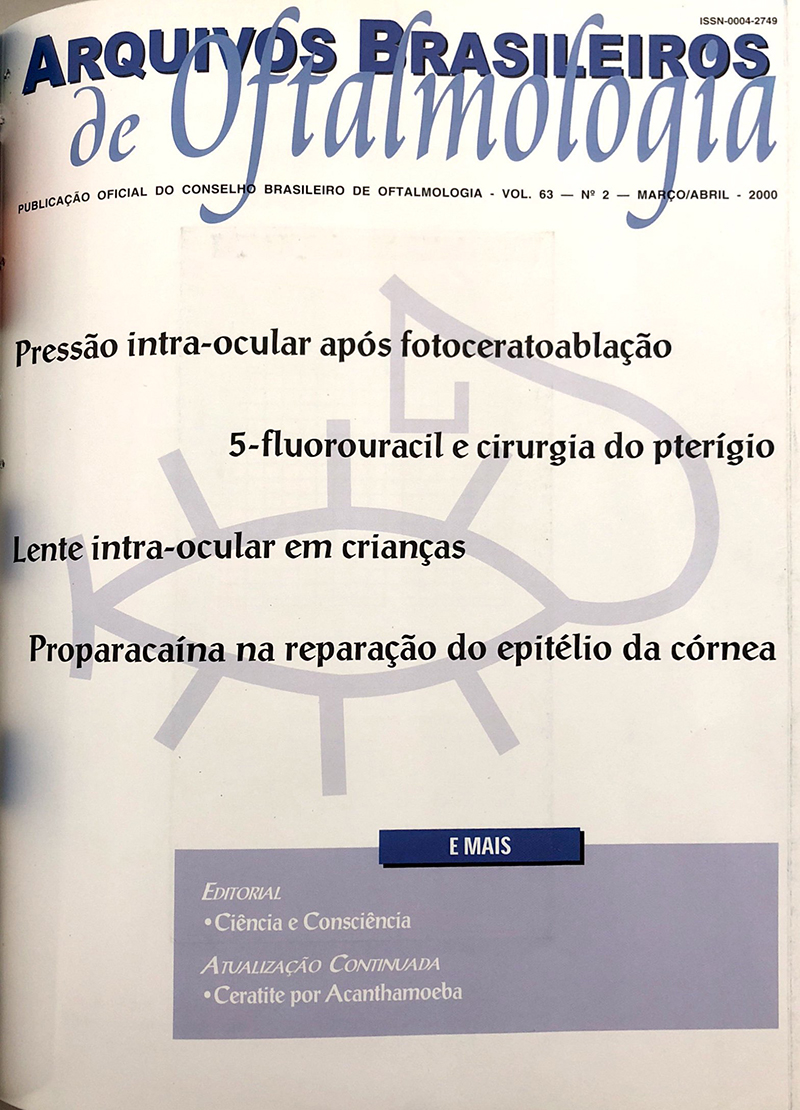
Purpose: To evaluate the effectiveness and the complications on intraoperative application of 5-fluorouracil (5FLU) in pterygium surgery. Method: We studied 28 eyes of 26 patients with pterygium, evaluating the type and size of the pterygium, previous surgeries and the response to surgical treatment (on the 7th, 21st, 60th, 90th postoperative day). The application of 5-FLU (25 mg/ml) was done soon after resection, for five minutes, followed by the sliding flap technique.
Results: Most of the patients were more than 50 years old, presented with primary (70.0%), degree II (60.7%), involu-tionary type (60.7%) pterygium. After surgery ischemic area (10.7%), conjunctival deiscence (7.1%), keratitis (3.5%), conjunctivitis (3.5%) and lesion relapse (3.5%) were observed.
Conclusion: 5-FLU is a safe and effective drug and could be of help in the treatment of pterygium to prevent relapse.
Keywords: Pterygium; 5-fluorouracil; Antimitotic; Relapse
Arq. Bras. Oftalmol. 200063
| DOI: 10.1590/S0004-27492000000200004
Purpose: To evaluate the results of the implantation of acrylic foldable intraocular lenses in children.
Methods: Ten eyes from 10 children aged 3 to 9 years with infantile cataracts were operated and received an acrylic intraocular lens implantation. Follow-up ranged from 6 to 20 months after surgery.
Results: The patients had their visual acuity measured at the last visit and a significant improvement in all but one patient was found. There was no posterior capsule opacification or any other surgical complication in this period. Conclusions: Although the number of cases is small, the results suggest that the use of acrylic intraocular lens provides a very good transparency of the visual axis in the short and medium term after surgery.
Keywords: Infantile cataract; Congenital cataract; Foldable intraocular lens
Arq. Bras. Oftalmol. 200063
| DOI: 10.1590/S0004-27492000000200005
Context: The topical use of anesthetic solutions is usually associated with toxic effects on the corneal epithelium. On the other hand, their use has been proposed for some situations, especially after photorefractive keratectomy a procedure that involves corneal scraping and has a very painful postoperative period.
Purpose: To evaluate the influence of the topical use of proparacaine (0.05% and 0.5%) and phosphate buffer on the epithelial healing of corneal central wounds.
Methods: A central epithelial corneal wound of a 6.0 mm diameter was performed in rabbits. Proparacaine and buffer were instilled every 30 minutes for 12 hours a day for 2 days. Epithelial regeneration was assessed through sequential photographs of the defective area stained with sodium fluorescein and the quantification of this area was performed using a computerized image analyzer.
Results: There were no statistical differences in the corneal healing between the compared groups during the study. Proparacaine in those concentrations didn't induce histo-pathological abnormalities such as discontinuity of the epithelium, disorganization of collagen layers or polymor-phonuclear infiltration (the stromic edema and the limbic inflammatory infiltrates were not important).
Conclusion: Topical use of proparacaine didn't delay reepi-thelialization of the defective area and was not responsible for important histopathological abnormalites.
Keywords: Proparacaine; Corneal wound healing
Arq. Bras. Oftalmol. 200063
| DOI: 10.1590/S0004-27492000000200006
Purpose: To study the behavior and characteristics of contact lens wearers involved in health areas.
Methods: To conduct a survey among students of health related courses at the Pontifícia Universidade Católica do Paraná, in Curitiba, during the period from 23rd to 27th November 1998. A previously tested, self-applicable questionnaire was used to collect data. Results and Discussion: Among 1,173 students, 207 (17.2%) used contact lenses, of which 78.3% were female and 21.7% were male. Twelve point one percent (12.1%) used rigid and 87.9% soft lenses, showing a progressive increase in the use of soft lenses when compared to previous national studies. Of the soft lens wearers, 57.6% used disposable lenses and of these, 88.5% did not follow the established standards for use and disposability. Of the total number of wearers, 37.7% reported ocular problems during contact lens use. Although 97.1% of the individuals of this study were fitted for contact lenses by an ophthalmologist, 14.2% obtained new lenses outside ophthal-mologic clinics. On the other hand, 81% consulted an oph-thalmologist one or twice yearly to check lens fitting. Recommendation: To reduce the number of complications and the discontinuance of wearing lenses, the user must be properly educated in the use of lenses and how to identify signs and symptoms indicating ocular problems as well as having this information in writing.
Keywords: Contact lenses; Disposable contact lens; Behavior of contact lens wearers
Arq. Bras. Oftalmol. 200063
| DOI: 10.1590/S0004-27492000000200007
Purpose: To determine the prevalence of low visual acuity (VA) in a populational sample, with a differentiated social pattern.
Methods: This was a prevalence study, in which the 213 volunteers' VA, examined in a shopping mall in Porto Alegre, was verified through the Ortho-Rater device, from Bausch & Lomb. Far sight VA was measured in all the individuals and in those who were 40 years old or older, near sight VA, both of them without and with correction. VA was considered low when it was less than 10 (equivalent to 20/20 on the Snellen chart).
Results: The age group varied from 6 to 75 years, presentig a mean ± standard deviation of 27.8 ± 15.16 years, most belonging to the range between 10 and 40 years. A prevalence of 38.7% (IC 95%: 32.1-45.7) of low far sight VA in both eyes was detected. 24.9% (IC 95%: 19.2-31.3) presented binocular visual deficit and they didn't use any optic correction. For near sight VA, it was observed that 70.8% (IC 95%: 55.9-83) of the tested individuals presented binocular visual deficit without correction and 41.7% (IC 95%: 27.6-56.8) presented low VA, independent of the correction used.
Conclusion:This study demonstrated that a considerable part of the population has low visual acuity, needing adequate evaluation and handling. It is concluded that visual screening programs and ocular health orientation are important for any group and should reach different socioeconomic levels.
Keywords: Visual acuity; Mass screening; Health promotion
Arq. Bras. Oftalmol. 200063
| DOI: 10.1590/S0004-27492000000200008
Purpose: To evaluate the effect of anterior stromal puncture to treat bullous keratopathy patients (BK) who were symptomatic.
Methods: Twenty-five patients with BK and decreased vision, awaiting or not penetrating keratoplasty, were evaluated before, 1, 4 and 12 weeks after anterior stromal punctures performed with a # 25 needle. The patients were asked about pain intensity, foreign body sensation and photophobia. Biomicroscopy, esthesiometry and pachymetry results were evaluated.
Results: The comparisons between results before and after the anterior stromal puncture related to pain (p<0.001), photophobia (p=0.0198), foreign-body sensation (p<0.001), insomnia (p=0.0015) and esthesiometry (p=0.00654) showed significant statistical differences regarding decreasing symptoms and corneal sensitivity. The mean pachymetry did not show a statistical difference between results before and after the procedure (p=0.873). We did not find important differences in terms of corneal neovascularization.
Conclusion: Anterior stromal puncture is an effective, simple and low cost alternative to treat symptomatic patients with BK.
Keywords: Bullous keratopathy; Corneal edema; Treatment
Arq. Bras. Oftalmol. 200063
| DOI: 10.1590/S0004-27492000000200010
Purpose: To report a case of S. aureus keratitis after laser in situ keratomileusis, the management and the outcome. Case report: 26-year-old male underwent toric LASIK OS, evoluing with S. aureus keratitis. After a clinical hypothesis of infection, we performed corneal scrape for lab analysis and proper treatment was given. After successful treatment, the patient showed an improvement in corneal transparency and recovered his visual acuity. Discussion: Infections following laser in situ keratomileusis may not produce visual loss if proper treatment is given.
Keywords: Staphylococcus aureus; Keratitis; Cornea; Laser in situ keratomileusis (LASIK)
Arq. Bras. Oftalmol. 200063
| DOI: 10.1590/S0004-27492000000200011
The authors report a case of a 56-year-old woman with high myopia and a very pronounced restrictive progressively developed eso- and hypotropia. The surgical access to the complete section of the medial rectus muscle was easily obtained by a transcaruncular orbitotomy, not only because of the impossibility of using conventional techniques but also because the scleral rupture becomes highly risky in such cases. The lateral rectus was resected and reinserted above its original path, after being found in the inferotemporal quadrant of the eye. The immediate surgical result (an exotropia of about 12delta) was considered a very good outcome, since such deviations tend to recur.
Keywords: Myopia; Strabismus; Strabismus; Orbitotomy
Arq. Bras. Oftalmol. 200063
| DOI: 10.1590/S0004-27492000000200012
Objetive: Description of a clinical case of a child presenting Opitz syndrome, strabismus and other oculomotor disturbances. Case report: A 3-year-old child, with penoscrotal hypos-padia, bifid scrotum, micrognathy, high palate, proeminent forehead, low nasal bridge, hypertelorism, epicanthus, low-set ears, clinodactyly, bifid spine, delayed motor develop-ment and anteriorly placed anus as manifestations of the Opitz syndrome (OMIM *145410). He presented also an alternating esotropia with crossed fixation (Ciancia's syndrome), associated with manifestations of a bilateral Duane's syndrome and a vertical deviation (L/R), possibly due to dissociated actions between the RSR and the palpebral muscles of the right eye. The child died after a surgery for an anorectal reconstruction. Discussion: Although presenting ocular manifestations, there are no papers referring to the Opitz syndrome in ophthalmological publications. Those which mention strabismus have no proper descriptions of the ocular motility conditions. The present case showed important oculomotor dissociations, but their causes could not be clarified, due to the premature death of the child.
Keywords: Opitz syndrome; Strabismus


 ABO is licensed under a Creative Commons Attribution-NonComercial 4.0 Internacional.