Arq. Bras. Oftalmol. 200164
| DOI: 10.1590/S0004-27492001000400002
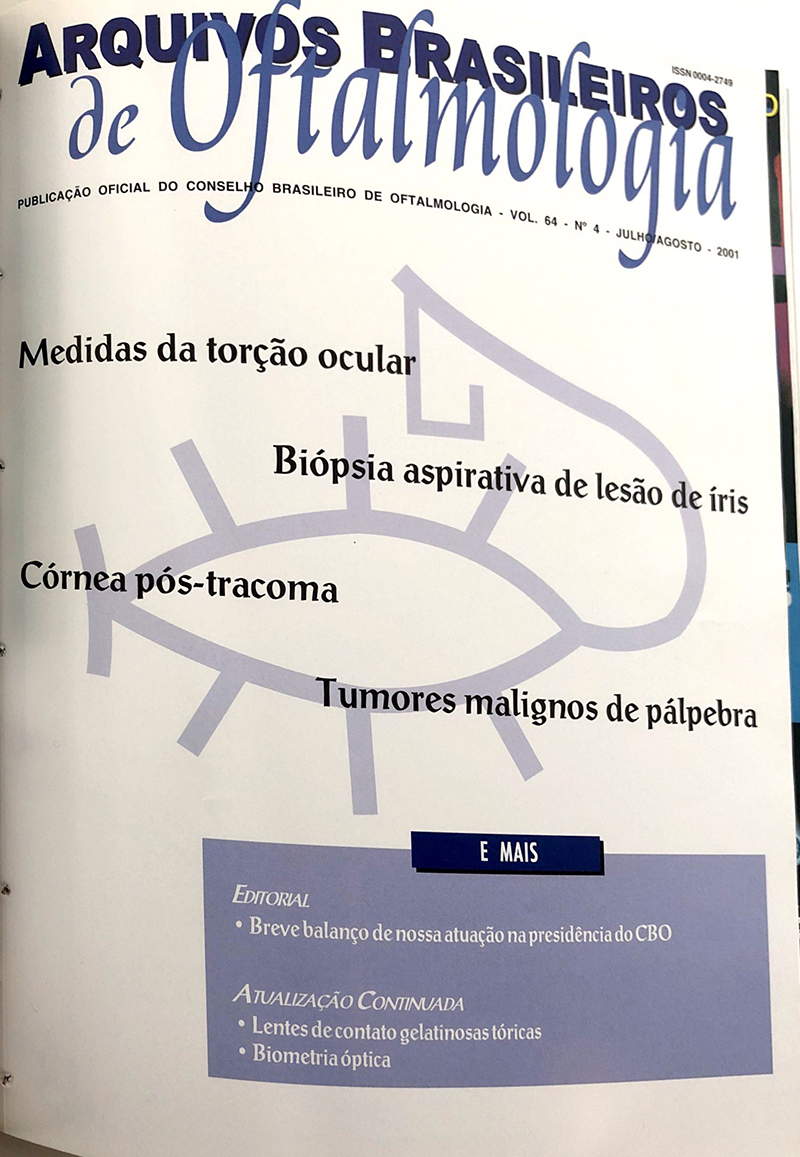
Purpose: To develop a methodology to evaluate ocular torsion reflex.
Methods: Modifications of a Helmholtz keratometer were made in order to perform keratometry in the primary position and during head tilt (30 degrees to the right, 30 degrees to the left). A total of 16 patients (32 eyes) were examined. There was a mean astigmatism of 0.50 to 3.50 (mean 1.18 ± 0.61).
Results: The mean recorded intortions (right eye 5.31 ± 4.23, left eye 5.22 ± 3.91) were slightly lower than the extortions (right eye 7.84 ± 4.79, left eye 7.78 ± 4.09) with no significant difference between both eyes. Conclusions: The modified Helmholtz keratometer allows new and simple method to quantify ocular counterrolling.
Keywords: Astigmatism; Reflex; vestibulo-ocular; Eye movements; Torsion; Diagnostic ophthalmological techniques; Case report
Arq. Bras. Oftalmol. 200164
| DOI: 10.1590/S0004-27492001000400003
Purposes: To study the incidence of eyelid malignant tumors in the Banco de Olhos Hospital of Porto Alegre from 1985 to 1997.
Methods: We retrospectivelly analyzed clinical archives and in this study all cases of malignant eyelid tumors with histopathologic examination were included.
Results: We found 54 eyelid tumors: 75.92% basal cell, 12.96% squamous cell, 7.40% melanoma, 1.85% undifferentiated carcinoma and 1.85% lentigo maligna. The majority of the patients was over 40 years old, 50% were male and 50% female. The diagnosis was confirmed in all cases through histopathologic examination. Conclusions: Basal cell carcinoma was the most frequent eyelid malignancy followed by squamous cell carcinoma. Melanoma was the third most frequently found tumor in our study.
Keywords: Carcinoma; basal cell; Eyelid neoplasms; Carcinoma; squamous cell; Tumor; Incidence
Arq. Bras. Oftalmol. 200164
| DOI: 10.1590/S0004-27492001000400004
Purpose: To describe corneal findings not related to eyelid involvement after trachoma.
Methods: Complete ocular evaluation was performed in 7 patients from the Cornea and External Diseases Clinics of the Escola Paulista de Medicina -Universidade Federal de São Paulo. The selected patients had a previous diagnosis of trachoma with no eyelid deformities, previous entropion repair or trichiasis, but presented corneal opacities.
Results: The most common findings were bilateral corneal opacities in 100% of the cases, corneal thinning in 85.7% of the cases, bilateral superior pannus in 71.4% of the cases and bilateral superior tarsal conjunctiva fibrosis in 85.7% of the cases.
Conclusion: Corneal findings after trachoma may be present different clinical aspects, including opacities, thinning, infectious keratitis, vascularization, ectasy, sensibility decrease and xerosis. If entropion and trichiasis are absent, these findings may result from trachomatous inflamation, interstitial keratitis or forms of treatment performed in the past. Nevertheless their pathophysiology is still controversial.
Keywords: Corneal opacity; Trachoma; Entropion
Arq. Bras. Oftalmol. 200164
| DOI: 10.1590/S0004-27492001000400005
Purpose: The clinical presentation of orbital foreign bodies is variable. The management and prognosis depends on the composition, location and if there is or not secondary infection. Metallic objects and glass are the most frequently encountered and well-tolerated, while organic foreign bodies can elicit an inflammatory reaction and leads to serious complications. It is frequently difficult to identify and localize organic intraorbital foreign bodies, despite modern imaging methods.
Methods: Three patients with intraorbital organic foreign body after penetrating injury were evaluated.
Results: All patients were submitted to removal of the foreign body presenting an improved clinical course. Computed Tomography (CT) was essential for evaluation, identification and localization of the foreign body.
Conclusion: Preoperative identification of the foreign body in the orbit with the use of computed tomography was very helpful for patient management. The removal of the organic foreign body must be performed in order to avoid complications.
Keywords: Eye foreign bodies; Orbit; X-ray computed tomography; Eye injuries; Prognosis; Case report
Arq. Bras. Oftalmol. 200164
| DOI: 10.1590/S0004-27492001000400006
Purpose: To evaluate the prevalence of glaucoma and associated risk factors diagnosed during a glaucoma screening program.
Methods: A screening program for detection of glaucoma was carried out in a major public hospital in São Paulo for one week in August 1997. During this period, 1438 patients with age between 40 and 87 years (average 58.24 ± 10.88) were evaluated regarding glaucoma. The inclusion criterion was age of at least 40 years. The screening examination consisted of a standardized questionnaire, intraocular pressure (IOP) and optic nerve assessment by direct ophthalmoscopy. Patients with: increased intraocular pressure and /or suspicious optic discs were referred to further tests (complete ocular examination, automated visual field test and optic disc stereophotograph). The clinical chart of all patients were reviewed by two experienced observers, using predefined criteria.
Results: A hundred and five patients (7.3%) were identified having glaucoma, 91 of these (86.7%) with primary open angle glaucoma (POAG). Fifty six of the POAG patients (61.5%) had screening IOP below 22 mmHg, and only 7 of these were using ocular hypotensive medications. Other 65 patients (4.5%) had suspicious optic disc appearance, without definitive disc or field damage. 49 patients (3.4%) were classified as ocular hypertensives (intraocular pressure over 21 mmHg with normal disc). Patients with POAG were significantly older than subjects without glaucoma. As expected, the mean IOP was significantly higher in POAG patients than in normal. No significant difference was observed between subjects with diabetes, systemic hypertension, coronary disease, migraine and family history of glaucoma and POAG patients and normals. Conclusions: A high prevalence of glaucoma was observed during this screening program. The majority of newly diagnosed cases had intraocular pressure below 22 mmHg. Older age and elevated intraocular pressure was associated with the presence of primary open angle glaucoma.
Keywords: Open-angle glaucoma; Open-angle glaucoma; Ocular hypertension; Health promotion; Eye health
Arq. Bras. Oftalmol. 200164
| DOI: 10.1590/S0004-27492001000400007
Purpose: To evaluate a twice daily 0.2% brimonidine tartrate effect on retrobulbar circulation with color Doppler in glaucomatous patients.
Methods: Both eyes of sixteen patients with glaucoma were studied. Using a Color Doppler imaging, peak systolic, end diastolic velocity and resistive index was determined in the ophthalmic artery, central retinal artery and temporal short posterior ciliary artery before and after 0.2% brimonidine treatment.
Results: 0.2% brimonidine tartrate significantly improved peak systolic (28.24 to 34.23 cm/seg) and end diastolic velocities (6.72 to 8.10 cm/seg) in the right eye and decreased resistive index (0.75 to 0.71) in the ophthalmic artery of the left eye. Conclusions: A twice daily 0.2% brimonidine tartrate treatment significantly increased peak systolic and end diastolic velocity and reduced resistive index in ophthalmic artery in patients with chronic glaucoma. This effect suggests that brimonidine could benefit glaucoma patients with optic nerve head vascular insufficiency.
Keywords: Optic disk; Glaucoma; Quinoxalines; Color Doppler ultrasonography
Arq. Bras. Oftalmol. 200164
| DOI: 10.1590/S0004-27492001000400008
Purpose: To evaluate changes in refraction and corneal curvature following surgery for correction of acquired esotropia.
Methods: 42 eyes of 21 patients with acquired moderate angle esotropia without any other form of strabismus were prospectively enrolled and submitted to a complete ophthalmological examination followed by recess/resect procedure in a single eye. Data from the fellow eye were selected as control. Ophthalmological assessment was carried out preoperatively, 1 month after surgery and 6 months after surgery, where astigmatism was compared using vector analysis and the polar value concept.
Results: The eyes submitted to surgery revealed a significant (p<0.05) decrease in spherical equivalent, from 3.28 ± 1.98 diopters to 3.05 ± 1.95 diopters. Refraction data disclosed a significant increase in the 90° component of net astigmatism, from 0.458 ± 0.594 diopters to 1.002 ± 0.718 diopters, which was also observed in keratometric readings:1.083 ± 0.560 diopters to 1.690 ± 0.591 diopters. Surgically induced astigmatism, assessed using refraction data was 0.63 ± 0.27 diopters at an average axis of 92.30 ± 14.91 degrees, and 0.71 ± 0.27 diopters at an average axis of 94.45 ± 15.69 degrees as obtained by keratometric readings. This is visually demonstrated by the corneal topography difference map. Conclusions: There is a statistically significant and clinically relevant increase in with-the-rule astigmatism in esotropic patients submitted to monocular recess/resect surgery. This change is stable at a 6 month follow-up and is associated with a decrease in mean spherical equivalent.
Keywords: Esotropia; Ocular refraction; Strabismus; Astigmatism; Operative surgery procedures
Arq. Bras. Oftalmol. 200164
| DOI: 10.1590/S0004-27492001000400009
Purpose: To analyze the effect of weakening of the superior oblique muscle (HOS) with anterior transposition of the inferior oblique muscle in patients with dissociated vertical deviation (DVD) associated with overaction of superior oblique muscle.
Methods: In 14 patients we analyzed the correction of dissociated vertical deviation, the reduction of the superior oblique overaction, and the reduction of the A pattern. Twenty-eight eyes were submitted to anterior transposition of the inferior oblique, and tenectomy of the superior oblique muscle.
Results: The correction of dissociated vertical deviation was 65.5% in right eye (RE) and 61.3% in left eye (LE). The reduction in the superior oblique overaction was 81.8% in and right eye 85.0% in left eye. The A pattern was reduced in 92.2%. All these values were statistically significant (p<0.01). Conclusions: The proposed surgery is effective in the correction of dissociated vertical deviation and overacting superior oblique muscle.
Keywords: Exotropia; Anisotropy; Anisometropia; Oculomotor muscles; Eye movements
Arq. Bras. Oftalmol. 200164
| DOI: 10.1590/S0004-27492001000400010
Purpose: To determine the growth of P. aeruginosa and S. aureus in liquid perfluoroctane (PFO).
Methods: Three culture media were used: PFO, soy and casein digestion broth and 0.9% saline solution. Five ml PFO were distributed to 1 ml flasks. Flasks 1 and 2 were inoculated with 1 entire colony of P. aeruginosa and flasks 3 and 4 were inoculated with the same amount of S. aureus. Flask 5 served as control without any contamination. One colony of each bacterium was also inoculated in 1 ml of the remaining culture media. All solutions were kept in an incubator at 37º C for 10 days. The cultures were replated under a laminar flow hood using a calibrated 1:1000 loop at times zero, 72 h, 168 h and 240 h after contamination. Bacterial growth was determined by counting the colonies on blood agar plates 24 hours after each replating.
Results: Time zero demonstrated bacterial growth in all media, confirming inoculation. During the subsequent hours no further growth of these microorganisms was observed in PFO. Both bacteria developed abundantly in the remaining culture media at all times studied. The control flask did not show any bacterial growth. Conclusions: The results show that PFO does not represent a favorable medium for bacterial growth.
Keywords: Bacterial growth; Fluorocarbons; Ocular bacterial contamination; Pseudomonas aeruginosa; Staphylococcus aureus
Arq. Bras. Oftalmol. 200164
| DOI: 10.1590/S0004-27492001000400011
Purpose: To describe the use of anterior capsule staining in cataracts without red reflex using a 0.025% trypan blue solution.
Methods: Six eyes of 6 patients with cataracts without red reflex were submitted to phacoemulsification using a direct injection of 0.2 to 0.5 ml of 0.025% trypan blue in the anterior chamber previous to viscoelastic injection. All patients had an ophthalmologic examination prior to surgery, as well as pre and postoperative corneal endothelial cell count.
Results: In all cases the capsule became stained with a faint blue color that enabled an adequate visibility of the flap during the continuous curvilinear anterior capsulotomy (CCC). There were no intra-or postoperative complications. The endothelial cell loss varied between 1.8% and 26.6% (mean 12.8%).
Conclusion: Staining the anterior capsule with 0.025% trypan blue solution allows a good visibility of the capsular flap and facilitates the confection of CCC in cataracts without red reflex.
Keywords: Cataract; Cataract extraction; Lens capsule; Crystalline; Trypan blue; Dyes
Arq. Bras. Oftalmol. 200164
| DOI: 10.1590/S0004-27492001000400012
Purpose: to analyze the diagnostic power of the GDx™ Scanning Laser System in primary open angle glaucoma (POAG) and glaucoma suspects.
Methods: 77 POAG patients (142 eyes) with characteristic visual field loss, 40 normal subjects and 36 glaucoma suspects (72 eyes) with intraocular pressure (IOP) above 20 and below 25 mmHg with normal visual fields were submitted to GDx™ Scanning Laser System examinations. Sensitivity, specificity, likelihood ratio and pre- and post-test probabilities were calculated.
Results: Considering abnormal the presence of at least one parameter out of normal limits, 82.5% specificity and 90.1% of sensitivity between glaucomatous and normals were found. Likelihood ratio was 5.1 and pre-test and post-test probabilities were 63.9% and 90% respectively. Between suspects and normals specificity was 82.5% and sensitivity 33.3%. Likelihood ratio was 1.9 and pretest and post-test probabilities were 8.5% and 15% respectively.
Conclusion: The GDx™ Scanning Laser System presented significant diagnostic power to differentiate glaucomatous from normal eyes. The examination showed low performance to differentiate glaucoma suspects from normals.
Keywords: Nerve fibers; Retina; Glaucoma; Glaucoma; open angle; Sensibility and specificity; Diagnostic techniques; ophthalmological
Arq. Bras. Oftalmol. 200164
| DOI: 10.1590/S0004-27492001000400013
Purpose: To analyze the effects of 100 mg of sildenafil citrate (Viagra®) on the retrobulbar circulation and visual field.
Methods: A double masked, placebo controlled study was conducted in 10 males with a mean age of 27.7 + 5.68 years. The right eye of each volunteer underwent orbital color Doppler imaging and automated perimetry (Humphrey, program 30-2, Full-Threshold Strategy) at 3 occasions: baseline, 1 hour after placebo and 1 hour after 100 mg of sildenafil. The foveal threshold and the mean deviation (MD) were analyzed by automated perimetry on the three occasions. Color Doppler imaging allowed the measurement of the peak systolic velocity (PSV), end diastolic velocity (EDV) and Pourcelot index (PI) in the central retinal artery and ophthalmic artery.
Results: The foveal threshold and the mean deviation did not show a significant change following the administration of sildenafil. The ophthalmic artery peak systolic velocity and end diastolic velocity significantly increased after the administration of sildenafil (p<0.001). The hemodynamic parameters in the central retinal artery and the ophthalmic artery PI did not significantly change. Conclusions: Sildefanil citrate increased the blood flow velocities in the ophthalmic artery in normal subjects, with no significant changes in the foveal threshold and mean deviation in the automated perimetry.
Keywords: Retinal artery; Visual fields; Piperazines; Blood flow velocity; Color ultrasonography Doppler; Fovea centralis; Single dose; Double-blind method
Arq. Bras. Oftalmol. 200164
| DOI: 10.1590/S0004-27492001000400014
To report the case of a patient who presented with a solid anterior segment intraocular mass in his right eye, and the diagnostic investigation chosen by the authors. Diagnostic uncertainty and patient's refusal to agree with the treatment caused the authors to perform a fine needle aspiration biopsy of the lesion. Biopsy was performed by corneal puncture, through the aqueous and the tumor. Cytology of the specimen obtained by the biopsy determined the therapeutic strategy for this case. Cytology diagnosis was consistent with primary malignant melanoma of the choroid of mixed cell type. Enucleation of the eye was suggested due to the position of the tumor and its potential to spread distant metastases. After enucleation, anatomopathological examination of the eye presented a similar result to cytology. The patient is currently been followed, with no signs of metastasis 2 years after enucleation.
Keywords: Choroid neoplasms; Melanoma; Needle biopsy; Eye enucleation
Arq. Bras. Oftalmol. 200164
| DOI: 10.1590/S0004-27492001000400015
Purpose: To demonstrate the importance of clinical history and general physical examination in orbital affections as guides for correction of and early diagnosis allowing adequate treatment.
Methods: Clinical history, ophthalmologic and general physical examination and complementary examinations: Chest X-ray, pelvic and abdominal ultrasonography, orbital computerized tomography; fine needle aspiration biopsy of tumor, orbitary procedures, excisional biopsy of sternal nodule and retrospective cytologic, histologic and imunohistochenical examinations.
Results: Pelvic ultrasonography demonstrated the presence of a large tumor in anexus, probably the primary focus. In the chest X-ray there is evidence of metastatic mass. The histopathological findings of both retrobulbar mass and sternal nodule were compatible with undifferentiated malignant neoplasm. Conclusions: This paper reports the importance of clinical history and general physical examination in the orbital affections guiding the physician to correct diagnosis and apply adequate treatment in a case in which the patient presenting multiple metastases, the ophthalmologic signs were the ones that led him to medical visit.
Keywords: Ovarian neoplasms; Lung neoplasms; Orbital neoplasms; Carcinoma; Unknown primary neoplasms; Needle biopsy; X-ray computed tomography; Biological tumor markers; Case report
Arq. Bras. Oftalmol. 200164
| DOI: 10.1590/S0004-27492001000400016
The authors present a case of a child with organoid nevus syndrome, characterized by epibulbar choristoma in the right eye, Jadassohn's nevus sebaceous in the scalp and arachnoid cist. The pathology of the ocular lesion revealed a mixture of ectodermal and mesodermal elements, leding to the rare diagnosis of epibulbar complex choristoma.The syndrome is rarely described in the ophthalmologic literature. Some considerations are made regarding ophthalmologic and systemic associations.
Keywords: Nevus; Hamartoma; Choristoma; Neurocutaneous syndromes; Eye neoplasms; Organoids; Case report; Child


 ABO is licensed under a Creative Commons Attribution-NonComercial 4.0 Internacional.