Arq. Bras. Oftalmol. 2022;85 (6 )
:549-557
| DOI: 10.5935/0004-2749.202200100
Abstract
Objetivo: Estimar a prevalência e os fatores de risco para os sintomas e o diagnóstico clínico da doença do olho seco na cidade de São Paulo, estado de São Paulo, Brasil.
Métodos: Quinhentos e oitenta e dois participantes acima de 18 anos, residentes na zona leste da cidade de São Paulo responderam a um questionário de três perguntas sobre olho seco. A doença do olho seco foi definida pela presença de sintomas severos ou diagnóstico clínico prévio de doença do olho seco por um oftalmologista. A associação entre doença do olho seco e possíveis fatores de risco foi avaliada.
Resultados: A prevalência de sintomas graves da doença do olho seco e/ou diagnóstico clínico foi calculada em 24,4% para ambos os sexos. O sexo feminino apresentou uma frequência maior de sintomas severos da doença do olho seco (16,07%) que o sexo masculino (8,48%; p=0,0244), assim como a associação de sintomas severos ou diagnóstico de doença do olho seco, foi de 26,86% no sexo feminino e 18,18% no sexo masculino (p=0,0366). No sexo feminino, a faixa etária entre 55 e 75 anos de idade foi associada com sintomas severos da DOS (odds ratios (OR) = 3,11; IC 95% 1,56-6,23; p=0,001) e com doença do olho seco diagnosticada (OR=2,02; IC 95% 1,04-3,93; p=0,037). Hipertensão foi associado com sintomas da doença do olho seco (OR=1,98; IC 95% 1,14-3,43; p=0,015) e diagnóstico da doença do olho seco (OR=3,54; IC 95% 1,92-6,53; p=0,001) no sexo feminino. Uso de colírios foi associado a sintomas severos e diagnóstico da doença do olho seco em ambos os sexos (p≤0,01).
Conclusão: A prevalência da doença do olho seco na cidade de São Paulo é mais frequente no sexo feminino que no masculino. Idade e hipertensão foram fatores de risco maiores para doença do olho seco no sexo feminino, enquanto uso de colírios foi um indicador de doença do olho seco para ambos os sexos.
Keywords: Síndromes do olho seco; Superfície ocular; Questionários e inquéritos
Arq. Bras. Oftalmol. 2025;88 (6 )
:1-8
| DOI: 10.5935/0004-2749.2024-0355
Abstract
PURPOSE: To analyze the quality of life and treatment adherence of patients with glaucoma at different disease stages, considering factors such as sex, visual acuity, disease severity, and treatment characteristics.
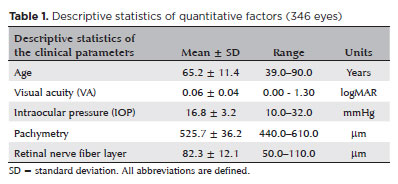
METHODS: This cross-sectional study included 174 patients (346 glaucomatous eyes) recruited from clinical records and routine follow-ups at a specialized ophthalmology center. Their mean age was 39–90 years, and 60.9% of them were women. Their quality of life and adherence were assessed using the NEI-VFQ25 and MMAS-8 questionnaires, respectively. Complementary tests included 24:2 visual field test, retinography, and optical coherence tomography. Patients diagnosed with glaucoma for at least 6 months were included, whereas pregnant patients and those with ocular diseases were excluded.
RESULTS: Among the participants, 59.2% adhered to the treatment whereas 40.8% showed low adherence. The mean quality of life score was 81.87. Patients with low adherence had slightly higher quality of life scores (mean 83.1) than those with good adherence (mean 81.0), but the difference was not statistically significant. Disease severity was associated with increased optic nerve cupping, reduced thickness of the nerve fiber and ganglion cell layers, and great visual field loss. No significant correlation was observed between adherence and quality of life, indicating the independence of these factors and the influence of psychological or social elements.
CONCLUSION: The absence of a correlation between quality of life and treatment adherence highlights the need for tailored interventions for psychological and social aspects. These findings indicate the importance of a comprehensive approach to managing glaucoma, preserving visual function, strengthening doctor–patient relationships, and considering psychosocial factors to enhance quality of life and treatment adherence.
Keywords: Glaucoma; Quality of life; Patient health questionnaire; Patient acuity; Antiglaucoma agents; Visual acuity; Treatment adherence and compliance; Surveys and questionnaires
Arq. Bras. Oftalmol. 2023;86 (6 )
:1-8
| DOI: 10.5935/0004-2749.2021-0105
Abstract
Objetivo: Avaliar a prática e tratamento da ptose da pálpebra superior por membros das sociedades latino-americanas e espanhola de Cirurgia Plástica Ocular.
Métodos: Os membros das referidas sociedades foram convidados por e-mail para responder a um questionário eletrônico garantindo o anonimato. O questionário constou de dados demográficos do cirurgião e outras quatro seções: avaliação pré-operatória da ptose da pálpebra superior, preferências cirúrgicas, conduta pós-operatória e complicações. Estatística descritiva foi utilizada para análise da frequência e proporções percentuais.
Resultados: Trezentos e cinquenta e quatro experientes cirurgiões oculoplásticos dos quais 47,7% realizam mais de 20 cirurgias de ptose da pálpebra superior por ano responderam ao questionário. Na avaliação pré-operatória, 68,9% realizam testes para olho seco, mas o teste da fenilefrina é feito por menos da metade dos entrevistados (47,4%). A ptose da pálpebra superior leve geralmente é corrigida por conjuntivo-mullerectomia (43,6%), a ptose da pálpebra superior grave por cirurgia do músculo frontal (57%) ou ressecção da aponeurose do levantador via anterior, principalmente usando a supramáxima (17,5%). O principal motivo para operar a ptose congênita grave é o risco de ambliopia (37,3%). A ptose involucional associada à dermatocálase costuma ser corrigida pela via anterior (63,3%). Hipocorreção é complicação comum após a ressecção da aponeurose do levantador (40%) ou suspensão ao frontal (27,5%).
Conclusões: As práticas atuais dos cirurgiões oculoplásticos espanhóis e latino-americanos para diagnóstico e tratamento de ptose da pálpebra superior foram relatadas. Os dados apresentados podem ser usados para comparar a abordagem dos cirurgiões com a de seus pares.
Keywords: Blefaroptose/diagnóstico; Ambliopia; Fenillefrina; Inquéritos e questionários; Demografia; Cirurgiões.
Arq. Bras. Oftalmol. 2025;88 (6 )
:1-4
| DOI: 10.5935/0004-2749.2025-0033
Abstract
PURPOSE: In Brazil, it has traditionally been standard practice to teach a wide range of surgical techniques to all ophthalmology residents, with the aim of equipping them to manage most ocular conditions. However, with modern developments, access to subspecialists has expanded to nearly the entire country. This raises the question of whether it is still necessary to teach numerous surgical techniques to every resident. This study evaluates the effectiveness of surgical training in Brazilian ophthalmology residency programs to determine if comprehensive surgical training for all residents is truly effective, thereby providing evidence to inform educational policy decisions.
METHODS: A cross-sectional study using a questionnaire distributed to physicians engaged in eye care.
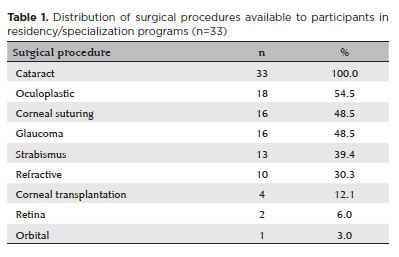
RESULTS: A total of 137 physicians responded to the survey, with 104 (76.0%) having already completed their specialization. The findings indicate that most practicing ophthalmologists received surgical training during residency in cataract, glaucoma, oculoplastic, and strabismus surgeries. Nonetheless, many of these specialists no longer perform most of these surgeries in practice, except for cataract surgery. While 53.8% of those who completed residency reported satisfaction with their training, 35.6% indicated that they wished they had received better surgical preparation.
CONCLUSION: The training of ophthalmology specialists must be made more efficient. Training efficiency is reduced when time and resources are devoted to surgical procedures that many specialists will not perform in their careers.
Keywords: Opthalmologists; Teaching; Education, medical; Ophthalmological surgical procedures; Simulation training; Wet lab; Surveys and questionnaires
Arq. Bras. Oftalmol. 2026;89 (1 )
:1-8
| DOI: 10.5935/0004-2749.2025-0109
Abstract
PURPOSE: To evaluate the preferred surgical practice patterns for glaucoma among members of the Latin American Glaucoma Society.
METHODS: A cross-sectional study was conducted using an electronic survey distributed in July 2023 via email to members of the Latin American Glaucoma Society. The questionnaire comprised four sections addressing the specialists' profiles, preferred surgical procedures for open-angle glaucoma, and choices in 10 different clinical scenarios, including congenital glaucoma.
RESULTS: Of the 63 members, 49 physicians (77.7%) responded – 13 women and 36 men – from nine Latin American countries. Thirty-one respondents (63.26%) had more than 20 yr of professional experience. For the surgical management of open-angle glaucoma, trabeculectomy was the most preferred procedure (48 physicians), followed closely by glaucoma drainage devices (47 physicians) and minimally invasive glaucoma surgery (29 physicians). Across the 10 clinical scenarios, glaucoma drainage devices were selected most frequently (203 preferences), followed by trabeculectomy (118), ciliary body laser procedures (107), and minimally invasive glaucoma surgery (40). However, minimally invasive glaucoma surgery was the preferred option for primary open-angle glaucoma with mild-to-moderate cataracts.
CONCLUSION: Among specialists of the Latin American Glaucoma Society, trabeculectomy and glaucoma drainage devices remain the most commonly performed surgical procedures. Minimally invasive glaucoma surgery is primarily used in combination with cataract surgery, while ciliary body laser procedures are generally reserved for cases of previous glaucoma drainage device failure or as an initial option for newly diagnosed glaucoma cases.
Keywords: Glaucoma; Ophthalmologic surgical procedures; Latin America; Practice patterns, physicians; Surveys and questionnaires
Arq. Bras. Oftalmol. 2024;87 (3 )
:1-5
| DOI: 10.5935/0004-2749.2022-0197
Abstract
OJETIVOS: O olho seco é uma doença multifatorial, muito comum na prática clínica oftalmológica. A utilização de questionários validados de sintomas de olho seco permite rastrear de maneira mais objetiva essa doença na população geral, avaliar a prevalência dos sintomas e frequência de diagnóstico, permitindo o tratamento precoce e adequado dessa condição. O 5-Item Dry Eye Questionnaire (DEQ-5) é um questionário em inglês que avalia a frequência e a intensidade do desconforto e ressecamento ocular e a frequência do lacrimejamento, já validado no inglês e espanhol, porém não no português até o presente momento. O objetivo deste estudo foi traduzir e validar o questionário DEQ-5 para a língua portuguesa.
MÉTODOS: Foi utilizado o questionário DEQ-5, composto por 5 perguntas simples e diretas - 2 relacionadas ao desconforto ocular, 2 ao ressecamento ocular e 1 ao lacrimejamento. Foi realizada a tradução inicial da versão em inglês para o português por dois tradutores de língua materna portuguesa, seguido de uma avaliação e compilação de uma versão única por um comitê interdisciplinar das versões traduzidas. Em seguida, tal versão foi traduzida de volta para o inglês por 2 indivíduos que possuíam o inglês como primeira língua, seguido de avaliação e comparação com a versão original em língua inglesa pelo mesmo comitê interdisciplinar. Após, a versão final do questionário foi aplicada em 31 voluntários em dois momentos diferentes.
RESULTADOS: A confiabilidade interobservador das 5 perguntas variou de 0,584-0,813 e a correlação de Pearson de 0.755-0.935, sendo o p-valor <0,0001 em todas elas. A consistência interna foi α=0,887. Todas as perguntas apresentaram concordância de moderada a alta.
CONCLUSÕES: A análise estatística dos dados coletados encontrou ótimos índices de concordância - moderada a alta para todas as questões analisadas -, permitindo o uso do DEQ-5 na língua portuguesa em pesquisas e também como forma de triagem para doença de olho seco e acompanhamento dos sintomas.
Keywords: Síndromes do olho seco; Técnicas de diagnóstico oftalmológico; Inquéritos e questionários; Traduções
Arq. Bras. Oftalmol. 2025;88 (2 )
:1-7
| DOI: 10.5935/0004-2749.2023-0317
Abstract
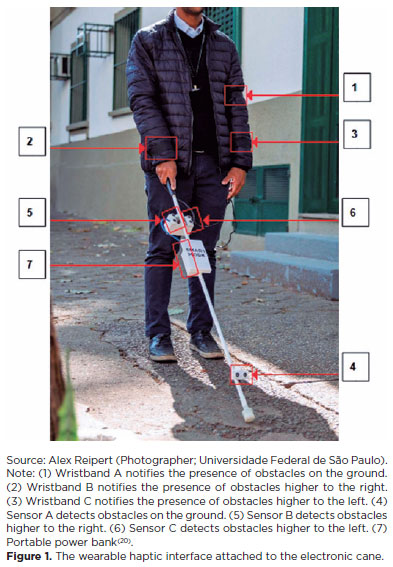
PURPOSE: This study aimed to evaluate the perception and degree of satisfaction of blind individuals regarding an electronic cane prototype with a wearable haptic interface.
METHODS: Two scenarios with different obstacles were created to conduct tests with the canes (the user's cane and the prototype one). The perception and satisfaction of participants regarding the electronic cane were assessed using a questionnaire, the number of collisions during the tests, and the time each individual took to complete the course in each scenario.
RESULTS: Ten blind individuals who used the white cane participated in this study. Eight were males, and two were females. Their age ranged from 23 to 43 (average 32.3 ± 7.13 years and median 32 years). There was a tendency for fewer collisions with ground obstacles when the electronic cane was used than when the white cane was used. However, there was no statistically significant difference between the number of collisions and the course completion time in each scenario with either canes tested.
CONCLUSION: Overall, the perception and satisfaction of individuals regarding the prototype used were positive.
Keywords: Blindness; Canes; Patient satisfaction; Perception; Haptic technology; Wearable electronic devices; Surveys and questionnaires
Arq. Bras. Oftalmol. 2024;87 (3 )
:1-5
| DOI: 10.5935/0004-2749.2022-0198
Abstract
OBJETIVO: Associar os resultados refrativos a longo prazo da cirurgia de catarata e a função visual autorreferida pelo questionário Catquest-9SF.
MÉTODOS: Paciente recrutados no ambulatório de catarata da VER MAIS Oftalmologia, foram submetidos a exame oftalmológico completo. Após diagnóstico de catarata com indicação de tratamento cirúrgico com facoemulsificação e implante de lente intraocular, o questionário foi aplicado antes da intervenção, 30 dias após cirurgia e 1 ano após, novamente.
RESULTADOS: Foram recrutados 133 pacientes. No decorrer do seguimento, 32 pacientes foram perdidos e ao final foram analisados os dados de 101 pacientes, dos quais 48 foram homens e 53 foram mulheres. A variância bruta explicada por dados foi de 69,9% e a inexplicada em primeiro contraste por 2,39 eigenvalores, sendo maior que 2, o que nos mostra que são resultados diferentes dos esperados de dados aleatórios. O índice de separação de pessoas foi de 2.95 (>2) e o valor de confiança de pessoas foi de 0,9 (>0,8). Estes índices são os valores mínimos aceitáveis na diferenciação de níveis de habilidade. Acuidade visual foi a principal variável correlacionada com o score do Catquest.
CONCLUSÕES: O Catquest-9SF traduzido para o português se demonstrou unidimensional e uma ferramenta psicometricamente válida para avaliar disfunção visual em pacientes com catarata, além de ter tido sucesso para quantificar objetivamente melhoras após a intervenção cirúrgica. Essa ferramenta pode ser utilizada como preditiva e concordante da melhora da acuidade visual.
Keywords: Extração de catarata; Acuidade visual; Inquéritos e questionários; Qualidade de vida; Medidas de resultados relatados pelo paciente
Arq. Bras. Oftalmol. 2025;88 (3 )
:1-6
| DOI: 10.5935/0004-2749.2024-0144
Abstract
PURPOSE: To evaluate the current scenario of rehabilitation services for people with retinal diseases in Brazil.
METHODS: An exploratory study was conducted between February 2023 and June 2023 using a Google Forms questionnaire that was distributed by patient associations.
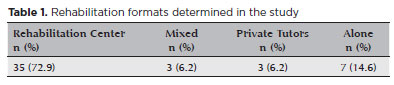
RESULTS: A total of 142 patients, aged 18-80 were included in the study. Forty-eight participants (33.8%) were undergoing rehabilitation, while 94 (66.2%) were not. The main reason for not undergoing rehabilitation was a lack of knowledge about the service (n=41, 43.6%). Healthcare professionals made the most referrals (n=20, 41.7%). Rehabilitation improved the quality of life in 38 (80.9%) participants, and 28 (62.2%) participants were satisfied with the process. There was a statistically significant disparity between patient satisfaction and the locale of rehabilitation implementation. Twenty-three (69.7%) participants who underwent rehabilitation at a specialized center reported satisfaction.
CONCLUSION: The rehabilitation process directly increases the quality of life of individuals with retinal diseases. However, despite the availability of rehabilitation centers in large parts of Brazil, most patients with retinal diseases are not acquainted with the rehabilitation process and do not receive referrals for it. Thus, healthcare providers should increase referrals to rehabilitation centers, and public policies should be formulated to raise awareness among the population regarding the availability of rehabilitation services.
Keywords: Rehabilitation; Quality of life; Retinal diseases; Personal satisfaction; Patient care team; Public policy; Surveys and questionnaires; Brazil
Arq. Bras. Oftalmol. 2024;87 (5 )
:1-5
| DOI: 10.5935/0004-2749.2023-0343
Abstract
PURPOSE: To determine and analyze the usability metrics of a free mobile learning app for ophthalmology in Brazil.
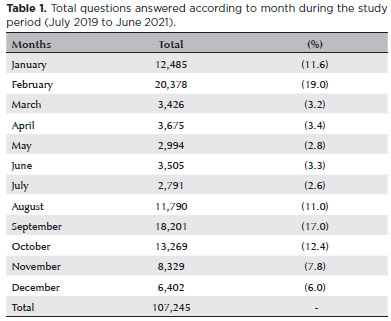
METHODS: Metric data from the management dashboard of the CBOQUIZ app were used. All users registered on the platform between March 2019 and June 30, 2021 were included. The number of questions answered, number of correct answers, number of questions answered and correct answers by subject area, and user performance by geographic region were analyzed.
RESULTS: There were 458 active users during the research period and 107,245 questions answered (average, 234.16 questions per user). Of the questions answered, 81,600 (75.5%) were correct and 2,645 were incorrect. The states in Brazil with the best performance were Espírito Santo, Paraiba, and Paraná. The subject area with the lowest hit rate was basic sciences (69.1%), within which embryology demonstrated the lowest hit rate (58.28%). The posterior segment had the highest number of questions answered, followed by miscellaneous topics and the anterior segment. Questions on strabismus were the least answered.
CONCLUSION: The app was used consistently throughout the period studied, and participants adhered to this teaching modality. Performance asymmetry was observed across the Brazil states. The CBOQUIZ app can be used to homogenize ophthalmology teaching in the country.
Keywords: Ophthalmology; Mobile applications; Teaching; Smartphone; Education, distance; Internship and residency; Brazil
Arq. Bras. Oftalmol. 2025;88 (5 )
:1-7
| DOI: 10.5935/0004-2749.2024-0368
Abstract
PURPOSE: To compare endothelial corneal cell changes following cataract surgery performed by phacoemulsification with intraocular lens implantation, conducted by surgeons with varying levels of experience.
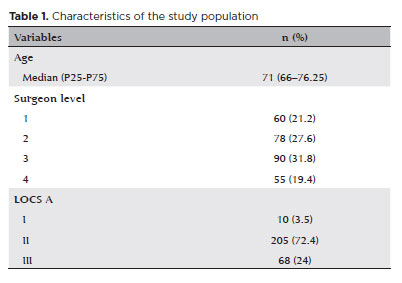
METHODS: Two hundred and eighty-three eyes diagnosed with cataract were included. Lens opacity was classified into three categories (I, II, and III). Surgeons were categorized into four experience levels (1, 2, 3, and 4), based on years of practice and lifetime surgeries performed. Corneal endothelial characteristics were assessed using non-contact specular microscopy, with measurements taken before surgery and 30-60 days post-surgery.
RESULTS: Pre- and postoperative endothelial analysis showed no significant differences between surgeon levels regarding visual acuity achieved, corneal thickness, and endothelial hexagonality. However, the central endothelial cell density index showed a significantly greater reduction among level 1 surgeons (p=0.026). Grade II cataracts exhibited significant variations in the central endothelial cell density (p=0.011) and average cell size, with level 1 surgeons showing the largest increases (p=0.024).
CONCLUSIONS: The analysis revealed significant differences in visual acuity and endothelial indices between surgeon experience levels, with less experienced surgeons showing greater variations and poorer performance. Clinical protocols should consider these data to establish safer training protocols.
Keywords: Cataract extraction; Phacoemulsification; Endothelium; corneal; Lens implantation, intraocular; Visual acuity; Internship and residency; Surgeons
Arq. Bras. Oftalmol. 2024;87 (3 )
:1-5
| DOI: 10.5935/0004-2749.2023-0038
Abstract
PURPOSE: To assess the effect of the coronavirus disease 2019 (COVID-19) pandemic on cataract surgery by residents who had mandatory surgical simulator training during residency.
METHODS: In this retrospective, observational analytical study, the total number of cataract surgeries and surgical complications by all senior residents of 2019 (2019 class; prepandemic) and 2020 (2020 class; affected by the reduced number of elective surgeries due to the COVID-19 pandemic) were collected and compared. All residents had routine mandatory cataract surgery training on a virtual surgical simulator during residency. The total score obtained by these residents on cataract challenges of the surgical simulator was also evaluated.
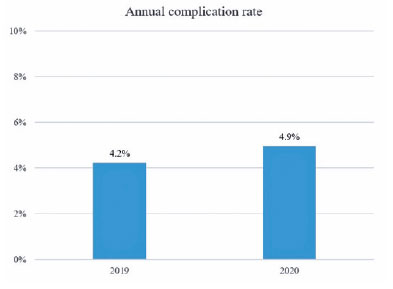
RESULTS: The 2020 and 2019 classes performed 1275 and 2561 cataract surgeries, respectively. This revealed a reduction of 50.2% in the total number of procedures performed by the 2020 class because of the pandemic. The incidence of surgical complications was not statistically different between the two groups (4.2% in the 2019 class and 4.9% in the 2020 class; p=0.314). Both groups also did not differ in their mean scores on the simulator’s cataract challenges (p<0.696).
CONCLUSION: Despite the reduction of 50.2% in the total number of cataract surgeries performed by senior residents of 2020 during the COVID-19 pandemic, the incidence of surgical complications did not increase. This suggests that surgical simulator training during residency mitigated the negative effects of the reduced surgical volume during the pandemic.
Keywords: COVID-19; Pandemics; Cataract extraction/education; Internship and residency/methods; Simulation training/methods; Phacoemulsification/education; Surgery, computer-assisted; Computer simulation; Clinical competence; Ophthalmology/education
Arq. Bras. Oftalmol. 2024;87 (2 )
:1-12
| DOI: 10.5935/0004-2749.2022-0015
Abstract
OBJETIVOS: Traduzir e validar para o português um questionário para avaliar o conhecimento teórico no exame de fundo de olho.
MÉTODOS: Um questionário de múltipla escolha de 60 questões em inglês, ao qual avalia diversos aspetos do conhecimento no exame de fundo de olho, foi traduzido para o português. O processo envolveu uma tradução, re-tradução e avaliação por um comitê de especialistas. O questionário resultante foi aplicado em estudantes de medicina do último ano e médicos-residentes em oftalmologia. Cada indivíduo respondeu o questionário duas vezes, com um intervalo de uma semana entre cada aplicação. A consistência interna, a confiança teste-reteste, a confiança entre avaliadores e a porcentagem de concordâncias foram calculadas.
RESULTADOS: Trinta participantes foram incluídos (25 estudantes de medicina e 5 residentes em oftalmologia). A nota de corte para aprovação-reprovação foi calculada em 46, sendo os falsos positivos teóricos de 8,7% e os falsos negativos teóricos 2,8%. No mesmo corte, os falsos positivos e falsos negativos observados foi de 0%. Dentre os 60 itens, a confiança teste-reteste foi forte em 17 itens, sendo que um apresentou uma correlação negativa, moderada em 14 itens, sendo que um apresentou uma correlação negativa, e fraca em 29 itens; a confiança inter-examinador foi inferior a 0,4 em 34 itens, entre 0,4 e 0,6 em 17 itens, e acima de 0,6 em 8 itens. Um dos itens apresentou um valor negativo. A porcentagem de concordância foi entre 40-60% em 10 itens, superior a 60% em 50 itens e acima de 80% em 18 itens. O alfa de Crombach foi calculado com 0,674.
CONCLUSÕES: O questionário traduzido propicia um instrumento padronizado para futuras pesquisas e intervenções às quais visem aprimorar o ensino em oftalmologia.
Keywords: Inquéritos e questionários; Tradução; Fundo de olho


 ABO is licensed under a Creative Commons Attribution-NonComercial 4.0 Internacional.


15-tab01.jpg)
09-fig01tb.jpg)
09-fig01.jpg)
11-tab01.jpg)
11-tab01.jpg)
15-fig01.jpg)