Arq. Bras. Oftalmol. 2026;89 (2 )
:1-9
| DOI: 10.5935/0004-2749.2025-0192
Abstract
PURPOSE: This study aimed to identify the strategies adopted by Brazilian ophthalmologists to control myopia in clinical practice.
METHODS: This was a prospective cross-sectional study. Data were collected using an online questionnaire.
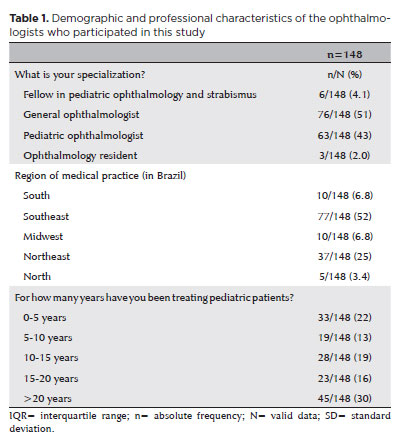
RESULTS: Responses from 148 participants were collected between March and May 2024. The majority of respondents were general ophthalmologists (51%) and pediatric ophthalmologists (43%). They came from all regions of Brazil, but more than half (52%) were from the Southeast region. Most participants (30%) had over 20 years of clinical practice experience. A significant proportion (89.2%) treated progressive myopia. The most requested complementary exams were optical biometry (83.78%) and corneal topography or tomography (69.59%). Behavioral measures were considered the most effective myopia treatment strategies by 41.2% of the respondents, followed by optical (33.8%) and pharmacological interventions (25%). Most recommended spending more time outdoors (94.59%) and reducing screen time (93.92%). Spectacle lenses for myopia (83.11%) and 0.025% atropine eye drops (54.73%) were the most prescribed treatments after the recommendation of environmental and behavioral changes.
CONCLUSION: This study presents a novel analysis of the clinical strategies for myopia control among Brazilian ophthalmologists. Understanding current clinical practices and identifying possible improvements are essential steps toward developing evidence-based guidelines and professional education aimed at improving patient care.
Keywords: Myopia/epidemiology; Refractive errors; Contact lenses; Myopia/drug therapy; Atropine/therapeutic use; Ophthalmologists; Practice patterns, physicians’; Surveys and questionnaires; Brazil/epidemiology
Arq. Bras. Oftalmol. 2021;84 (1 )
:31-36
| DOI: 10.5935/0004-2749.20210006
Abstract
Objetivo: Avaliar a prevalência de transtornos de depressão e ansiedade em pacientes com glaucoma e identificar fatores de riscos associados.
Métodos: Estudo transversal em pacientes com glaucoma, avaliados durante Agosto de 2016 e Agosto de 2017 no Hospital das Clínicas da Universidade de Campinas e no Hospital Oftalmológico de Brasília. Todos pacientes foram submetidos à exame oftalmológico completo para confirmar o diagnóstico de glaucoma. Todos pacientes preencheram o questionário “Hospital Anxiety and Depression Scale”.
Resultados: Foram incluídos 129 pacientes no estudo, sendo 74 homens (57.36%) e 55 (42.64%) mulheres, 90 pacientes eram brancos (69.77%) e 38 (29.46%) eram negros. A idade média foi de 70.14 ± 15.8 anos. O estudo demonstrou uma prevalência de 10.08% de transtornos depressivo e/ou ansiedade.
A regressão logística demonstrou que mulheres apresentam
maior risco de desenvolver transtornos depressivos e/ou ansiedade (Risco relativo: 5.25, p=0.015), assim como pacientes com maior número de co-morbidades clínicas (Risco relativo: 2.82, p=0.038).
Conclusão: Uma proporção significativa dos pacientes com glaucoma podem apresentar transtornos de depressão e/ou ansiedade. Pacientes com glaucoma do sexo feminino e que apresentem maiores co-morbidades clínicas apresentam maior risco de apresentar esses transtornos.
Keywords: Glaucoma; Depressão/epidemiologia; Ansiedade/epidemiologia; Estudos transversais
Arq. Bras. Oftalmol. 2023;86 (3 )
:1-7
| DOI: 10.5935/0004-2749.20230029
Abstract
Objetivo: Caracterizar a população com suspeita de glaucoma encaminhada a um centro público terciário no sul do Brasil e avaliar diferenças no dano dos parâmetros funcionais e estruturais entre os pacientes diagnosticados com diferentes tipos de glaucoma e aqueles classificados como normais e aqueles mantidos como suspeitos de glaucoma.
Métodos: Esta é uma coorte dos pacientes encaminhados para o setor de glaucoma suspeito do Hospital Nossa Senhora da Conceição, Porto Alegre - BR, no período de março de 2016 a dezembro de 2018. Os pacientes foram acompanhados até obterem exames confiáveis (exame oftalmológico completo, campimetria visual, tomografia de coerência óptica) para serem classificados como: normal, glaucoma suspeito, glaucoma com pressão intraocular elevada, glaucoma de pressão normal ou hipertenso ocular.
Resultados: Um total de 135 pacientes foram incluídos neste estudo, sendo que destes, 117 pacientes completaram todos os exames e foram incluídos neste estudo. A maioria dos pacientes foi considerada normal (36,8%), seguido por glaucoma suspeito (25,64%), glaucoma de pressão normal (18,8%), glaucoma com pressão intraocular elevada (12%) e hipertensão ocular (6%). A principal razão para encaminhamento foi escavação do nervo óptico aumentada. Pacientes com glaucoma de pressão normal eram em média mais velhos que os demais (p=0,03). Esses também apresentavam índice de campo visual e desvio médio da campimetria visual piores que sujeitos normal, com suspeita de glaucoma e hipertensos oculares, e tinham a camada de fibra nervosa medida pela tomografia de coerência óptica mais fina que normais e suspeitos de glaucoma (p<0,002). Os pacientes com glaucoma de pressão elevada não diferiram significativamente dos outros grupos.
Conclusão: Pacientes com glaucoma de pressão normal tendem a ser diagnosticados mais tardiamente devido ao fato da pressão intraocular não estar elevada, logo a escavação do disco óptico deve ser maior para gerar a suspeita de glaucoma. Neste estudo, paciente com glaucoma de pressão normal apresentaram doença mais avançada no momento do diagnóstico em comparação com os outros grupos.
Keywords: Glaucoma/diagnóstico; Hipertensão ocular; Glaucoma de ângulo aberto/diagnóstico; Glaucoma de ângulo fechado/diagnóstico; Atenção terciária à saúde; Padrões de prática médica
Arq. Bras. Oftalmol. 2025;88 (6 )
:1-9
| DOI: 10.5935/0004-2749.2024-0381
Abstract
PURPOSE: This study aimed to examine factors related to the professionalism of ophthalmology residents.
METHODS: A cross-sectional study was carried out involving 48 ophthalmology residents in Brazil. Professionalism was assessed using the professionalism mini-evaluation exercise, completed by both preceptors and residents, and the Pennsylvania State College of Medicine Professionalism Questionnaire, completed by the residents. The association between the professionalism score assigned by the preceptor through the professionalism mini-evaluation exercise and various sociodemographic and educational variables was assessed. The correlation between the residents’ self-assessment across both instruments and the preceptor’s assessments was measured using Spearman’s Rho.
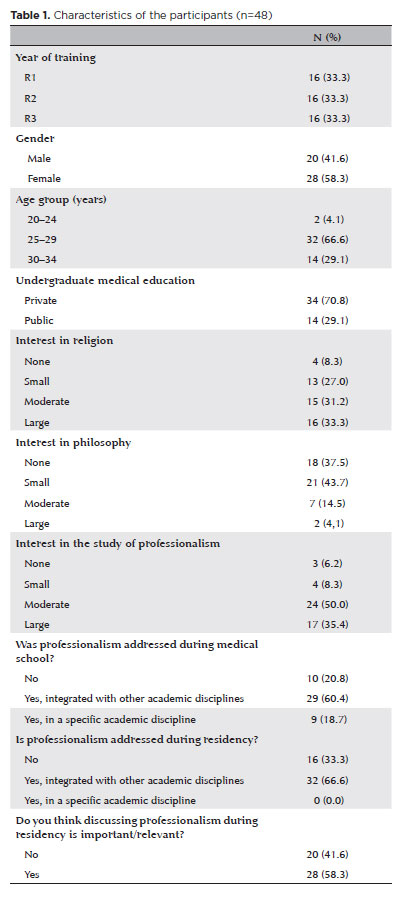
RESULTS: All 48 residents were included, with equal representation across the 3 years of residency. The majority were female (58.3%) and between 25 and 29 years old (66.7%). The average professionalism score on the professionalism mini-evaluation exercise given by the preceptors was 3.0 (75%). A significant association was found between the year of training and the score in the doctor-patient relationship domain, with first-year residents showing lower scores (p=0.002). Male residents had higher scores in the “Interprofessional” domain (p=0.031). Graduates from private medical schools scored higher in both the “doctor-patient relationship” (p=0.015) and “reflective skills” (p=0.033) domains. Lower interest in professionalism was linked to lower scores in the “Interprofessional relationships” (p=0.033) and “time management” (p=0.003) domains. A strong correlation was observed between preceptor’s professionalism mini-evaluation exercise scores and residents’ self-assessed professionalism mini-evaluation exercise scores (r=0.917). However, the correlation between the self-assessed professionalism mini-evaluation exercise and the Pennsylvania questionnaire scores was weak (r=0.226).
CONCLUSION: Professionalism scores among ophthalmology residents were associated with year of training, gender, type of undergraduate education, and level of interest in the topic.
Keywords: Internship and residency; Ophthalmology; Professional competence; Education, professional; Physician-patient relations; Surveys and questionnaires
Arq. Bras. Oftalmol. 2025;88 (6 )
:1-7
| DOI: 10.5935/0004-2749.2025-0083
Abstract
PURPOSE: To examine how ophthalmological features, screen exposure duration, and break habits among office employees affect ocular surface parameters.
METHODS: This single-center cross-sectional study involved two assessments on the same day: one before and one after a visual display terminal task. During the initial assessment, information on screen use was gathered, and refractive error, anterior segment examination, tear breakup time, and Schirmer test measurements were conducted. Participants tracked their screen usage and break durations throughout the day. At the end of the workday, tear breakup time and Schirmer I tests were repeated. Baseline and follow-up results were compared, and regression analysis was performed to identify factors linked to tear breakup time reduction.
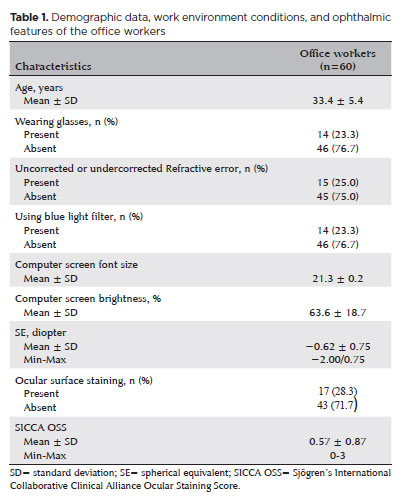
RESULTS: The study enrolled 60 female office employees. Their mean screen time was 269.26 ± 70.21 min, with an average break duration of 151.93 ± 46.24 min. Tear breakup time at the second assessment (6.38 ± 2.70) was significantly lower than at baseline (8.62 ± 2.73) (p<0.001), whereas Schirmer test scores showed no significant change (p>0.05). Tear breakup time reduction was noted in 54 participants (90.0%), with a significant association between tear breakup time decrease percentage and screen exposure (p=0.001, r=0.463). Regression analysis showed that uncorrected or undercorrected refractive error was an independent risk factor for a ≥30% tear breakup time reduction, while taking more frequent short breaks (<15 min) acted as a protective factor.
CONCLUSIONS: Taking more frequent short breaks (<15 min) and correcting refractive errors help prevent intra-day tear breakup time decline during visual display terminal use. Structuring breaks to support tear film stability is advisable for occupations that require regular visual display terminal tasks.
Keywords: Tear film; Screen time; Tear breakup time; Office workers; Protective factors; Lacerations; Refractive errors; Risk factors.
Arq. Bras. Oftalmol. 2026;89 (1 )
:1-8
| DOI: 10.5935/0004-2749.2025-0109
Abstract
PURPOSE: To evaluate the preferred surgical practice patterns for glaucoma among members of the Latin American Glaucoma Society.
METHODS: A cross-sectional study was conducted using an electronic survey distributed in July 2023 via email to members of the Latin American Glaucoma Society. The questionnaire comprised four sections addressing the specialists' profiles, preferred surgical procedures for open-angle glaucoma, and choices in 10 different clinical scenarios, including congenital glaucoma.
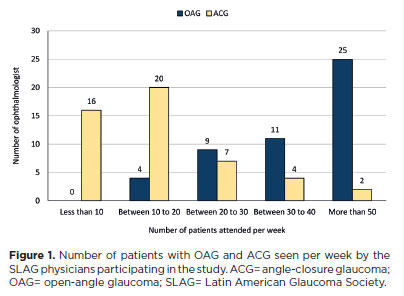
RESULTS: Of the 63 members, 49 physicians (77.7%) responded – 13 women and 36 men – from nine Latin American countries. Thirty-one respondents (63.26%) had more than 20 yr of professional experience. For the surgical management of open-angle glaucoma, trabeculectomy was the most preferred procedure (48 physicians), followed closely by glaucoma drainage devices (47 physicians) and minimally invasive glaucoma surgery (29 physicians). Across the 10 clinical scenarios, glaucoma drainage devices were selected most frequently (203 preferences), followed by trabeculectomy (118), ciliary body laser procedures (107), and minimally invasive glaucoma surgery (40). However, minimally invasive glaucoma surgery was the preferred option for primary open-angle glaucoma with mild-to-moderate cataracts.
CONCLUSION: Among specialists of the Latin American Glaucoma Society, trabeculectomy and glaucoma drainage devices remain the most commonly performed surgical procedures. Minimally invasive glaucoma surgery is primarily used in combination with cataract surgery, while ciliary body laser procedures are generally reserved for cases of previous glaucoma drainage device failure or as an initial option for newly diagnosed glaucoma cases.
Keywords: Glaucoma; Ophthalmologic surgical procedures; Latin America; Practice patterns, physicians; Surveys and questionnaires
Arq. Bras. Oftalmol. 2026;89 (5 )
:1-7
| DOI: 10.5935/0004-2749.2026-0067
Abstract
PURPOSE: Neuro-ophthalmology is a highly specialized subspecialty at the interface of neurology and ophthalmology. Globally, workforce shortages and geographic maldistribution limit access to neuro-ophthalmic care. Although Brazil has a large ophthalmology workforce, regional disparities may restrict access to subspecialty services. The national distribution of neuro-ophthalmologists has not previously been quantified. This study aimed to characterize the geographic distribution of neuro-ophthalmologists in Brazil and identify potential gaps in access to neuro-ophthalmic care.
METHODS: This cross-sectional, population-based study used data from the registry of the Brazilian Neuro-Ophthalmology Association (Associação Brasileira de Neuro-Oftalmologia [ABNO]) to identify practicing neuro-ophthalmologists (data extracted on January 1, 2026). Municipal- and state-level population estimates were obtained from the Brazilian Institute of Geography and Statistics. Specialist density was calculated as the number of neuro-ophthalmologists per million inhabitants. States were classified according to the presence or absence of at least one specialist and were further grouped into Brazil's five macroregions for comparative analyses. Descriptive statistical analyses were performed.
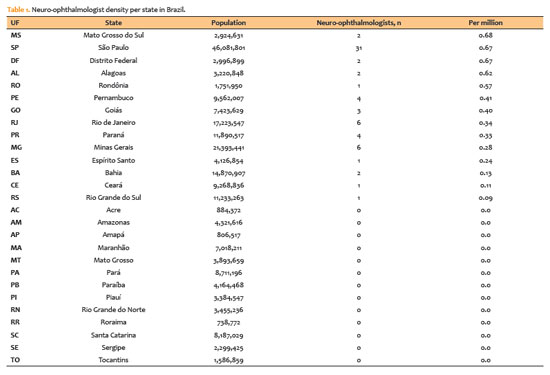
RESULTS: A total of 66 neuro-ophthalmologists were identified across 14 of Brazil's 27 states. Thirteen states had no registered neuro-ophthalmologists, representing approximately 49.4 million people (23.2% of the national population). Five states—São Paulo (n=31), Rio de Janeiro (n=6), Minas Gerais (n=6), Pernambuco (n=4), and Paraná (n=4)—accounted for more than two-thirds of all specialists. Specialist density ranged from 0 to more than 0.7 per million inhabitants, with higher concentrations in the Southeast and no specialists in several states in the North and Northeast. The distribution was highly clustered in metropolitan areas.
CONCLUSION: Brazil exhibits marked geographic maldistribution of neuro-ophthalmologists, with nearly one-quarter of the population lacking local access to specialized care. The concentration of specialists in urban and economically developed regions mirrors international trends and may exacerbate inequities within the public health system. Expanding the workforce and integrating teleophthalmology into neuro-ophthalmic services may help reduce regional disparities and improve access to specialized care.
Keywords: Ophthalmologists; Public health; Health policy; Workforce; Professional practice location; Telemedicine; Teleophthalmology; Brazil
Arq. Bras. Oftalmol. 2026;89 (3 )
:1-14
| DOI: 10.5935/0004-2749.2025-0248
Abstract
PURPOSE: This study aimed to identify barriers to diabetic retinopathy screening among a socioeconomically vulnerable urban population in northeast Brazil.
METHODS: A cross-sectional study was conducted during a diabetic retinopathy screening campaign at primary healthcare units. Ninety-five patients with diabetes underwent retinal examinations and completed a structured interview. Clinical, demographic, and socioeconomic data were collected.
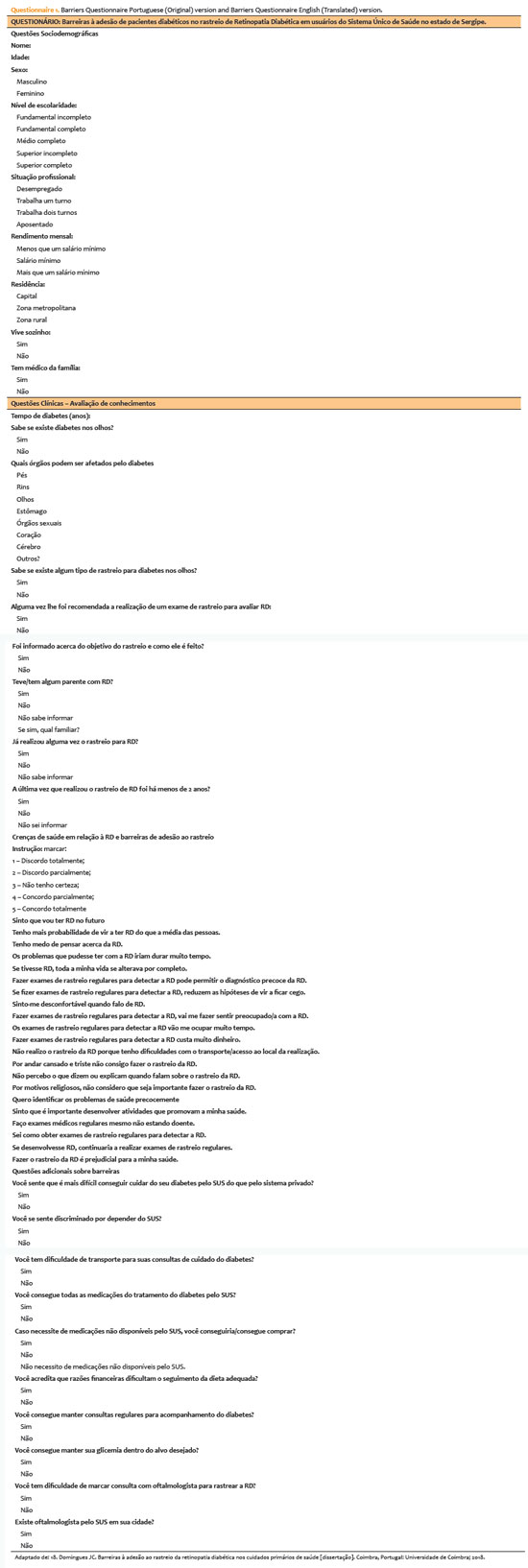
RESULTS: The study population consisted predominantly of older adults (mean age: 60.7 ± 10.5 years), with a high prevalence of type 2 diabetes (99.0%) and low educational attainment. Most participants were economically inactive (81.1%) and reported low income (83.2%). Diabetic retinopathy and maculopathy were highly prevalent, affecting 50.0% and 22.9% of participants, respectively. Longer duration of diabetes was significantly associated with greater awareness of diabetic retinopathy (p=0.035), higher HbA1c levels (p<0.001), and increased prevalence of diabetic retinopathy (p=0.013) and maculopathy (p=0.002). Notably, 33.3% of participants reported difficulties attending medical appointments for diabetes management. In addition, 78.1% experienced challenges scheduling ophthalmologic evaluations, and 76.3% reported that no ophthalmologist was available in their city through the public healthcare system. Financial constraints also limited adherence to recommended dietary practices (90.4%) and impaired glycemic control, with more than half of participants reporting difficulty maintaining target glucose levels.
CONCLUSION: Major barriers to diabetic retinopathy screening included limited awareness of the importance of screening, financial hardship, and transportation challenges. Targeted educational initiatives and structural interventions such as expanded screening programs incorporating telemedicine and subsidized transportation—may improve screening adherence among vulnerable populations.
Keywords: Diabetic retinopathy; Mass screening; Health services accessibility; Health knowledge, attitudes, practices; Socioeconomic factors
Arq. Bras. Oftalmol. 2024;87 (6 )
:1-5
| DOI: 10.5935/0004-2749.2021-0482
Abstract
OBJETIVO: Nos últimos 20 anos, o número de escolas médicas no Brasil aumentou, mas as vagas para especialização em Oftalmologia não acompanharam a demanda crescente. Este estudo quer estimar a demanda por especialização e avaliar a oferta de oportunidades de aprendizado em Oftalmologia.
MÉTODOS: Estudo epidemiológico com pesquisa em banco de dados provenientes do Ministério da Educação e Conselho Brasileiro de Oftalmologia. Estes dados foram checados através de 120 editais publicados pelos serviços de Residência em 2021.
RESULTADOS: De 2002 a 2021, o número de vagas em faculdades de Medicina aumentou 370%, enquanto o número de vagas certificadas de especialização em Oftalmologia aumentou 64%. Houve um desalinhamento de 11.4% entre os dados do Conselho Brasileiro de Oftalmologia e do Ministério da Educação.
CONCLUSÃO: A proporção de graduados em Medicina aumentou muito mais do que a oferta de oportunidades de especialização em Oftalmologia, o impacto disto na busca por vagas de especialização não acreditadas é desconhecido, políticas de monitoramento das vagas de especialização em Oftalmologia devem ser estabelecidas.
Keywords: Oftalmologia; Ensino; Educação médica; Especialização
Arq. Bras. Oftalmol. 2026;89 (4 )
:1-6
| DOI: 10.5935/0004-2749.2025-0283
Abstract
PURPOSE: To assess the performance of a contemporary large language model (ChatGPT-5) against ophthalmology residents on a standardized set of glaucoma multiple-choice questions.
METHODS: We conducted a cross-sectional comparative study with 189 text-only glaucoma multiple-choice questions from the Cybersight question bank. ChatGPT-5 was tested under standardized conditions, with each item placed in a new chat and limited to letter-only outputs. Six ophthalmology residents from a Brazilian training program (two Postgraduate Year 1, two Postgraduate Year 2, and two Postgraduate Year 3) answered the same questions under supervision. Accuracy was calculated using the official key. McNemar’s exact test was used to compare items between ChatGPT-5 and residents, and matched odds ratios and 95% confidence intervals (95% CIs) were calculated using the Haldane–Anscombe correction.
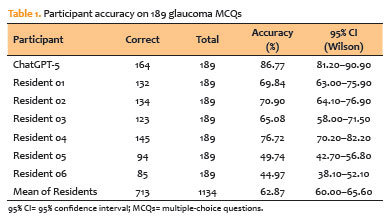
RESULTS: ChatGPT-5 received 164 of 189 correct responses (86.8%; 95% CI, 81.2–90.9). Residents’ overall accuracy was 62.9% (713/1,134; 95% CI, 60.0–65.6). The top-performing resident earned 76.7%. ChatGPT-5 outperformed all residents in head-to-head comparisons, with odds ratios ranging from 1.84 (95% CI, 1.10–3.08) to 13.15 (95% CI, 5.93–29.20), all p≤0.023. ChatGPT-5 correctly answered 17/189 items (9.0%), but fewer than half of residents were correct (“large language model-only wins”), whereas residents were more successful on items that ChatGPT-5 overlooked.
CONCLUSIONS: ChatGPT-5 outperformed ophthalmology residents on text-based glaucoma multiple-choice questions, indicating its potential as a subspecialty education and assessment tool. Generalizability is limited by the single question bank, text-only items, a small resident cohort, and the evaluation of one large language model version at a single time point. Before incorporating these findings into clinical decision-making, larger, multimodal, and longitudinal studies are required.
Keywords: Glaucoma; Artificial intelligence; Large language models; Education, medical; Medical staff, hospital
Arq. Bras. Oftalmol. 2026;89 (3 )
:1-6
| DOI: 10.5935/0004-2749.2025-0272
Abstract
PURPOSE: To assess musculoskeletal symptoms, identify the most affected body areas, and investigate factors associated with the development of musculoskeletal disorders among ophthalmologists in Brazil.
METHODS: A survey was conducted using an online questionnaire and snowball sampling. Statistical analyses were performed using Jamovi version 2.3.28, and graphs were generated using RStudio version 2023.06.2 + 561.
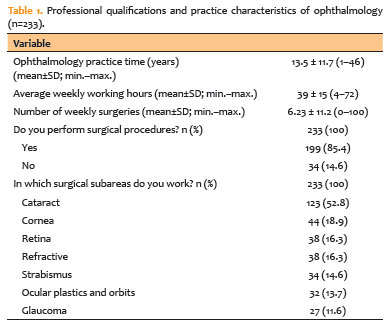
RESULTS: A total of 233 participants (42 ophthalmology residents and 191 ophthalmologists) were included, with a mean age of 40.4 years (standard deviation 11.3; range 25–73 years). Musculoskeletal symptoms were reported by 83% of participants. The cervical region (57.1%), upper back (54.5%), and lumbar region (53.6%) were the most frequently reported sites of pain. A high body mass index was identified in 54.9% of the sample, and 50.2% of participants reported using painkillers in the previous year for musculoskeletal symptoms. The mean duration of professional activity in ophthalmology was 13.5 years, and the mean weekly workload was 39 hours. A significant association was observed between weekly workload and the presence of musculoskeletal disorders (p=0.045).
CONCLUSION: This study demonstrated a high prevalence of musculoskeletal disorders among ophthalmologists in Brazil, particularly involving the cervical, lumbar, and upper back regions, consistent with findings reported in international studies. Important contributing factors include long working hours, a high patient volume, and repetitive or awkward postures during examinations and procedures. Preventive strategies and improvements in working conditions are needed to protect the health and well-being of ophthalmologists.
Keywords: Musculoskeletal Diseases/epidemiology; Back pain; Lumbar Vertebrae; Occupational diseases/epidemiology; Ergonomics; Ophthalmic practice; Ophthalmologists/statistics & numerical data; Brazil/epidemiology
Arq. Bras. Oftalmol. 2024;87 (6 )
:1-6
| DOI: 10.5935/0004-2749.2022-0257
Abstract
OBJETIVO: Descrever as características clínicas e os fatores associados à presença de ceratite em pacientes com corpos estranhos na córnea em uma população colombiana.
MÉTODOS: Trata-se de um estudo transversal baseado na revisão dos registros clínicos de pacientes com corpos estranhos na córnea admitidos em um departamento de emergência em Cali, Colômbia, entre junho de 2018 e junho de 2019. O desfecho primário foi a presença de ceratite diagnosticada através de critérios clínicos. Foram utilizados modelos de regressão logística univariada e multivariada para identificar os fatores associados.
RESULTADO: Neste estudo, foi analisado um total de 381 corpos estranhos na córnea em 372 pacientes (idade média: 40,0 anos, intervalo interquartil: 29,0-53,0; sexo masculino: 94,7% [352 casos]). Noventa e cinco casos desenvolveram ceratite (24,9%, intervalo de confiança de 95% — IC 95%: 20,8%-29,5%). Na análise multivariada, para idade ≤30 anos (razão de chances — RC: 2,15, IC 95%: 1,06-4,36), o achado de flare aquoso (RC: 2,81, IC 95%: 1,39-5,66]) e a presença de corpo estranho na periferia da córnea (RC: 2,05, IC 95%: 1,19-3,50) foram associados a um risco aumentado de ceratite. Sexo, tempo entre a lesão e a internação, e edema da córnea não foram relacionados à ceratite (p>0,05).
CONCLUSÃO: Há uma proporção elevada de ceratite em casos de corpos estranhos na córnea em Cali, Colômbia. Os três fatores associados à ceratite foram a idade, o achado de flare aquoso e a presença de corpo estranho na periferia da córnea.
Keywords: Corpos estranhos no olho; Lesões da córnea; Ceratite/epidemiologia; Estudos transversais; Colômbia.
Arq. Bras. Oftalmol. 2024;87 (4 )
:1-6
| DOI: 10.5935/0004-2749.2023-0200
Abstract
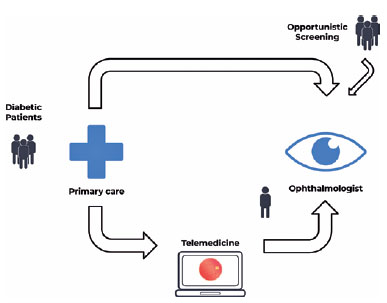
PURPOSE: Timely screening and treatment are essential for preventing diabetic retinopathy blindness. Improving screening workflows can reduce waiting times for specialist evaluation and thus enhance patient outcomes. This study assessed different screening approaches in a Brazilian public healthcare setting.
METHODS: This retrospective study evaluated a telemedicine-based diabetic retinopathy screening implemented during the COVID-19 pandemic and compared it with in-person strategies. The evaluation was conducted from the perspective of a specialized referral center in an urban area of Central-West Brazil. In the telemedicine approach, a trained technician would capture retinal images by using a handheld camera. These images were sent to specialists for remote evaluation. Patient variables, including age, gender, duration of diabetes diagnosis, diabetes treatment, comorbidities, and waiting time, were analyzed and compared.
RESULTS: In total, 437 patients with diabetes mellitus were included in the study (mean age: 62.5 ± 11.0 years, female: 61.7%, mean diabetes duration: 15.3 ± 9.7 years, insulin users: 67.8%). In the in-person assessment group, the average waiting time between primary care referral and specialist evaluation was 292.3 ± 213.9 days, and the referral rate was 73.29%. In the telemedicine group, the average waiting time was 158.8 ± 192.4 days, and the referral rate was 29.38%. The telemedicine approach significantly reduced the waiting time (p<0.001) and significantly lowered the referral rate (p<0.001).
CONCLUSION: The telemedicine approach significantly reduced the waiting time for specialist evaluation in a real-world setting. Employing portable retinal cameras may address the burden of diabetic retinopathy, especially in resource-limited settings.
Keywords: Telemedicine/methods; Diabetic retinopathy; Diagnostic screening programs; Vision screening; Practice patterns, physicians


 ABO is licensed under a Creative Commons Attribution-NonComercial 4.0 Internacional.


05-tab01.jpg)
05-tab01.jpg)
12-tab01.jpg)
11-tab01tb.jpg)
02-tab01.jpg)
15-fig01.jpg)