Arq. Bras. Oftalmol. 2021;84 (3 )
:241-248
| DOI: 10.5935/0004-2749.20210032
Abstract
OBJETIVO: Determinar o papel do receptor da vitamina D na patogênese do pterígio. Os níveis de expressão do receptor da vitamina D no tecido do pterígio, os níveis sanguíneos de vitamina D e a frequência de alguns polimorfismos do gene do receptor da vitamina D (BsmI, FokI e TaqI) foram comparados entre pacientes com pterígio e participantes saudáveis.
MÉTODOS: Foram incluídos pacientes com pterígio (n=50) e voluntários saudáveis (n=50). Os níveis séricos de vitamina D foram medidos em ambos os grupos. Foi feita uma coloração imuno-histoquímica para o receptor da vitamina D em cortes obtidos do pterígio e dos tecidos conjuntivais saudáveis adjacentes dos mesmos indivíduos. A existência de polimorfismos do receptor da vitamina D (BsmI, FokI e TaqI) no genoma foi analisada em DNA obtido do sangue venoso dos participantes, usando métodos de Polymerase chain reaction (PCR) e RFLP.
RESULTADOS: Não foi observada nenhuma diferença entre os níveis séricos de vitamina D dos pacientes com pterígio e os dos controles saudáveis. Entretanto, a expressão tissular do receptor da vitamina D foi maior nas células endoteliais dos microvasos do pterígio (p=0,002), nas células estromais sub-epiteliais (p=0,04) e nas células inflamatórias intravasculares (p=0,0001), quando comparada à expressão no tecido conjuntival saudável adjacente. Além disso, embora o haplótipo BBtt tenha sido duas vezes mais frequente, o haplótipo bbTt foi 2,5 vezes menos frequente e o haplótipo BbTT foi 2,25 vezes menos frequente no grupo de controle do que no grupo com pterígio (p<0,001).
CONCLUSÕES: Os níveis séricos de vitamina D não apresentaram diferenças entre o grupo de pessoas saudáveis e o com pterígio. A expressão do receptor da vitamina D mostrou-se maior no grupo com pterígio do que no tecido saudável adjacente. Entretanto, a análise dos polimorfismos do receptor da vitamina D nos pacientes com pterígio não revelou qualquer diferença significativa nos polimorfismos BsmI, FokI ou TaqI em comparação com os voluntários saudáveis.
Keywords: Pterígio; Vitamina D; Polimorfismo genético; Imuno- histoquímica
Arq. Bras. Oftalmol. 2021;84 (6 )
:576-581
| DOI: 10.5935/0004-2749.20210095
Abstract
Objetivo: Comparar a acuidade visual prevista pelo Escore de Trauma Ocular com a acuidade visual final dos pacientes vítimas de trauma ocular aberto atendidos em hospital no sul do Brasil.
Métodos: Foram analisados 120 olhos de 119 vítimas de trauma ocular aberto. Foi realizado um estudo observacional e retrospectivo em hospital universitário. Foram extraídos dados de prontuários relacionados a idade, sexo, olho acometido e mecanismo de trauma, bem como dados para o cálculo do Escore de Trauma Ocular (acuidade visual inicial, presença de ruptura de globo, perfuração, endoftalmite, descolamento de retina, defeito pupilar aferente) e acuidade visual final.
Resultado: Houve concordância entre a acuidade visual prevista pelo Escore de Trauma Ocular e a acuidade visual final prevista no presente estudo. A análise isolada das variáveis demonstrou significância para acuidade visual inicial (p<0,001), para descolamento de retina (p=0,001) e para defeito pupilar aferente (p<0,004). Não houve diferença significativa entre a acuidade visual final do estudo original do Escore de Trauma Ocular. e na população abordada no presente estudo.
Conclusão: O Escore de Trauma Ocular pode ser aplicado à população estudada no presente estudo como ferramenta de determinação do prognóstico visual em vítimas de trauma ocular aberto. As variáveis mais significativas são acuidade visual inicial, descolamento de retina e defeito pupilar aferente. Estudos prospectivos com amostras maiores são necessários para comprovar tal hipótese.
Keywords: Índices de gravidade do trauma; Acuidade visual; Traumatismos oculares; Prognóstico
Arq. Bras. Oftalmol. 2025;88 (3 )
:1-8
| DOI: 10.5935/0004-2749.2023-0115
Abstract
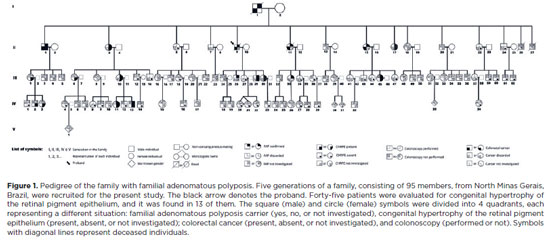
PURPOSE: To evaluate the presence of congenital hypertrophy of the retinal pigment epithelium in a large family affected by familial adenomatous polyposis and identify the causative mutation in the adenomatous polyposis coli gene. Thus, we aimed to determine the significance of congenital hypertrophy of the retinal pigment epithelium as a phenotypic marker of the disease.
METHODS: A family consisting of 95 individuals was evaluated. Among these, 45 individuals were randomly selected by convenience sampling method to undergo ophthalmological evaluation. A funduscopic exam, including slit lamp and indirect ophthalmoscopy, were performed in the selected patients. In those with retinal lesions, a retinography was obtained. The adenomatous polyposis coli gene was sequenced in one affected family member to identify the pathogenic mutation. Once the variant was identified, six undiagnosed family members were tested for the mutation via capillary electrophoresis sequencing.
RESULTS: Congenital hypertrophy of the retinal pigment epithelium was observed in 13 (28.9%) of the 45 individuals evaluated. Of these, nine patients were confirmed to have familial adenomatous polyposis (via colonoscopy or molecular testing). However, four patients had not been investigated. Of the 32 (71.1%) family members without the lesion, 14 did not have familial adenomatous polyposis and 18 were yet to be evaluated. The lesions were bilaterally present and exhibited a peculiar fish-tail shape in all the evaluated individuals. Adenomatous polyposis coli gene sequencing revealed a pathogenic variant c.4031del. (Ser1344*), in heterozygosity (49.27%), in exon 16.
CONCLUSIONS: The study findings confirmed the significance of congenital hypertrophy of the retinal pigment epithelium as a phenotypic marker for familial adenomatous polyposis. Furthermore, it is an effective first-line screening method for at risk family members of such patients. The novel mutation identified in our study participants, which is yet to be described in the literature, causes an aggressive form of the disease.
Keywords: Retinal diseases/congenital; Retinal pigment epithelium; Hypertrophy/congenital; Adenomatous polyposis coli / genetics; Phenotype; Optical coherence tomography
Arq. Bras. Oftalmol. 2024;87 (4 )
:1-8
| DOI: 10.5935/0004-2749.2021-0415
Abstract
Objetivo: Fenótipos Stargardt-like já foram associados a variantes patogênicas no gene ABCA4. O propósito desse estudo é descrever quatro pacientes com achados retinianos semelhantes a doença de Stargardt com resultados moleculares diferentes do esperado.
Métodos: Esse relato fez a revisão de prontuários médicos de quatro pacientes com distrofia macular e achados clínicos sugestivos de doença de Stargardt. Foram realizados avaliação oftalmológica, exames de imagens e testes usando next generation sequencing para avaliar variantes patogênicas associadas aos fenótipos dos pacientes.
Resultados: Os pacientes apresentavam atrofia macular e alterações pigmentares sugerindo achados clínicos de doença de Stargardt. Dois pacientes foram associados a genes com herança autossômica dominante (RIMS1 e CRX) e dois pacientes foram associados a genes com herança autossômica recessiva (CRB1 e RDH12) com variantes preditoras de serem patogênicas.
Conclusão: Distrofias maculares podem ter similaridades fenotípicas com fenótipo de Stargardt-like associados a outros genes além dos classicamente já descritos.
Keywords: Doença de Stargardt; Estudos de associação genética; Fenótipo; Padrões de herança; Sequenciamento de nucleotídeos em larga escala; Degeneração macular; Distrofias retinianas; Doenças genéticas
Arq. Bras. Oftalmol. 2025;88 (3 )
:1-8
| DOI: 10.5935/0004-2749.2024-0104
Abstract
PURPOSE: This study aimed to characterize retinitis pigmentosa associated with the eyes shut homolog gene, which causes hereditary retinal degeneration.
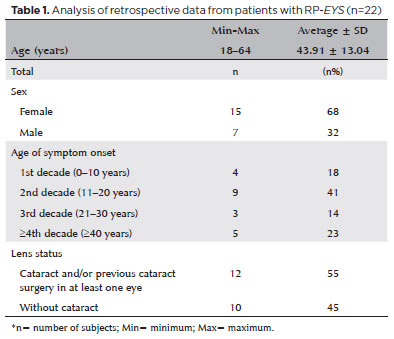
METHODS: The anatomical and functional findings of retinitis pigmentosa in patients with variants of the eyes shut homolog gene were characterized and compared using multimodal imaging and genetic analysis of the variants. Clinical data such as visual acuity, lens status, and refraction were obtained from medical records. Patients underwent an ophthalmic examination, including static visual field, microperimetry, optical coherence tomography, fundus autofluorescence, and fundus photography.
RESULTS: Twenty-two patients were included in the study. Several anatomical and functional characteristics of retinitis pigmentosa-eyes shut homolog were identified, including the presence of cataracts, cystoid macular edema, epiretinal membrane, and a tubular visual field. Genetic results revealed 26 distinct variants in the cohort, with 7 novel variants not previously documented or reported in the scientific literature or databases.
CONCLUSION: The findings demonstrate that eyes shut homolog-retinitis pigmentosa manifests in specific patterns, starting in adolescence with mild progression and advancing with age. The integration of multimodal imaging and genetic analysis has provided a detailed understanding of the anatomical and functional features of retinitis pigmentosa-eyes shut homolog. Seven novel variants of the eyes shut homolog gene have been identified. These findings enhance the understanding of eyes shut homolog-related retinitis pigmentosa characteristics of by detailing the spectrum of mutations in this gene within the Brazilian population.
Keywords: Retinal diseases/diagnostic imaging; Retinitis pigmentosa/genetics; Retinal degeneration; Eye proteins/genetics; Eye diseases, hereditary/genetics; Genes, recessive; Phenotype; Multimodal imaging; Tomography, optical coherence/methods; Fluorescein angiogr
Arq. Bras. Oftalmol. 2024;87 (2 )
:1-6
| DOI: 10.5935/0004-2749.2021-0435
Abstract
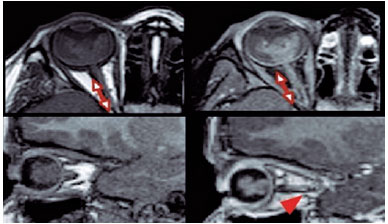
PURPOSE: This study aimed to analyze the association between magnetic resonance imaging apparent diffusion coefficient map value and histopathological differentiation in patients who underwent eye enucleation due to retinoblastomas.
METHODS: An observational chart review study of patients with retinoblastoma that had histopathology of the lesion and orbit magnetic resonance imaging with apparent diffusion coefficient analysis at Hospital de Clínicas de Porto Alegre between November 2013 and November 2016 was performed. The histopathology was reviewed after enucleation. To analyze the difference in apparent diffusion coefficient values between the two major histopathological prognostic groups, Student's t-test was used for the two groups. All statistical analyses were performed using SPSS version 19.0 for Microsoft Windows (SPSS, Inc., Chicago, IL, USA). Our institutional review board approved this retrospective study without obtaining informed consent.
RESULTS: Thirteen children were evaluated, and only eight underwent eye enucleation and were included in the analysis. The others were treated with photocoagulation, embolization, radiotherapy, and chemotherapy and were excluded due to the lack of histopathological results. When compared with histopathology, magnetic resonance imaging demonstrated 100% accuracy in retinoblastoma diagnosis. Optic nerve invasion detection on magnetic resonance imaging showed a 66.6% sensitivity and 80.0% specificity. Positive and negative predictive values were 66.6% and 80.0%, respectively, with an accuracy of 75%. In addition, the mean apparent diffusion coefficient of the eight eyes was 0.615 × 103 mm2/s. The mean apparent diffusion coefficient value of poorly or undifferentiated retinoblastoma and differentiated tumors were 0.520 × 103 mm2/s and 0.774 × 103 mm2/s, respectively.
CONCLUSION: This study revealed that magnetic resonance imaging is useful in the diagnosis of retinoblastoma and detection of optic nerve infiltration, with a sensitivity of 66.6% and specificity of 80%. Our results also showed lower apparent diffusion coefficient values in poorly differentiated retinoblastomas with a mean of 0.520 ×
103 mm2/s, whereas in well and moderately differentiated, the mean was 0.774 × 103 mm2/s.
Keywords: Retinoblastoma; Prognosis; Retinal neoplasms; Orbit; Diffusion magnetic resonance imaging