
Arq. Bras. Oftalmol. 2026; 89 (4): 10.5935/0004-2749.2025-0356
Total: 874
Carolina C. Valente1; Gustavo R. Gameiro2; Beatriz K. T. Oguido3; Rodrigo Jorge4; J. William Harbour5; Zelia M. Correa1,6
DOI: 10.5935/0004-2749.2025-0356
ABSTRACT
PURPOSE: To analyze the results of the 15-gene expression profile/preferentially expressed antigen in melanoma (15-GEPP) prognostic classifier and associated survival outcomes in a series of Brazilian patients with posterior uveal melanoma.
METHODS: Patients born and raised in Brazil who were diagnosed with posterior uveal melanoma and underwent fine-needle aspiration biopsy for 15-GEPP prognostic testing using the DecisionDx-Uveal melanoma and DecisionDx-PRAME assays between September 2020 and 2023 were included. All patients were diagnosed and treated by the senior author.
RESULTS: Of 236 patients diagnosed with posterior uveal melanoma during the study period, 11 (4.6%) met the inclusion criteria, including six males and five females. Based on 15-GEPP results, seven patients (63.6%) were classified as Class 1 and 4 (36.4%) as Class 2. Preferentially expressed antigen in melanoma (PRAME) expression was negative in six patients (54.6%) and positive in five patients (45.4%). During a mean follow-up of 36.4 ± 17.6 months, five patients developed metastasis: two with Class 2/PRAME-positive tumors, one with Class 2/PRAME-negative tumors, one with Class 1/PRAME-positive tumors, and one with Class 1/PRAME-negative tumors. Three of these patients died. The mean survival after the diagnosis of metastasis was 21.2 months (median: 17.0 months).
CONCLUSIONS: The proportions of Class 1 versus Class 2 tumors and PRAME-negative versus PRAME-positive tumors as well as the prognostic performance of these biomarkers appear similar in Brazilian patients with posterior uveal melanoma compared with large published cohorts from North America. Further studies with larger Brazilian cohorts are needed to validate these findings.
Keywords: Uveal melanoma; Fine-needle biopsy; Prognosis; Biomarkers; Neoplasms; Transcriptome; Survival; Brazil
INTRODUCTION
Uveal melanoma (UM) is the most common primary intraocular malignancy in adults. It accounts for approximately 4%-5% of all melanomas and has an incidence of about 5.6 cases per million person-years, with a predominance among individuals of Caucasian ancestry(1).
Despite significant advances in the understanding of this disease, overall survival has not improved substantially, largely because metastatic disease — particularly liver metastasis — remains difficult to control(2).
Previous studies have shown that primary uveal melanomas can be classified into two distinct molecular groups based on gene expression profiling: Class 1 (low risk) and Class 2 (high risk). The gene expression profile (15-GEP) of Class 1 tumors resembles that of normal uveal melanocytes and low-grade melanocytic lesions, whereas Class 2 tumors exhibit reduced expression of melanocytic genes and instead resemble more primitive neural/ectodermal cells(3).
Preferentially expressed antigen in melanoma (PRAME) has been identified as an independent prognostic biomarker associated with increased metastatic risk in UM(4-6). PRAME has been prospectively validated and shown to further improve the prognostic accuracy of GEP(6,7). Moreover, GEP and PRAME together are more predictive of survival than most previously identified clinical variables, except the largest basal diameter (LBD)(7).
Although several studies have evaluated the prognostic impact of 15-GEP classification and PRAME expression on metastasis and survival, these studies have primarily involved Caucasian populations, with limited data available for other groups(8). Given the highly diverse genetic background of the Brazilian population, shaped by multiple waves of migration(9,10), racial and ancestral factors may influence disease prognosis(8,11).
The objective of this study was to describe the distribution and prognostic implications of 15-GEP and PRAME (15-GEP/PRAME) in a series of Brazilian patients with posterior uveal melanoma from a single-center database, with a focus on metastatic risk and survival outcomes.
METHODS
This study was conducted in accordance with the ethical principles of the World Medical Association Declaration of Helsinki. It was designed as a retrospective chart review and is part of the Ocular Oncology Database Collection approved by the ethics committee of the senior author's institution (Approval No. 20210961). The requirement for informed consent was waived.
Patients were identified from a single-center database between September 2020 and 2023 and were evaluated and treated by the senior author. Following clinical diagnosis and comprehensive ophthalmic assessment, all patients underwent fine-needle aspiration biopsy (FNAB) either at the time of or prior to tumor treatment. Tumor samples were subsequently analyzed using a PCR-based 15-gene expression profile and PRAME assay (DecisionDx-UM and DecisionDx-PRAME, Castle Biosciences, Inc., Friendswood, Texas) between July 2020 and 2023.
De-identified data were collected by the senior author and included patient demographics, self-reported ethnicity, tumor characteristics and dimensions, previous procedures, tumor treatment, local recurrence, overall survival, and distant metastasis.
Tumor clinical characteristics were assessed using dilated fundus examination, A- and B-scan ultrasonography, optical coherence tomography, and fundus autofluorescence. Local tumor recurrence was evaluated during scheduled follow-up visits through clinical examination and imaging studies.
Time to metastasis, method of metastatic detection, cause of death, and overall survival were recorded for all patients. Tumors were staged according to the 8th edition of the American Joint Committee on Cancer (AJCC) classification system.
Post-treatment ophthalmic follow-up visits were scheduled every 3-4 months during the first year, every 4-6 months during the second year, and every 6-12 months thereafter. Baseline metastatic screening included computed tomography (CT) scans of the chest, abdomen, and pelvis. Subsequent systemic surveillance generally included CT, magnetic resonance imaging, or ultrasonography for liver assessment at least twice yearly, along with annual chest CT or chest radiography.
Patient demographics and tumor characteristics were summarized using frequencies and percentages for categorical variables. Continuous variables were reported as means and medians. All statistical analyses were performed using StataSE version 18.5 for Mac (StataCorp LLC, College Station, Texas). Because of the limited sample size, survival analyses and statistical correlation testing were not performed.
RESULTS
Of the 236 patients with posterior uveal melanoma (PUM) evaluated by FNAB by the senior author during the study period, only 11 (4.7%) reported being born and raised in Brazil and therefore met the inclusion criteria.
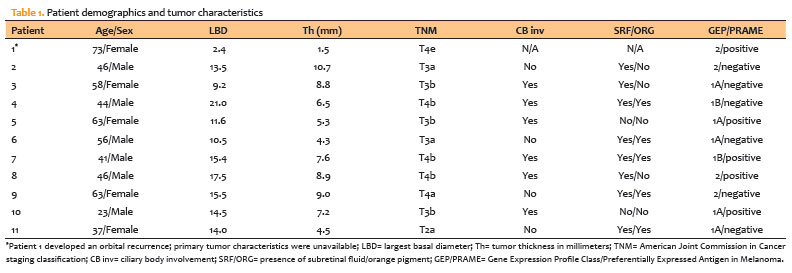
Table 1 summarizes the individual patient demographics, including tumor staging according to the AJCC, 8th edition. Seven patients self-identified as White, and four as Pardo. Only three of the 11 patients had blue irides. None reported Asian or Middle Eastern ancestry, and no cases of associated oculodermal melanocytosis were identified.
The mean age at diagnosis was 50.0 ± 14.2 yr (median: 46 yr; Table 2). The mean largest tumor diameter was 13.2 ± 4.8 mm (median: 14.0 mm), and the mean tumor thickness was 6.7 ± 2.7 mm (median: 7.5 mm).
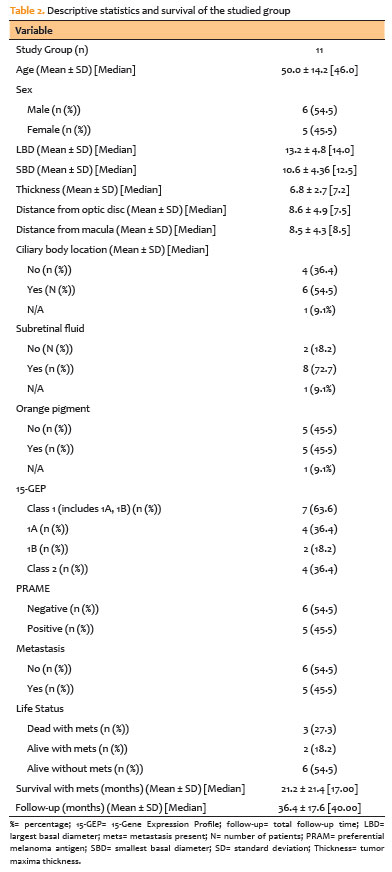
Seven patients (63.6%) were classified as GEP Class 1, including 4 Class 1A and 2 Class 1B tumors, while four patients (36.4%) were classified as Class 2. PRAME expression was negative in six patients (54.5%) and positive in five patients (45.5%). The follow-up period ranged from 8 to 57 months, with a mean of 36.4 ± 17.6 months and a median of 40.0 months. Additional descriptive data are provided in Table 2.
During the follow-up period, five patients (45.5%) developed metastasis. Of these, two patients had Class 2/PRAME-positive tumors, one had a Class 2/PRAME-negative tumor, one had a Class 1/PRAME-positive tumor, and one had a Class 1B/PRAME-negative tumor. Overall, three of the metastatic cases were PRAME-positive.
Three patients with metastatic disease subsequently died. The mean survival after the diagnosis of metastasis was 21.2 months (median: 17.0 months). All deceased patients self-identified as White, whereas the two surviving patients with metastasis self-identified as White and Pardo.
Among the eight patients who underwent primary treatment with iodine-125 (I-125) plaque brachytherapy, no cases of local recurrence were observed during the follow-up period. Local recurrence was defined as tumor regrowth following an initial documented response to treatment (tumor regression), typically occurring between 6 and 12 months after therapy and most often arising at the margins of the treated area, although not necessarily contiguous with the original tumor bed.
In contrast, three patients demonstrated local treatment failure, defined as continued tumor growth or absence of tumor regression despite treatment, indicating primary resistance. One of these patients (ID 1) had undergone enucleation 20 yr earlier due to recurrence following brachytherapy, with both treatments performed in Brazil. This patient later presented with an orbital nodule, which was confirmed to represent recurrent (or metastatic) UM and was treated with radiation at our institution. FNAB of the lesion classified the tumor as Class 2 and PRAME-positive. The patient declined surveillance and developed multiorgan metastases 17 months later, ultimately dying within a few weeks.
The remaining two patients (ID 2 and ID 10) underwent enucleation at the time of study inclusion due to recurrence of the primary tumor.
DISCUSSION
Caucasian ethnicity appears to be closely associated with the development and aggressiveness of PUM, which, unlike cutaneous melanoma, has been shown to lack a UV mutational signature(8). In addition, large studies have reported a very low incidence of UM among non-Caucasian individuals(12).
According to Brazil's 2022 census, the population is composed of a variety of ethnic groups. "Pardo" is an ethnic and skin color category used to refer to individuals with mixed ancestry, as defined by the Brazilian Institute of Geography and Statistics (IBGE)(9). Although White and Pardo Brazilians together comprise a large proportion of the population, their distribution varies considerably across regions. In the southern region, approximately 78% of the population is White and 17% Pardo, whereas in the northern region, 23% is White and 67% Pardo(13). This demographic variability, combined with the known predominance of UM among individuals of European ancestry, motivated the evaluation of the clinical and genomic characteristics of this cohort of Brazilian patients.
Although this is a small cohort, several findings are noteworthy. First, there was a slight predominance of White individuals (7 of 11) compared with Pardo individuals, although most patients (8 of 11) had brown irides. Second, the proportion of Class 1 and Class 2 tumors was similar to that reported in the Collaborative Ocular Oncology Group (COOG) Study #2; however, PRAME positivity was observed in nearly half of the patients. This contrasts with the approximately 70% PRAME-negative rate reported in that large multicenter study(7). This difference may be influenced by the small sample size and by tumor characteristics in this cohort, as most tumors were classified as T3-T4, and six patients had ciliary body involvement(4,6,14).
Third, patients in this study were younger at diagnosis compared with those reported in COOG Study #2 and other series from the Northern Hemisphere(3,7,15-17). Excluding patient ID 1, the mean age decreases to 47.7 yr. This finding is relevant because younger age at diagnosis has been associated with a lower risk of metastasis in uveal melanoma(17). However, this observation should be interpreted with caution due to the small sample size, although it may suggest earlier tumor onset in this population. None of the patients underwent germline BAP1 testing.
This study has limitations, including its retrospective design and small sample size. Nevertheless, the consistent and detailed clinical documentation allowed for adequate data collection and analysis. The limited number of patients may be related to the heterogeneous ethnic composition of the Brazilian population(10), as well as factors such as cost and access to care.
Importantly, this cohort did not demonstrate improved survival despite the mixed ancestry of the patients. In addition, the 15-GEP/PRAME classifier appeared to perform similarly to previously published data, as reflected by the observed survival outcomes.
Further studies involving larger Brazilian cohorts are needed to better characterize the incidence and genomic features of UM in this diverse population. If validated, the integration of 15-GEP and PRAME testing into clinical practice in Brazil may contribute to the development of national guidelines for risk-adapted management of PUM.
ACKNOWLEDGMENTS
This study was supported by National Cancer Institute Support Grants to Sylvester Comprehensive Cancer Center, University of Miami (P30 CA240139) and Simmons Comprehensive Cancer Center, University of Texas Southwestern Medical Center (P30 CA142543); National Eye Institute Core Grants to Bascom Palmer Eye Institute and Department of Ophthalmology, University of Miami (P30 EY014801) and the Department of Ophthalmology, University of Texas Southwestern Medical Center (P30 EY030413); Research to Prevent Blindness, Inc. Unrestricted Grant (GR004596) to Bascom Palmer Eye Institute, Department of Ophthalmology, University of Miami and Research to Prevent Blindness, Inc. Challenge Grant to the Department of Ophthalmology, University of Texas Southwestern Medical Center.
AUTHORS' CONTRIBUTIONS
Significant contribution to conception and design: Zelia M Correa
Data acquisition: Zelia M Correa
Data analysis and interpretation: Gustavo R. Gameiro, Carolina C. Valente
Manuscript drafting: Zelia M Correa, Carolina C. Valente, Gustavo R. Gameiro, Beatriz K. T. Oguido.
Significant intellectual content revision of the manuscript: Zelia M Correa, J William Harbour, Rodrigo Jorge.
Final approval of the submitted manuscript: Zelia M Correa, Carolina C. Valente, Gustavo R. Gameiro, Beatriz K. T. Oguido, Rodrigo Jorge, and J William Harbour.
Statistical analysis: Gustavo R. Gameiro
Obtaining funding: Zelia M Correa, J William Harbour.
Supervision of administrative, technical, or material support: Zelia M Correa.
Research group leadership: Zelia M Correa.
REFERENCES
1. Aaberg TM Jr, Cook RW, Oelschlager K, Maetzold D, Rao PK, Mason JO 3rd. Current clinical practice: differential management of uveal melanoma in the era of molecular tumor analyses. Clin Ophthalmol. 2014;8:2449-60.
2. Lane AM, Kim IK, Gragoudas ES. Survival Rates in Patients After Treatment for Metastasis From Uveal Melanoma. JAMA Ophthalmol. 2018;136(9):981-6.
3. Onken MD, Worley LA, Char DH, Augsburger JJ, Correa ZM, Nudleman E, et al. Collaborative Ocular Oncology Group report number 1: prospective validation of a multi-gene prognostic assay in uveal melanoma. Ophthalmology. 2012;119(8):1596-603.
4. Schefler AC, Koca E, Bernicker EH, Correa ZM. Relationship between clinical features, GEP class, and PRAME expression in uveal melanoma. Graefes Arch Clin Exp Ophthalmol. 2019;257(7):1541-5.
5. Harbour JW. A prognostic test to predict the risk of metastasis in uveal melanoma based on a 15-gene expression profile. Methods Mol Biol. 2014;1102:427-40.
6. Cai L, Paez-Escamilla M, Walter SD, Tarlan B, Decatur CL, Perez BM, et al. Gene Expression Profiling and PRAME Status Versus Tumor-Node-Metastasis Staging for Prognostication in Uveal Melanoma. Am J Ophthalmol. 2018;195:154-60.
7. Harbour JW, Correa ZM, Schefler AC, Mruthyunjaya P, Materin MA, Aaberg TA Jr, et al. 15-Gene Expression Profile and PRAME as Integrated Prognostic Test for Uveal Melanoma: First Report of Collaborative Ocular Oncology Group Study No. 2 (COOG2.1). J Clin Oncol. 2024;42(28):3319-29.
8. Rodriguez DA, Sanchez MI, Decatur CL, Correa ZM, Martin ER, Harbour JW. Impact of Genetic Ancestry on Prognostic Biomarkers in Uveal Melanoma. Cancers (Basel). 2020;12(11):3208.
9. Ribeiro TV, Ferreira LB. Description of color/race in Brazilian biomedical research. Sao Paulo Med J. 2012;130(2):115-8.
10. Nunes K, Araújo Castro E Silva M, Rodrigues MR, Lemes RB, Pezo-Valderrama P, Kimura L, et al. Admixture's impact on Brazilian population evolution and health. Science. 2025;388(6748):eadl3564.
11. Hu DN, Yu GP, McCormick SA, Schneider S, Finger PT. Population-based incidence of uveal melanoma in various races and ethnic groups. Am J Ophthalmol. 2005;140(4):612-7.
12. Shields CL, Kaliki S, Cohen MN, Shields PW, Furuta M, Shields JA. Prognosis of uveal melanoma based on race in 8100 patients: The 2015 Doyne Lecture. Eye (Lond). 2015;29(8):1027-35.
13. Baqui P, Bica I, Marra V, Ercole A, van der Schaar M. Ethnic and regional variations in hospital mortality from COVID-19 in Brazil: a cross-sectional observational study. Lancet Glob Health. 2020;8(8):e1018-26.
14. Kaliki S, Shields CL, Shields JA. Uveal melanoma: estimating prognosis. Indian J Ophthalmol. 2015;63(2):93-102.
15. Damato B, Dopierala JA, Coupland SE. Genotypic profiling of 452 choroidal melanomas with multiplex ligation-dependent probe amplification. Clin Cancer Res. 2010;16(24):6083-92.
16. Correa ZM, Augsburger JJ. Sufficiency of FNAB aspirates of posterior uveal melanoma for cytologic versus GEP classification in 159 patients, and relative prognostic significance of these classifications. Graefes Arch Clin Exp Ophthalmol. 2014;252(1):131-5.
17. Kaliki S, Shields CL, Mashayekhi A, Ganesh A, Furuta M, Shields JA. Influence of age on prognosis of young patients with uveal melanoma: a matched retrospective cohort study. Eur J Ophthalmol. 2013;23(2):208-16.
Submitted for publication:
November 28, 2025.
Accepted for publication:
April 8, 2026.
Approved by the following research ethics committee: This study protocol is part of the ongoing data collection at the University of Miami Ocular Oncology Service and was approved by the Institutional Review Board (Approval No. 20210961).
Data Availability Statement: The datasets generated and/or analyzed during the current study are included in the manuscript.
Edited by
Editor-in-Chief: Newton Kara-Júnior
Associate Editor: Tiago Eugênio F. Arantes
Disclosure of potential conflicts of interest: J.W.H. is the inventor of intellectual property related to prognostic testing in uveal melanoma. He is a paid consultant for Castle Biosciences, the licensee of this intellectual property, and receives royalties from its commercialization. Z.M.C. has served as a consultant for Castle Biosciences, Inc. All remaining authors declare no competing financial interests. Castle Biosciences, Inc. had no role in the study design; in the collection,

How to cite this article:
 ABO is licensed under a Creative Commons Attribution-NonComercial 4.0 Internacional.