Arq. Bras. Oftalmol. 2021;84 (3 )
:203-208
| DOI: 10.5935/0004-2749.20210034
Abstract
OBJETIVO: Avaliar comparativamente o limiar de sensibilidade macular da microperimetria e a estabilidade de fixação entre o primeiro (direito) e o segundo (esquerdo) olhos testados de indivíduos normais.
MÉTODOS: Trinta pacientes saudáveis foram divididos aleatoriamente em 2 grupos. Os participantes foram submetidos à microperimetria no “fast mode” e no “expert mode” no grupo I e II, respectivamente. Cada participante foi submetido a um único teste e o olho direito foi testado primeiro.
RESULTADOS: No grupo I, o limiar médio de sensibilidade macular (± DP) foi de 24,5 ± 2,3 dB e 25,7 ± 1,1 dB nos olhos direito e esquerdo, respectivamente (p=0,0415). No grupo II foi de 26,7 ± 4,5 dB e 27,3 ± 4,0 dB nos olhos direito e esquerdo, respectivamente (p=0,58). Não houve diferença estatisticamente significativa entre os olhos dos dois grupos (p=0,1512). Em relação à estabilidade de fixação (avaliada no grupo microperimetria no “expert mode”), a média das porcentagens dos pontos de fixação dentro do 1 grau central da mácula (P1) ± DP foi de 87,9 ± 11,5% no olho direito e de 93,8 ± 6,6% no olho esquerdo. O teste t pareado não mostrou diferença estatística entre os olhos (p=0,140). O valor médio de P2 ± DP foi de 95,5 ± 4,9% no olho direito e 98,5 ± 2,1% no olho esquerdo. Foi demonstrado um aumento na porcentagem de pontos de fixação no segundo olho testado quando comparado ao primeiro (teste t pareado= 2,364; p=0,034). Houve correlação negativa entre o limiar de sensibilidade macular do olho direito e a duração do exame nos dois grupos (microperimetria no “expert mode”: r=-0,717; p=0,0026; microperimetria no “fast mode”: r=-0,843; p <0,0001).
CONCLUSÃO: O limiar médio de sensibilidade macular foi maior no segundo olho testado no grupo microperimetria no “fast mode” e foi semelhante nos dois olhos no “expert mode”. Nossos dados sugerem que a compreensão do exame pelo indivíduo pode impactar nos resultados da microperimetria.
Keywords: Macula lutea; Fixação ocular; Viés; Campos visuais; Acuidade visual
Arq. Bras. Oftalmol. 2026;89 (1 )
:1-10
| DOI: 10.5935/0004-2749.2024-0344
Abstract
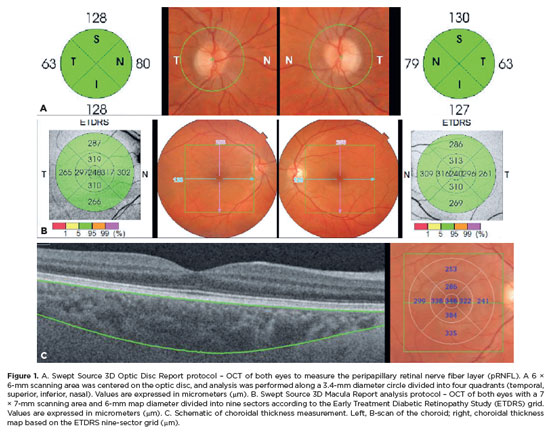
PURPOSE: To evaluate the relationships between retinal changes identified by optical coherence tomography in patients with migraine with aura or migraine without aura and the duration and severity of the disease, as measured by the questionnaire.
METHODS: In this cross-sectional study, 16 patients with migraine with aura and 15 patients with migraine without aura were compared with 16 age- and sex-matched controls without migraine. Retinal parameters were assessed using optical coherence tomography, and disease severity was evaluated using scores.
RESULTS: Foveal choroidal thickness was significantly reduced in migraine patients to controls (p=0.040). Negative correlations were observed between disease duration and total macular thickness (p=0.037), ganglion cell complex thickness (p=0.017), and choroidal thickness (p=0.039) in the migraine without aura Group. Additionally, scores showed an inverse correlation with peripapillary retinal nerve fiber layer thickness (p=0.027) in the migraine without aura Group.
CONCLUSION: Individuals with migraine exhibited significant choroidal thinning compared with controls. Longer disease duration was associated with reduced total macular, ganglion cell complex, and choroidal thickness, while greater migraine-related disability correlated with thinner peripapillary retinal nerve fiber layers.
Keywords: Migraine with aura; Migraine without aura; Nerve fibers; Retina; Macula; Optic disc; Choroid; Tomography, optical coherence; Surveys and questionnaires.
Arq. Bras. Oftalmol. 2025;88 (6 )
:1-9
| DOI: 10.5935/0004-2749.2024-0411
Abstract
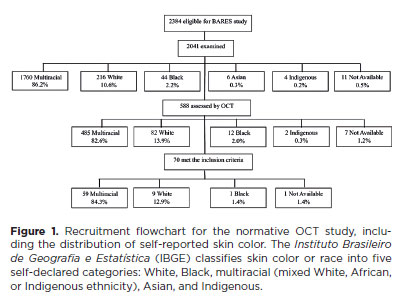
PURPOSE: This study evaluated macular thickness using spectral-domain optical coherence tomography in healthy participants from a population-based eye survey.
METHODS: The Brazilian Amazon Region Eye Survey was a population-based study assessing the prevalence and causes of visual impairment, blindness, and ocular diseases in adults aged ≥45 years from urban and rural areas of Parintins. A subgroup was selected based on inclusion criteria for both eyes: best-corrected visual acuity ≥20/32, normal eye examination results, and no prior ocular surgery. Scans were performed using the iVue optical coherence tomography device. Measurements were taken from the nine subfields defined by the Early Treatment Diabetic Retinopathy Study, examining the full retina as well as the inner and outer retinal layers. Associations of retinal thickness with age and sex were also analyzed. Statistical significance was set at p≤0.05.
RESULTS: In total, 70 healthy participants (25 males), aged 45–65 years (mean=52 ± 5), were included. Mean central foveal thickness was 248.71 ± 18.73 μm. A significant age-related reduction in macular thickness was observed, particularly in the inner superior parafovea (p=0.036), nasal perifovea (p=0.001), superior perifovea (p=0.028), outer layer of inferior parafovea (p=0.049), and the inferior perifovea of the full retina (p=0.029). Males showed significantly greater thickness in the outer layer, especially in the outer parafovea (p=0.004) and perifovea (p<0.0001).
CONCLUSIONS: This study established normative macular thickness values for healthy older adults in the Brazilian Amazon region using spectral-domain optical coherence tomography. Age and sex were found to significantly influence macular thickness and should be considered when interpreting measurements. These data will support future studies of retinal diseases in this population.
Keywords: Retinal diseases/diagnosis; Macula lutea/pathology; Macular degeneration/diagnosis; Diabetic retinopathy/diagnosis; Vision, low; Vision tests; Tomography, optical coherence/methods; Young adult; Cross-sectional studies; Brazil/epidemiology


 ABO is licensed under a Creative Commons Attribution-NonComercial 4.0 Internacional.


01-tab01tb.jpg)
08-fig01.jpg)
12-fig01.jpg)
08-fig01.jpg)
01-fig01tb.jpg)
01-fig01.jpg)
03-fig01.jpg)
03-fig01.jpg)
04-fig01.jpg)
03-fig01.jpg)
05-fig01tb.jpg)