Arq. Bras. Oftalmol. 2021;84 (3 )
:214-219
| DOI: 10.5935/0004-2749.20210029
Abstract
OBJETIVO: Avaliar a influência da dinâmica pupilar na curva de desfoco de olhos implantados com lente intraoculares multifocais difrativas.
MÉTODOS: Estudo prospectivo e randomizado realizado na Faculdade de Medicina de Ribeirão Preto - Universidade de São Paulo - Departamento de Oftalmologia. Trinta e oito pacientes foram aleatoriamente designados para receber bilateralmente lentes intraoculares SN6AD1 (n=20) (mfIOL) ou SN60WF (n=18) (aIOL). Além da acuidade visual para longe e perto, corrigida e não corrigida, e curva de desfoco, foi ainda realizada pupilometria dinâmica. A área sob a curva de desfoco foi calculada usando um modelo polinomial empírico.
RESULTADOS: Um total de 16 e 17 pacientes (n=32 e 34 olhos) completaram 1 ano de seguimento nos grupos mfIOL e aIOL, respectivamente. Não houve diferenças significativas entre grupos para as acuidades visuais seja para longe ou perto. As curvas de desfoco do grupo mfIOL mostraram um pico duplo; enquanto o SN60WF mostrou apenas um pico, típico para uma lente intraoculares monofocal. A média da área sob a curva de desfoco do grupo aIOL foi (4,66 ± 1,51 logMAR.dp), e essa é estatisticamente significante diferente da métrica do grupo mfIOL (1,99 ± 1,31 logMAR.dp). A pupila na contração máxima após a exposição a um flash de 30 cd/m2 por 1 segundo foi significativamente correlacionada com uma melhor área de foco no grupo mfIOL (r=0,54; p=0,0017), essa relação não foi observada para o grupo aIOL.
CONCLUSÃO: Estes dados indicam que quanto menor a pupila durante contração, melhor é a área sob a curva de desfoco e, portanto, o desempenho visual dos olhos implantados com essa mfIOL. Esta correlação não foi encontrada para lentes intraoculares monofocais.
Keywords: Lentes intraoculares multifocais; Pupila/fisiologia, Catarata; Facoemulsificacão
Arq. Bras. Oftalmol. 2022;85 (1 )
:25-29
| DOI: 10.5935/0004-2749.20210091
Abstract
Objetivo: Avaliar e comparar a variação do diâmetro pupilar antes e após a cirurgia de catarata por facoemulsificação convencional versus cirurgia de catarata assistida por laser de femtossegundo, usando o LDV Z8 (Ziemer Ophtalmic). Também avaliamos a relação entre o diâmetro pupilar com o tempo da cirurgia e o tempo de ultrassom.
Métodos: Estudo comparativo prospectivo, realizado no Centro de Excelência em Oftalmologia, Brasil. Foram incluídos 79 olhos de 67 pacientes com opacidade nuclear. Os mesmos foram divididos em Grupo Controle, que foi submetido a cirurgia de catarata com facoemulsificação manual, e Grupo Estudo, com catarata assistida por laser de femtossegundo. Todas as cirurgias foram realizadas pelo mesmo cirurgião experiente. Todos os pacientes receberam antiinflamatório não esteróide tópico no dia anterior à cirurgia e o mesmo colírio midriático no pré-operatório. Para quantificar o tamanho da pupila, as medidas foram realizadas usando um compasso cirúrgico: anterior ao procedimento de facoemulsificação e ao final da cirurgia. No grupo de estudo, medidas após o laser foram adicionadas. O tempo cirúrgico e o tempo de facoemulsificação também foram analisados.
Resultados: Não foi encontrada diferença significativa entre o tamanho da pupila pré-femto x pré-faco (8,69 ± 0,44 mm x 8,63 ± 0,72 mm; p=0,643), bem como o tamanho da pupila no final da cirurgia (7,96 ± 0,98 mm x 7,78 ± 0,95 mm; p=0,480) e o tempo médio de cirurgia (p=0,780). No entanto, no grupo de catarata assistida por laser de femtossegundo, houve um aumento transitório do diâmetro pupilar após o laser, indicando uma tendência para maior variação no grupo femto.
Conclusões: Embora o diâmetro pupilar fosse semelhante ao final da cirurgia, o grupo com catarata assistida por laser de femtossegundo apresentou maior variação intraoperatória da pupila. Portanto, para uma cirurgia de catarata assistida por laser de femtossegundo mais eficiente e segura, o cirurgião deve estar ciente do tamanho do diâmetro pupilar antes do procedimento.
Keywords: Catarata; Miose; Facoemulsificação; Laser; Pupila
Arq. Bras. Oftalmol. 2026;89 (1 )
:1-5
| DOI: 10.5935/0004-2749.2025-0045
Abstract
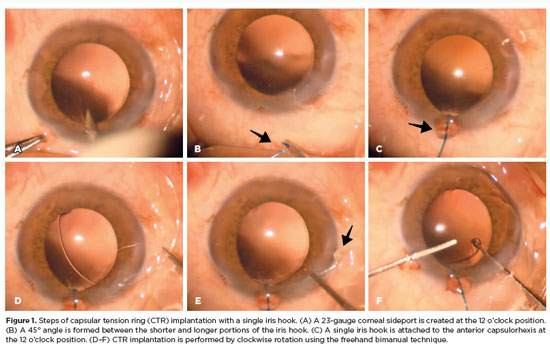
PURPOSE: To evaluate the effect of using a single iris retractor, affixed to the anterior capsulorhexis at the 12 o'clock position, on the ease of capsular tension ring implantation.
METHODS: This prospective comparative study comprised 37 patients with zonular weakness attributed to pseudoexfoliation syndrome who underwent capsular tension ring implantation during cataract surgery. In Group 1, a single iris retractor was inserted into the anterior capsulorhexis at the 12 o'clock position. Group 2 did not receive this intervention. Zonular weakness was graded on a scale of 1–5, and the subjective difficulty of capsular tension ring implantation was categorized as easy, medium, or difficult.
RESULTS: Group 1 and 2 comprised 20 and 17 patients, respectively. There were no significant differences between the groups in age, sex distribution, and presence of glaucoma (p=0.53, p=0.28, and p=1.00, respectively). The mean zonular weakness score was significantly higher in Group 1 (3.35 ± 0.45) than in Group 2 (2.71 ± 0.59; p=0.02). Capsular tension ring implantation was significantly easier in the iris retractor group (p<0.001).
CONCLUSIONS: Placement of a single iris retractor attached to the anterior capsulorhexis at the 12 o'clock position may facilitate easier capsular tension ring implantation, even in patients with greater zonular weakness. This technique could reduce the risk of capsular tension ring displacement into the iridocorneal angle or ciliary sulcus.
Keywords: Capsular tension ring; Cataract; Iris hook; Pseudoexfoliation syndrome; Zonular weakness; Cataract extraction; Phacoemulsification; Capsulorhexis.
Arq. Bras. Oftalmol. 2021;84 (2 )
:158-162
| DOI: 10.5935/0004-2749.20210024
Abstract
OBJETIVO: Avaliar o momento apropriado para implante de anel de tensão capsular em casos de fraqueza zonular devida à síndrome pseudoesfoliativa.
MÉTODOS: Este foi um estudo prospectivo e comparativo realizado no Departamento de Oftalmologia da Universidade İnönü. Foram incluídos 43 pacientes, sendo 16 no grupo 1 e 27 no grupo 2. O grupo 1 era composto de pacientes que se submeteram ao implante precoce do anel de tensão capsular, enquanto no grupo 2 os pacientes tiveram implante tardio. Foram incluídos pacientes com síndrome pseudoesfoliativa submetidos à cirurgia de facoemulsificação e ao implante de lente intraocular na câmara posterior e anel de tensão capsular. Em cada olho, foram avaliadas as complicações intraoperatórias e as dificuldades tanto com a implantação do anel de tensão capsular quanto com a remoção do córtex.
RESULTADOS: Não houve diferença significativa entre os grupos quanto à dificuldade de implante do anel de tensão capsular (p=0,124). Ao se comparar as remoções do córtex, observou-se diferença significativa entre os grupos (p=0,003). Complicações intraoperatórias foram observadas em 3 pacientes do grupo 1 e 11 pacientes do grupo 2; porém, não houve diferença significativa entre os grupos (p=0,18). No grupo 2, observaram-se flutuações da cápsula posterior em 8 pacientes (29,5%), com ruptura da cápsula posterior em dois deles.
CONCLUSÕES: A remoção do córtex é mais difícil no implante precoce do anel de tensão capsular e flutuações da cápsula posterior podem causar problemas no implante tardio do anel de tensão capsular. O cirurgião deve ponderar a relação risco/benefício do implante precoce e tardio ao avaliar o momento ideal para implante de anel de tensão capsular.
Keywords: Catarata; Facoemulsificação; Anel de tensão capsular
Arq. Bras. Oftalmol. 2025;88 (6 )
:1-8
| DOI: 10.5935/0004-2749.2024-0394
Abstract
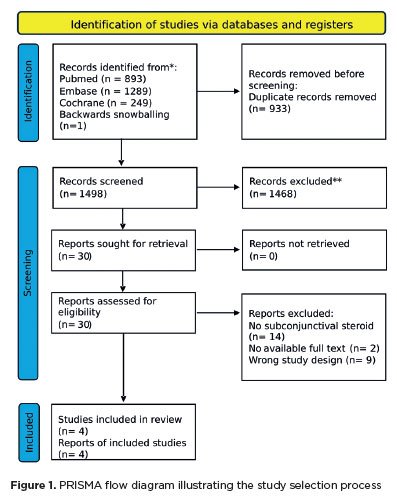
The advantages and disadvantages of using perioperative subconjunctival steroid injections in dropless cataract surgery continue to be debated. A systematic review of PubMed, EMBASE, and the Cochrane Central database identified five studies—two randomized controlled trials and three non-randomized studies—encompassing 70,751 eyes. Among these, 12,319 eyes (17.4%) received subconjunctival steroid injections, while 58,432 eyes (82.6%) were managed with topical steroids. The Cochrane Collaboration’s RoB 2 tool was applied for bias assessments in randomized controlled trials, and heterogeneity was assessed using the I² statistics. No statistically significant differences were found between the two groups regarding macular edema (p=0.249), visual acuity (p=0.73), or laser flare count (p=0.45). Both subconjunctival injections and topical steroids demonstrated comparable efficacy and safety in controlling postoperative inflammation after cataract surgery. Additional research is warranted to validate these conclusions.
Keywords: Cataract extraction; Phacoemulsification; Lens implantation, intraocular; Postoperative care; Intravitreal injections; Anti-inflammatory agents, non-steroidal/administration & dosage; Glucocorticoids; Triamcinolone acetonide; Research design; Randomiz
Arq. Bras. Oftalmol. 2025;88 (3 )
:1-6
| DOI: 10.5935/0004-2749.2023-0345
Abstract
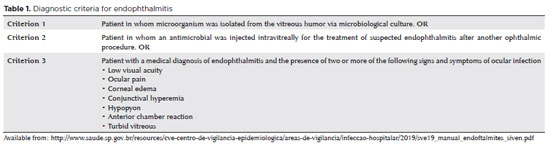
PURPOSE: To determine the impact of prophylactic intracameral cefuroxime administration on the post-cataract surgery endophthalmitis rates and analyze its safety.
METHODS: The incidence of post-phacoemulsification endophthalmitis before and after the introduction of antibiotic prophylaxis with cefuroxime was compared. Data were extracted from the electronic medical records of patients who underwent cataract surgery between July 2019 and July 2022 at a tertiary-care hospital. Data were also collected from the Hospital Infection Control Service database. Statistical analysis was performed to assess the efficacy of cefuroxime prophylaxis in reducing endophthalmitis rates.
RESULTS: Of the 4459 cataract surgeries included in the study, 2247 were included in the control group (pre-cefuroxime), and 2212 were included in the post-cefuroxime (ATB-P) Group. In the control group, 6 (0.13%) cases of endophthalmitis were reported. In the ATB-P Group, there were no cases of acute endophthalmitis. The frequency of endophthalmitis was significantly higher in the control group than in the ATB-P Group (p=0.016). Furthermore, Staphylococcus sp. was the most identified causative agent (75%). No adverse effects were reported after cefuroxime administration.
CONCLUSION: The introduction of intracameral prophylaxis with cefuroxime significantly reduced the incidence of post-cataract surgery endophthalmitis. Additionally, its administration is safe.
Keywords: Cataract extraction; Endophthalmitis; Antibiotic prophylaxis; Injections; Cefuroxime
Arq. Bras. Oftalmol. 2024;87 (3 )
:1-7
| DOI: 10.5935/0004-2749.2021-0493
Abstract
Objetivo: Avaliar a qualidade de vida e o nível de estresse relacionada à função visual após a cirurgia de catarata pediátrica em um hospital público brasileiro.
Métodos: Estudo prospectivo em crianças de seis a 14 anos submetidas à cirurgia de catarata. A Escala de Stresse Infantil e o Questionário de Função Visual em Crianças foram usados para avaliar o nível de estresse e a qualidade de vida, respectivamente. Ambos os instrumentos foram aplicados por duas psicólogas antes e após a cirurgia. O exame oftalmológico foi realizado por dois oftalmologistas. Os dados coletados no pré e pós-operatório foram comparado.
Resultados: Vinte e três crianças (32 olhos) foram incluídas no estudo, nove delas apresentavam catarata bilateral. A média de idade na cirurgia foi de 9,65±2,26 (6 a 14) anos. Um mês após a cirurgia, o equivalente esférico foi de -0,90 ± 1,66D e a acuidade visual corrigida a distância foi de 0,13 ± 0,10 (0-0,3) LogMAR em casos bilaterais e 0,50 ± 0,39 (0-1,3) LogMAR em casos unilaterais (p<0.01). De acordo com a Escala de Stresse Infantil, 77,7% dos casos de catarata bilaterais, e 57,1% dos casos unilaterais mantiveram o nível de estresse e 34,7% das crianças melhoraram o nível de estresse. A análise do Questionário de Função Visual em Crianças foi baseada em pontuações para saúde geral, saúde geral da visão, competência, personalidade e tratamento. Após a cirurgia de catarata, 78,2% dos pacientes melhoraram ou mantiveram o escore do Questionário de Função Visual em Crianças na saúde geral, 82,6% na saúde geral da visão, 95,6% na competência, 56,5% na personalidade e 78,2% no tratamento.
Conclusão: A cirurgia de catarata pediátrica melhora a função visual e a qualidade de vida em pacientes submetidos a procedimento cirúrgico, sem aumentar o nível de estresse.
Keywords: Catarata; Extração de catarata; Experiências adversas da infância Qualidade de vida; Criança
Arq. Bras. Oftalmol. 2025;88 (5 )
:1-8
| DOI: 10.5935/0004-2749.2024-0328
Abstract
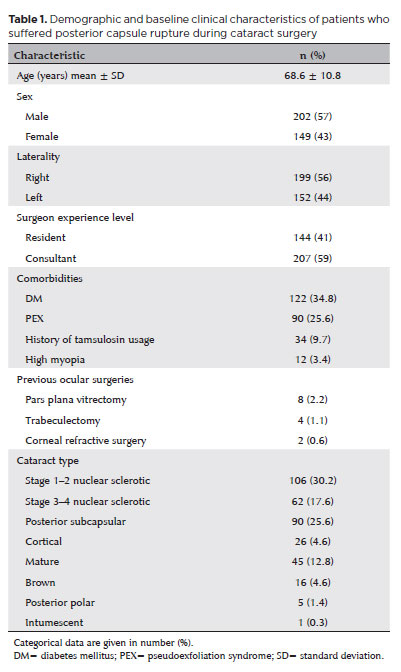
PURPOSE: Posterior capsule rupture is defined as an intraoperative posterior capsule tear resulting in vitreous loss. This study aimed to analyze the clinical characteristics, preoperative risk factors, intraoperative management strategies, and postoperative complications associated with posterior capsule rupture during phacoemulsification surgery.
METHODS: This was a retrospective observational cohort study of the medical records for 25,224 phacoemulsification surgeries performed at our tertiary eye care center between 2017 and 2022. We collected and collated the demographic characteristics and clinical findings of the patients in our cohort. Intraoperative management strategies and postoperative outcomes over a 1-year followup period were also recorded.
RESULTS: Posterior capsule rupture occurred in 351 eyes (351 patients), giving an overall posterior capsule rupture rate of 1.3%. The mean patient age was 68.6 ± 10.8 years. Pseudoexfoliation syndrome, mature cataracts, brown cataracts, and surgery performed by a resident were identified as risk factors for posterior capsule rupture (p<0.05 for each; the risk ratios were 2.70, 2.15, 2.44, 1.34, respectively). The most common intraoperative complications were dislocated lens fragments in the vitreous (8%) and iris damage (7.1%). The mean best-corrected visual acuity improved from 1.31 ± 0.84 (logMAR) postoperatively to 0.51 ± 0.56 at the end of the 1-year follow-up period (p<0.001). Corneal edema (55.6%) and elevated intraocular pressure (33.3%) were the most common early postoperative complications. Persistently elevated intraocular pressure (11.1%) and cystoid macular edema (5.1%) were the most common late postoperative complications.
CONCLUSION: Posterior capsule rupture is a common complication of phacoemulsification surgery that requires prolonged postoperative follow-up and a multidisciplinary approach. Despite the increased incidence of complications when rupture occurs, appropriate intraoperative and postoperative management can lead to satisfactory visual outcomes.
Keywords: Cataract extraction; Phacoemulsification; Posterior capsule rupture; Corneal edema; Risk factors; Postoperative complications; Intraoperative complications
Arq. Bras. Oftalmol. 2025;88 (5 )
:1-7
| DOI: 10.5935/0004-2749.2024-0368
Abstract
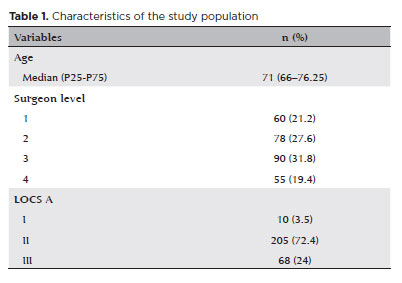
PURPOSE: To compare endothelial corneal cell changes following cataract surgery performed by phacoemulsification with intraocular lens implantation, conducted by surgeons with varying levels of experience.
METHODS: Two hundred and eighty-three eyes diagnosed with cataract were included. Lens opacity was classified into three categories (I, II, and III). Surgeons were categorized into four experience levels (1, 2, 3, and 4), based on years of practice and lifetime surgeries performed. Corneal endothelial characteristics were assessed using non-contact specular microscopy, with measurements taken before surgery and 30-60 days post-surgery.
RESULTS: Pre- and postoperative endothelial analysis showed no significant differences between surgeon levels regarding visual acuity achieved, corneal thickness, and endothelial hexagonality. However, the central endothelial cell density index showed a significantly greater reduction among level 1 surgeons (p=0.026). Grade II cataracts exhibited significant variations in the central endothelial cell density (p=0.011) and average cell size, with level 1 surgeons showing the largest increases (p=0.024).
CONCLUSIONS: The analysis revealed significant differences in visual acuity and endothelial indices between surgeon experience levels, with less experienced surgeons showing greater variations and poorer performance. Clinical protocols should consider these data to establish safer training protocols.
Keywords: Cataract extraction; Phacoemulsification; Endothelium; corneal; Lens implantation, intraocular; Visual acuity; Internship and residency; Surgeons
Arq. Bras. Oftalmol. 2025;88 (3 )
:1-5
| DOI: 10.5935/0004-2749.2024-0084
Abstract
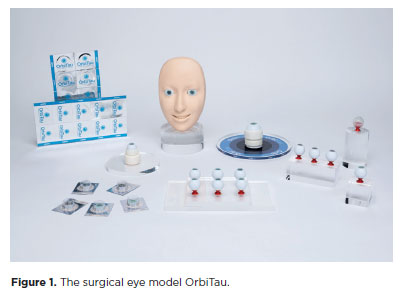
PURPOSE: The OrbiTau surgical simulator is a synthetic eye model developed to enhance cataract surgical training. Herein, we aimed to describe the perspectives of Harvard’s Ophthalmology faculty and residents regarding the effectiveness of OrbiTau.
METHODS: A cross-sectional study was conducted in which 11 surgeons from the Massachusetts Eye and Ear Infirmary, with prior experience utilizing simulated phacoemulsification platforms, conducted cataract surgery with the OrbiTau. Subsequently, they completed a satisfaction questionnaire using the Likert scale.
RESULTS: Regarding the various OrbiTau components, 90.90% of the participants reported that the OrbiTau lens capsule was comparable to that of the human lens during capsulotomy. Furthermore, 72.72% of the participants found that the OrbiTau lens consistency was analogous to that of the human lens nucleus. Approximately 63.63% of the participants reported that the model’s posterior lens capsule resembled the native posterior capsule, and 72.72% of the participants noted that the model’s red reflex was similar to that of the dilated human pupil. Most participants believed that the OrbiTau was easier to use and more realistic than other commercially available simulators.
CONCLUSION: Our single-institution survey of the Orbitau demonstrated that this model realistically replicates ocular structures and may be a viable option for cataract surgery training.
Keywords: Cataract extraction/education; Simulation training/methods; Ophthalmology/education; Phacoemulsification/education; Ophthalmologists/education; Surgeons/education; High fidelity simulation training
Arq. Bras. Oftalmol. 2024;87 (3 )
:1-5
| DOI: 10.5935/0004-2749.2023-0038
Abstract
PURPOSE: To assess the effect of the coronavirus disease 2019 (COVID-19) pandemic on cataract surgery by residents who had mandatory surgical simulator training during residency.
METHODS: In this retrospective, observational analytical study, the total number of cataract surgeries and surgical complications by all senior residents of 2019 (2019 class; prepandemic) and 2020 (2020 class; affected by the reduced number of elective surgeries due to the COVID-19 pandemic) were collected and compared. All residents had routine mandatory cataract surgery training on a virtual surgical simulator during residency. The total score obtained by these residents on cataract challenges of the surgical simulator was also evaluated.
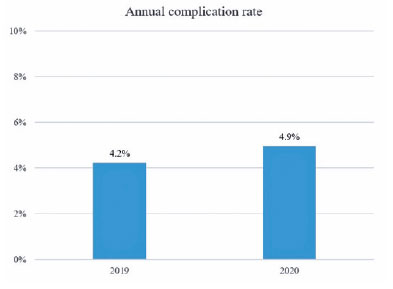
RESULTS: The 2020 and 2019 classes performed 1275 and 2561 cataract surgeries, respectively. This revealed a reduction of 50.2% in the total number of procedures performed by the 2020 class because of the pandemic. The incidence of surgical complications was not statistically different between the two groups (4.2% in the 2019 class and 4.9% in the 2020 class; p=0.314). Both groups also did not differ in their mean scores on the simulator’s cataract challenges (p<0.696).
CONCLUSION: Despite the reduction of 50.2% in the total number of cataract surgeries performed by senior residents of 2020 during the COVID-19 pandemic, the incidence of surgical complications did not increase. This suggests that surgical simulator training during residency mitigated the negative effects of the reduced surgical volume during the pandemic.
Keywords: COVID-19; Pandemics; Cataract extraction/education; Internship and residency/methods; Simulation training/methods; Phacoemulsification/education; Surgery, computer-assisted; Computer simulation; Clinical competence; Ophthalmology/education


 ABO is licensed under a Creative Commons Attribution-NonComercial 4.0 Internacional.


03-fig01.jpg)
03-tab01tb.jpg)
11-tab01tb.jpg)
14-tab01tb.jpg)
13-fig01.jpg)
12-fig01.jpg)