Arq. Bras. Oftalmol. 2022;85 (6 )
:599-605
| DOI: 10.5935/0004-2749.20220082
Abstract
Objetivo: Avaliar as características clínicas de pacientes pediátricos com blefaroptose adquirida unilateral, transitória e de início agudo.
Métodos: Neste estudo retrospectivo, foram revisados prontuários clínicos entre abril de 2015 e junho de 2020. Os pacientes foram avaliados em termos de características demográficas, manifestações neurológicas e oftalmológicas associadas, duração dos sintomas, etiologia e achados de imagem. Foram excluídos pacientes com blefaroptose congênita e com blefaroptose adquirida de etiologia crônica.
Resultados: Foram incluídos neste estudo 16 pacientes pediátricos (10 masculinos e 6 femininos) com blefaroptose adquirida transitória unilateral de início agudo. A média de idade dos pacientes foi de 6,93 ± 3,16 anos. As causas etiológicas mais comumente identificadas foram trauma em 7 pacientes (43,75%) e infecção (casos parainfecciosos) em 5 pacientes (31,25%). Além disso, a síndrome de Miller-Fisher, a síndrome de Horner secundária a neuroblastoma, a síndrome de Brown adquirida e pseudotumor cerebral foram determinados como causas etiológicas em um paciente cada uma. Achados oculares adicionais estavam associados à blefaroptose em 7 pacientes (58,33%). Foi observada a resolução espontânea da blefaroptose, sem tratamento, em todos os pacientes, exceto nos pacientes com síndrome de Miller-Fisher, neuroblastoma e pseudotumor cerebral. Nenhum paciente precisou de tratamento cirúrgico. Morbidades oculares, como ambliopia, não foram encontradas em nenhum paciente.
Conclusão: Este estudo demonstrou que a blefaroptose transitória unilateral de início agudo, rara na infância, pode regredir sem a necessidade de tratamento cirúrgico na população pediátrica. No entanto, também não deve ser esquecido que patologias graves que requerem tratamento podem se apresentar com blefaroptose.
Keywords: Blefaroptose; Trauma craniocerebral; Síndrome de Miller Fisher; Síndrome de Horner; Criança
Arq. Bras. Oftalmol. 2025;88 (4 )
:1-6
| DOI: 10.5935/0004-2749.2024-0278
Abstract
PURPOSE: This study aimed to evaluate the prevalence of orbital conditions in a tertiary ophthalmic outpatient hospital in Sao Paulo, Brazil, with a focus on the main diagnoses and their distribution.
METHODS: A retrospective chart review was conducted involving patients registered and admitted to the orbital disease unit at the Department of Ophthalmology, University of São Paulo Medical School, from January 2004 to March 2018. A total of 838 medical charts were analyzed, of which 37 were excluded due to incomplete data. The remaining charts were categorized into eight diagnostic groups: Graves’ orbitopathy , inflammatory disorders, tumors, vascular lesions, acquired structural abnormalities, congenital structural abnormalities, infectious diseases, and others.
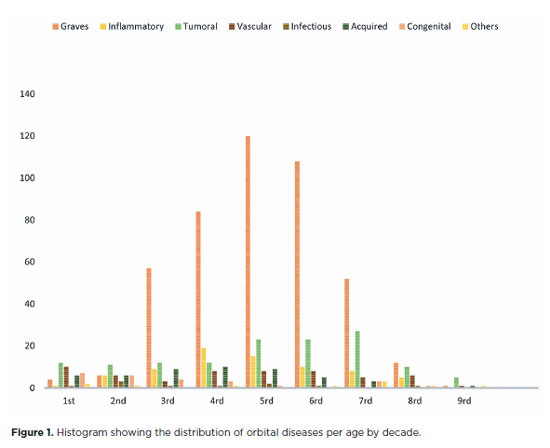
RESULTS: Of the 837,300 ophthalmological appointments, 3,372 (0.4%) were related to orbital diseases. The study included 801 patients, of whom 63.45% were women. The patients’ mean age was 42.86 years. Graves’ orbitopathy was the most common (55%), followed by tumor (17%), inflammatory disorders (9%), vascular lesions (7%), acquired structural abnormalities (5%), congenital structural abnormalities (4%), others (2%), and infectious diseases (1%). The study found significant differences in the incidence and types of orbital diseases, indicating the specialized nature of tertiary care and referral biases.
CONCLUSION: Published data on epidemiological orbital diseases is scarce. Therefore, this study focused on the diverse nature of orbital diseases and their low incidence among ophthalmology appointments. The major trends align with other epidemiological studies, demonstrating a preponderance of Graves’ orbitopathy in middle-aged adults and a bimodal distribution of tumors. These findings are essential in shaping resident training programs and healthcare policies, particularly in tertiary settings. Understanding the epidemiology of orbital diseases can improve diagnostic accuracy, treatment approaches, and patient outcomes as well as support future systemic prospective studies.
Keywords: Orbital diseases; Orbital tumors; Neoplasms; Inflammation; Graves’ ophthalmopathy; Outpatients


 ABO is licensed under a Creative Commons Attribution-NonComercial 4.0 Internacional.


07-tab01tb.jpg)
08-fig01.jpg)
12-fig01.jpg)
11-fig01.jpg)
08-fig01.jpg)

14-fig01.jpg)
02-fig01.jpg)
03-fig01.jpg)
03-fig01.jpg)
02-fig01.jpg)