Arq. Bras. Oftalmol. 2026; 89 (2): 10.5935/0004-2749.2025-0348
Total: 1258
Mayumi Shirota Kanamura; Silvana Artioli Schellini
DOI: 10.5935/0004-2749.2025-0348
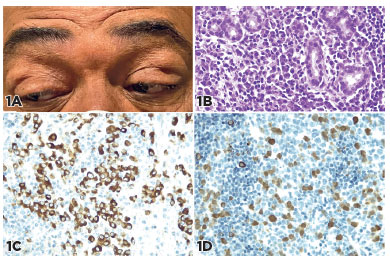
A 58-year-old male presented with bilateral periorbital swelling, ptosis, and lacrimal gland enlargement (Figure 1A). IgG4-related disease is a systemic immune-mediated condition that can affect multiple organs, including orbital structures; however, lacrimal gland involvement is relatively uncommon, particularly in Eastern countries(1,2). Diagnosis is based on imaging and histopathological examination, which typically demonstrate dense lymphocytic infiltration, fibrosis, and IgG4-positive plasma cells (Figure 1B–D), allowing exclusion of conditions such as Mikuliz disease(3), Sjögren's syndrome, lymphoma, and idiopathic orbital inflammation(3). Management generally includes systemic corticosteroids, immunosuppressive therapy, and careful long-term follow-up(1,3).
REFERENCES
1. Huang S, Juniat V, Satchi K, Cohen LM, Davis G, Rootman DB, et al. Bilateral lacrimal gland disease: clinical features and outcomes. Eye (Lond). 2022;36(11):2163-71.
2. Ito M, Vaidya A, Kakizaki H, Takahashi Y. Spontaneous regression of immunoglobulin G4-related dacryoadenitis and multiple organ involvement: A case report. Medicine (Baltimore). 2023;102(1):e32618.
3. Bae DH, Kim YR, Yang W, Kim GI, Lew H, Yoo J. Function of immune checkpoints in IgG4–related disease with lacrimal gland involvement: clinical features, serum igG4 level, immunohistochemical landscape, and treatment responses. Int J Mol Sci. 2025;26(7):3021.
Data Availability Statement: The datasets generated and/or analyzed during the current study are already available.
Edited by:
Editor-in-Chief: Newton Kara-Júnior
Submitted for publication:
December 18, 2025.
Accepted for publication:
January 21, 2026.
Funding: This study received no specific financial support.
Disclosure of potential conflicts of interest: The authors declare no potential conflicts of interest.

How to cite this article:
 ABO is licensed under a Creative Commons Attribution-NonComercial 4.0 Internacional.