
Arq. Bras. Oftalmol. 2026; 89 (2): 10.5935/0004-2749.2025-0224
Total: 1609
Rosângela Demetrio; Adriano Cypriano Faneli; Denise de Freitas; Caio Vinicius Saito Regatieri
DOI: 10.5935/0004-2749.2025-0224
ABSTRACT
PURPOSE: To evaluate the academic and professional trajectories of graduates from the Graduate Program in Ophthalmology and Visual Sciences at the Escola Paulista de Medicina, Universidade Federal de São Paulo, including geographic distribution, occupational characteristics, and scientific productivity.
METHODS: This descriptive, retrospective, quantitative study included 498 alumni who completed the program between 1979 and 2021. Data were obtained from institutional records and supplemented by public databases (Google Scholar, Lattes Platform, and LinkedIn). The analyzed variables included demographic characteristics, academic background, current professional role, and bibliometric indicators (citation count and h-index). Statistical analyses comprised nonparametric tests and linear regression, with a significance level set at 5%.
RESULTS: Most alumni were Brazilian (96.6%) and physicians (90.7%), predominantly located in the Southeast region (66.9%). Doctoral training was completed by 80.5% of participants. Alumni with current institutional ties to Universidade Federal de São Paulo or Hospital São Paulo demonstrated significantly higher citation counts and h-index values. No significant correlation was observed between time since graduation and citation count (p=0.185). Alumni engaged in academic roles or with postdoctoral training showed greater scientific productivity.
CONCLUSIONS: The findings highlight the strong academic performance and professional integration of alumni from Universidade Federal de São Paulo, particularly within public institutions and the Southeast region of Brazil. Doctoral training and institutional affiliation were associated with higher scientific productivity. Alumni tracking provides valuable insights into the impact of postgraduate programs and informs strategic planning and development.
Keywords: Factual databases; Program evaluation; Medical education; Graduate education; Ophthalmology; Linear models
INTRODUCTION
Graduate education in Brazil emerged in the mid-20th century as part of a national strategy to develop highly qualified professionals capable of advancing scientific, technological, and economic progress(1). The establishment of the Coordenação de Aperfeiçoamento de Pessoal de Nível Superior (CAPES) in 1951 marked a key milestone in structuring postgraduate programs and defining quality standards. Since then, the postgraduate sector has evolved substantially and now represents one of the primary drivers of Brazil’s National System for Science, Technology, and Innovation(2,3).
In recent decades, CAPES has increasingly emphasized evidence-based evaluations of postgraduate programs. Although faculty productivity has traditionally been a central criterion, more recent assessment frameworks have incorporated alumni outcomes—such as professional integration, scientific output, and institutional impact—as key indicators of program effectiveness(4,5). This shift aligns with international trends that recognize alumni tracking as an essential tool for strategic planning and accountability in higher education(6,7).
Ophthalmology is a highly specialized and research-intensive medical field. The Graduate Program in Ophthalmology and Visual Sciences at the Escola Paulista de Medicina, Universidade Federal de São Paulo (EPM/UNIFESP), accredited by CAPES in 1979, is among the oldest and most productive programs of its kind in Latin America. The program operates within a setting of high clinical demand, interdisciplinary collaboration, and strong academic infrastructure. Despite its long-standing academic excellence, systematic evaluations of alumni trajectories in ophthalmology postgraduate programs remain scarce in Brazil and internationally. The recent integration of scientometric indicators into graduate program evaluations has further underscored the need to quantify the academic impact of alumni(5,8). Metrics such as citation counts and the h-index, although not without limitations, are widely used to assess individual and institutional scientific productivity(9). These indicators inform decisions related to funding allocation, academic promotion, and program accreditation(10). However, the longitudinal relationship between time since graduation and scientific productivity remains poorly characterized, particularly within medical subspecialties (11).
The present study addresses this gap by analyzing the academic and professional profiles of 498 alumni from the EPM/UNIFESP Graduate Program in Ophthalmology and Visual Sciences who completed their training between 1979 and 2021. Specifically, we examined geographic distribution, institutional affiliations, and scientometric indicators, including citation counts and h-index values derived from Google Scholar. In addition, linear regression models were applied to evaluate whether time since completion of the highest academic degree was associated with citation metrics. This study contributes to the literature by presenting a replicable methodology for postgraduate program evaluation and by providing a publicly accessible, anonymized dataset to support transparency and reproducibility.
METHODS
This retrospective, descriptive, cross-sectional study analyzed the academic and professional trajectories of 498 alumni who graduated from the Graduate Program in Ophthalmology and Visual Sciences at the Escola Paulista de Medicina, Universidade Federal de São Paulo (EPM/UNIFESP), between 1979 and 2021. The study was conducted in accordance with the Declaration of Helsinki and was approved by the Research Ethics Committee of UNIFESP (approval no. 1.480.825; amendment no. 2.621.509).
Alumni identification and graduation records were obtained from the official database of the UNIFESP Graduate Office. Bibliometric data were collected between October and December 2022 from Google Scholar and cross-validated using the Lattes Platform and LinkedIn to ensure consistency of academic profiles and institutional affiliations. Supplementary information was retrieved from publicly available sources, including Google Scholar, the Lattes Curriculum Platform (maintained by the Brazilian National Council for Scientific and Technological Development), and LinkedIn(12).
The following variables were collected:
• Demographic data: age, sex, nationality, region of birth, and type of undergraduate institution (public or private).
• Academic data: postgraduate degree(s) obtained (Master’s degree, PhD, and postdoctoral fellowship), year of graduation, academic background (medical or non-medical), citation count, and h-index (Google Scholar)(13).
• Professional data: sector of employment (public, private, or both), work location (Brazil or abroad), institutional affiliation (UNIFESP or Hospital São Paulo), and type of professional activity (clinical practice, teaching/research, or combined).
The study cohort included all individuals who obtained a Master’s or PhD degree from the program during the study period. Records with incomplete information, duplicate entries, or degrees not formally conferred were excluded. For alumni who completed both a Master’s and a PhD degree, only the highest academic degree was included in the analysis.
Name disambiguation was performed through manual verification of publication lists, institutional affiliations, and ORCID identifiers when available. Twelve ambiguous profiles (2.4%) that could not be reliably confirmed were excluded from bibliometric analyses.
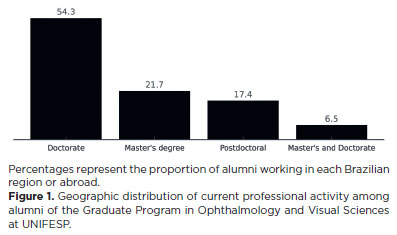
Scientific productivity was quantified using total citation counts and h-index scores retrieved from Google Scholar. Geographic location was categorized according to Brazil’s five official regions, with an additional category for alumni working abroad. Alumni were also classified based on their highest academic qualification and current professional role. Missing data were minimal (<5% per variable) and were addressed using a complete-case analysis. A flow diagram summarizing alumni identification, exclusion, and inclusion is presented in Figure 2.
Statistical analyses were performed using IBM SPSS Statistics version 25.0 (IBM Corp., Armonk, NY, USA). Continuous variables were assessed for normality using the Shapiro–Wilk test and were presented as medians and interquartile ranges (IQR) due to non-normal distributions(14). Citation counts and h-index values showed significant deviation from normality (p<0.001) and were therefore analyzed using nonparametric methods. Comparisons between two groups were conducted using the Mann–Whitney U test, while comparisons among three or more groups were conducted using the Kruskal–Wallis test with Bonferroni-adjusted post hoc analyses(15). Categorical variables were summarized as frequencies and percentages and compared using the chi-square test. Correlations between continuous nonparametric variables were assessed using Spearman’s rank correlation coefficient. A simple linear regression model was applied to evaluate whether time since the completion of the highest academic degree predicted citation count. Model assumptions of linearity, normality of residuals, and homoscedasticity were verified. Regression coefficients were reported with 95% confidence intervals (CIs) and corresponding p-values.
RESULTS
A total of 498 alumni from the Graduate Program in Ophthalmology and Visual Sciences at EPM/UNIFESP, who obtained a Master’s or PhD degree between 1979 and 2021, were included in the analysis. Of these, 285 (57.2%) and 213 (42.8%) held a Master’s and a PhD degree, respectively. The median age at the time of data collection was 47 years (interquartile range [IQR], 40–56), with a slight predominance of female participants (54.4%). Most alumni were born in the Southeast region of Brazil (67.1%), and the majority had completed their undergraduate education at public universities (71.5%, Table 1).
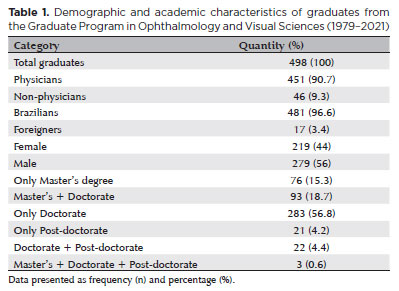
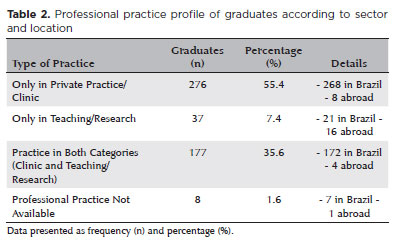
Regarding geographic distribution, 77.5% of alumni were working in Brazil at the time of data collection, predominantly in the Southeast region (60.1%). Approximately 22.5% were working abroad, mainly in North America and Europe (Figure 1). Most alumni were employed in the public sector (51.6%) or in both public and private sectors (35.7%), whereas a smaller proportion (12.7%) reported exclusive employment in the private sector. Professional roles were categorized as clinical (46.4%), academic (31.2%), or mixed clinical–academic (22.5%, Table 2).
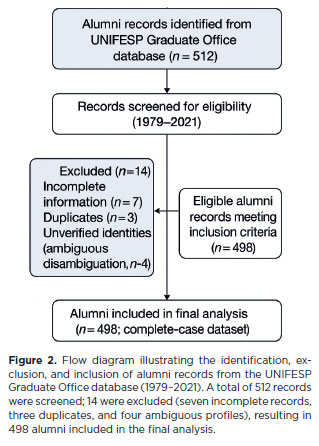
Analysis of academic background showed that most alumni (87.6%) held a medical degree, while 12.4% held degrees in other health-related or biological sciences. The number of alumni completing doctoral degrees increased steadily over the decades, with the highest number of PhD completions occurring between 2010 and 2020.
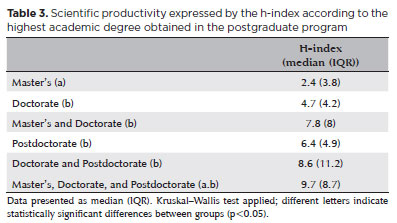
Scientific productivity was assessed using citation counts and h-index values obtained from Google Scholar. The median citation count and h-index were 112 (IQR, 26–389) and 5 (IQR, 2–10), respectively. PhD graduates demonstrated significantly higher median citation counts (233 vs. 42) and h-index values (8 vs. 3) than Master’s graduates (p<0.001 for both comparisons, Table 3).
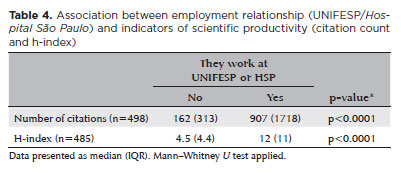
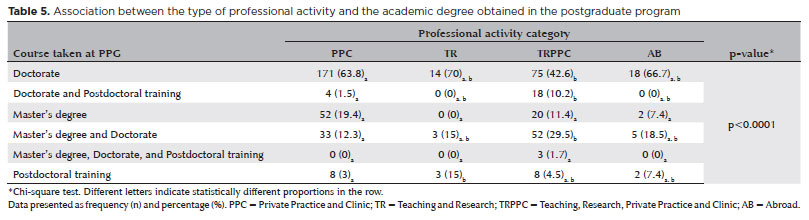
Nonparametric analyses revealed that alumni currently affiliated with UNIFESP or Hospital São Paulo had significantly higher citation counts and h-index values than those without academic affiliation (Table 4). Scientific productivity also varied according to professional activity, with higher median values observed among alumni engaged in teaching and research (Table 5).
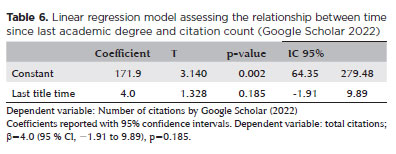
Spearman’s correlation analysis showed a moderate positive association between the number of years since degree completion and citation count (ρ=0.49, p<0.001). A simple linear regression model confirmed that time since the completion of the highest academic degree was a significant predictor of citation count (β=18.7, p<0.001, R²=0.24, Table 6).
DISCUSSION
This study provides a comprehensive evaluation of the academic and professional trajectories of alumni from the Graduate Program in Ophthalmology and Visual Sciences at EPM/UNIFESP, highlighting geographic distribution, professional engagement, and scientific productivity. Our findings indicate that most alumni are physicians (90.7%) and are predominantly engaged in clinical practice within Brazil’s Southeast region, reflecting a pattern of regional concentration consistent with previous studies on the retention of medical graduates(16).
The high proportion of doctoral degree holders (80.5%) observed in this cohort aligns with national trends demonstrating substantial expansion of doctoral programs relative to Master’s programs in Brazil(17,18). Alumni with PhD degrees exhibited significantly greater scientific productivity than Master’s graduates, reinforcing evidence that doctoral training is a key determinant of sustained research output(17,18).
A significant association was identified between scientific productivity—measured by citation counts and h-index values—and ongoing affiliation with academic institutions, particularly UNIFESP and Hospital São Paulo. This finding supports prior research indicating that institutional affiliation facilitates continued scholarly output through access to research infrastructure, mentorship, and collaborative networks(19,20). The median h-index (5) and citation count (112) observed in this study were comparable to the values reported for biomedical postgraduate programs at other major Brazilian institutions, such as Fiocruz and the Universidade Federal do Rio Grande do Sul, where median h-index values range from 4 to 7(21,22). These benchmarks place the UNIFESP program within the expected range of high-impact national postgraduate programs.
Time since degree completion showed a moderate positive correlation with citation count, and regression analysis confirmed the cumulative nature of scholarly impact over time(9). However, the moderate strength of this association suggests that factors such as professional role, institutional affiliation, and sustained research engagement might exert a stronger influence on productivity than elapsed time alone(23,24).
Although most alumni remained primarily in clinical roles, nearly half were involved in academic and research activities, underscoring the program’s contribution to training physician-scientists. Nevertheless, approximately 55% of alumni were not directly engaged in teaching or research, which might reflect limited academic employment opportunities within Brazil’s public institutions or individual career preferences favoring clinical practice(25,26). Institutional characteristics, including structured mentorship, access to research infrastructure, and exposure to funding mechanisms during training, likely played a role in sustaining long-term productivity. These findings highlight the importance of integrating formal mentorship programs and research management training into postgraduate curricula.
This study had limitations inherent to its retrospective design, including incomplete or outdated online profiles for some alumni, which may have introduced information bias(27). Future longitudinal and qualitative studies incorporating alumni interviews could provide deeper insights into factors influencing career trajectories and research productivity(28,29). Overall, this study underscores the importance of systematic alumni tracking to inform strategic planning and highlights opportunities for curricular enhancement and alumni support, particularly in fostering broader geographic diversity and interdisciplinary collaboration(30). Additionally, as this study was conducted at a single Brazilian institution, caution is warranted when generalizing the findings to other postgraduate contexts, given potential differences in institutional structure, funding, and career pathways.
In conclusion, alumni from the Graduate Program in Ophthalmology and Visual Sciences at EPM/UNIFESP demonstrate diverse academic and professional trajectories, with most engaged in clinical practice in Brazil. PhD holders exhibited significantly greater scientific productivity than Master’s graduates, and academic affiliation with UNIFESP or Hospital São Paulo was associated with higher productivity. The number of citations increased proportionally with time since graduation, reflecting the cumulative nature of scholarly impact. Together, these findings support the program’s effectiveness in developing physician-scientists and provide a useful framework for evaluating the outcomes of postgraduate training.
AUTHORS’ CONTRIBUTIONS
Significant contribution to conception and design: Rosângela Demetrio, Caio Vinicius Saito Regatieri. Data acquisition: Rosângela Demetrio, Adriano Cypriano Faneli, Caio Vinicius Saito Regatieri. Data analysis and interpretation: Rosângela Demetrio, Caio Vinicius Saito Regatieri. Manuscript drafting: Rosângela Demetrio, Caio Vinicius Saito Regatieri, Adriano Cypriano Faneli, Denise de Freitas. Significant intellectual content revision of the manuscript: Denise de Freitas, Caio Vinicius Saito Regatieri. Final approval of the submitted manuscript: Rosângela Demetrio, Caio Vinicius Saito Regatieri, Adriano Cypriano Faneli, Denise de Freitas. Statistical analysis: Rosângela Demetrio, Caio Vinicius Saito Regatieri. Obtaining funding: not applicable. Supervision of administrative, technical, or material support: Denise de Freitas, Caio Vinicius Saito Regatieri. Research group leadership: Denise de Freitas, Caio Vinicius Saito Regatieri.
REFERENCES
1. Schwartzman S. Formação da comunidade científica no Brasil: Financiadora de Estudos e Projetos; 1979.
2. Delgado IF, Andrade CLTd, Avanci JQ, Deslandes SF. Trajetória profissional e impacto da formação em egressos da Especialização da Fiocruz. Ciênc Saúde Colet. 2023;28 (4). Disponível em: http://cienciaesaudecoletiva.com.br/artigos/trajetoria-profissional-e-impacto-da-formacao-em-egressos-da-especializacao-da-fiocruz/18554?id=18554
3. Schwartzman S. Um espaço para a ciência - a formação da comunidade científica no Brasil. Campinas: Editora da Unnicamp; 2015.
4. Trevisol JV, Balsanello G. Os egressos como sujeitos do processo de autoavaliação: análise de uma experiência na Pós-Graduação. Quaestio - Rev Estudos Educ. 2023;25:e023035.
5. Souza CD, Filippo DD, Casado ES. Crescimento da atividade científica nas universidades federais brasileiras: análise por áreas temáticas. Avaliação: Rev Aval Educ Superior (Campinas). 2018;23(1). Disponível em: https://periodicos.uniso.br/avaliacao/article/view/3468
6. Altbach P, Salmi J, editors. The road to academic excellence: the making of world-class research universities. Washington DC: The World Bank; 2011.
7. Guimarães JA. A pesquisa médica e biomédica no Brasil: comparações com o desempenho científico brasileiro e mundial. Ciênc Saúde Colet . 2004;9:303-27.
8. Bornmann L. Measuring impact in research evaluations: a thorough discussion of methods for, effects of and problems with impact measurements. High Educ. 2017;73(5):775-87.
9. Deville P, Wang D, Sinatra R, Song C, Blondel VD, Barabási A-L. Career on the move: geography, stratification and scientific impact. Sci Rep. 2014;4(1):4770.
10. Gomes CM, Marchini G, Bessa Júnior Jd, Carvalhal G, Caldeira MP, Saldiva PH, et al. The landscape of biomedical research funding in Brazil: a current overview. Int Braz J Urol. 2024;50(2):209-22.
11. Guzman AK, Rzepecki AK, Lewis GD, Balagula Y, McLellan BN. Relationship between scholarly activity and postgraduate career choice: a bibliometric analysis of the 2017 diplomates of the American Board of Dermatology. J Grad Med Educ. 2020;12(4):455-60.
12. Martín-Martín A, Thelwall M, Orduna-Malea E, Delgado López-Cózar E. Google Scholar, Microsoft Academic, Scopus, Dimensions, Web of Science, and OpenCitations’ COCI: a multidisciplinary comparison of coverage via citations. Scientometrics. 2021;126(1):871-906.
13. Hirsch J. An Index to Quantify An Individual’s scientific research output. Proc Natl Acad Sci U S A. 2005;102(46):16569-72.
14. Ghasemi A, Zahediasl S. Normality tests for statistical analysis: a guide for non-statisticians. Int J Endocrinol Metab. 2012;10(2):486-9.
15. Dawson B, Trapp RG. Basic & clinical biostatistics. 4 ed. (Ebook). McGraw Hill LLC; 2004.
16. Purim KS, Borges LD, Possebom AC. Profile of the newly graduated physicians in southern Brazil and their professional insertion. Rev Col Bras Cir. 2016;43(4):295-300.
17. Velloso J. Mestres e doutores no país: destinos profissionais e políticas de pós-graduação. Cad Pesqui (Fund Carlos Chagas). 2004;34(123):34
18. Altbach PG, Salmi J. The Road to Academic Excellence: The Making of World-Class Research Universities: World Bank Publications; 2011.
19. Gutiérrez MG, Barros AL, Barbieri M. Seguimento de doutores egressos de um programa de pós-graduação em enfermagem. Acta Paul Enferm. 2019;32(2):129-38.
20. Ribeiro V, Garcia L, Caumo W, Capp E. Desempenho acadêmico de doutores egressos do Programa de Pós-Graduação em Medicina Ciências Médicas da Faculdade de Medicina da UFRGS. 2021.
21. Ribeiro V, Garcia L, Caumo W, Capp E. Desempenho acadêmico de doutores egressos do Programa de Pós-Graduação em Medicina Ciências Médicas da Faculdade de Medicina da UFRGS. Clinical & Biomedical Research. 2021;40(3):154-9.
22. (Fiocruz) FOC. Relatório de Avaliação dos Programas de Pós-Graduação Stricto Sensu da Fiocruz – 2017–2020. Rio de Janeiro: Fundação Oswaldo Cruz; 2023.
23. Martins O, Monte P. Um Recorte da Produção Científi ca dos Egressos de um Programa de Pós-Graduação Stricto Sensu em Contabilidade. Rev Contemp Contabil. 2009;6(12):127-50.
24. Moreira ML, Velho L. Trajetória de egressos da pós- graduação do Instituto Nacional de Pesquisas Espaciais: uma ferramenta para avaliação. Avaliação: Rev Aval Educ Sup. (Campinas). 2012;17. Disponível em: https://periodicos.uniso.br/avaliacao/article/view/754
25. Deslandes S, Pina JQ, Pinto LW, Delgado IF, Silva CM. Perfil e percurso profissional de egressos dos cursos de mestrado e doutorado da Fundação Oswaldo Cruz (2013-2020). Cad Saúde Públ. 2024;40(2): e00209222.
26. Engstrom EM, Hortale VA, Moreira CO. Trajetória profissional de egressos de Curso de Mestrado Profissional em Atenção Primária à Saúde no Município de Rio de Janeiro, Brasil: estudo avaliativo. Ciênci Saúde Colet. 2020;25(4):25.
27. Silva T, Bardagi M. O aluno de pós-graduação stricto sensu no Brasil: revisão da literatura dos últimos 20 anos. Rev Bras Pós-Grad. 2016;12(29). Disponível em: https://rbpg.capes.gov.br/rbpg/article/view/853.
28. Trevisol JV, Balsanello G. A pós-graduação sob a perspectiva dos egressos: um estudo de autoavaliação. Avaliação: Rev Aval Educ Superior (Campinas). 2022;27(3):470-92.
29. Barros MB, Vitullo NAV. Seminário do CCSA-UFRN: mapeamento temático das produções científicas na área de Ciência da Informação. Rev Inform Soc Contemp. 2017;1(3):1-13.
30. Castellanos M, Silveira A, Martins L, Nascimento V, Silva C, Bortollotte F, et al. Perfil dos egressos da Faculdade de Medicina do ABC: o que eles pensam sobre atenção primária em saúde? Arq Bras Ciênc Saúde. 2009;34(2):71-9.
Submitted for publication:
August 6, 2025.
Accepted for publication:
December 8, 2025.
Approved by the following research ethics committee: Universidade Federal de São Paulo – Hospital São Paulo – UNIFESP (CAAE: 54180716.2.0000.5505).
Data Availability Statement: The datasets generated and/or analyzed during the current study are available from the corresponding author upon reasonable request and subject to justified conditions.
Edited by
Editor-in-Chief: Newton Kara-Júnior
Associate Editor: Camila Koch
Funding: This study received no specific financial support.
Disclosure of potential conflicts of interest: The authors declare no potential conflicts of interest.

How to cite this article:
 ABO is licensed under a Creative Commons Attribution-NonComercial 4.0 Internacional.