
Arq. Bras. Oftalmol. 2026; 89 (1): 10.5935/0004-2749.2026-1021
Total: 1431
Marcony R. Santhiago
DOI: 10.5935/0004-2749.2026-1021
Science can take many forms – painstaking, exhilarating, frustrating, or unexpectedly rewarding – but one thing it never is, is lonely. Even when a paper is written in solitude, its true life begins only when others read, use, and cite it. In this sense, appearing on a list of the world's most cited researchers serves as a reminder that science is an ongoing conversation – and that our voices, from Brazil, are being heard in this global dialogue.
The impact of scientific research is not measured solely by the number of papers published but, more importantly, by the influence these works exert on the advancement of knowledge. International citation rankings objectively reflect this intellectual influence: to be cited is to be recognized as relevant, as someone who shapes scientific thought and informs future research.
Being included among Elsevier's top cited researchers – a list that spans all fields of knowledge and considers both career-long impact and recent performance – represents not only an individual achievement but also a strategic symbol for national scientific progress. This recognition transcends disciplinary and geographic boundaries, positioning the researcher on the global map of academic influence.
1. ELSEVIER'S METHODOLOGY
The ranking is derived from the Scopus database, updated through the end of 2024. Selection is based on a composite bibliometric indicator developed by John Ioannidis and cols.(1), known as the c-score. This metric was designed to address the limitations of single indicators, such as the h-index or raw citation counts, by combining multiple dimensions of scholarly influence.
The c-score integrates, with specific weighting, the following components:
• Total citations, including and excluding self-citations, to capture the overall reception of a researcher's work while minimizing artificial inflation.
• h-index and adjusted variants (such as the hm-index), which account for co-authorship and recognize individual contributions within large collaborative teams.
• Citations by authorship position – first, last, or single author – highlighting scientific leadership and distinguishing central from peripheral roles in publications.
• Citation-to-citing-article ratios, reflecting how influential a researcher's work is relative to the number of articles citing it, thereby capturing depth of influence rather than sheer volume.
• Field-adjusted percentiles, which normalize comparisons across disciplines of differing sizes and citation cultures (for example, between physics, the social sciences, and ophthalmology).
• Retraction analysis, cross-referenced with the Retraction Watch database, to verify whether citations derive from retracted papers and to ensure transparency regarding the reliability of influence.
Collectively, these elements form a balanced measure that accounts for both the quantity and quality of citations, adjusting for disciplinary context and authorship roles.
The final output highlights either the top 100,000 researchers worldwide by c-score or those within the top 2% of their subfield. This dual threshold ensures recognition of exceptional scientists from smaller or less citation-dense disciplines while maintaining robust global comparability.
In practical terms, the c-score does not reward mere productivity – publishing numerous papers – but emphasizes sustained, meaningful impact: how frequently one's work is used, built upon, and considered essential by peers. By integrating leadership roles, disciplinary adjustments, and safeguards against distortion, the Elsevier ranking seeks to reflect genuine scientific significance, positioning researchers according to the enduring value of their contributions rather than publication volume alone.
2. BRAZIL IN THE INTERNATIONAL CONTEXT
In the global breakdown of more than 230,000 researchers included in the Elsevier/Stanford dataset, the United States leads by a wide margin, with 87,859 scientists (38.1%), followed by the United Kingdom (20,461; 8.9%), China (12,374; 5.4%), Germany (12,167; 5.3%), Canada (9,784; 4.3%), Japan (8,680; 3.8%), Australia (8,120; 3.5%), France (7,422; 3.2%), Italy (6,672; 2.9%), and the Netherlands (4,781; 2.1%). Within this landscape, Brazil contributes 1,195 researchers (0.5%), ranking 27th globally (Figure 1).
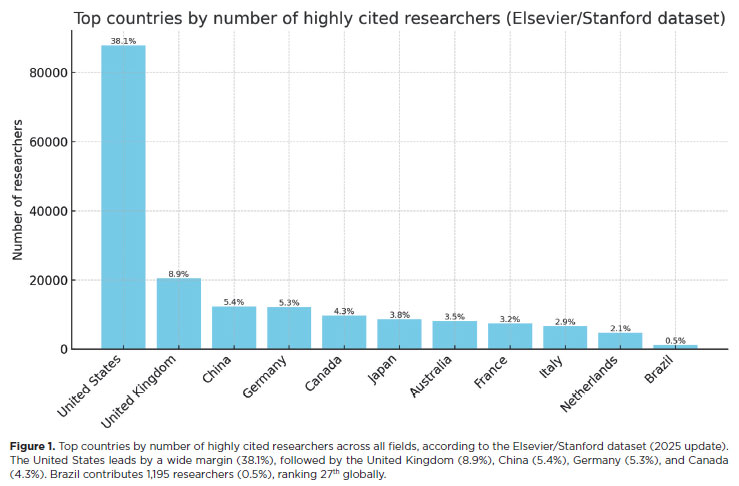
By continent, North America and Europe account for the majority of highly cited scientists, followed by Asia. Within Latin America, Brazil stands out as the clear leader, well ahead of its neighboring countries.
At the institutional level, the concentration of Brazilian researchers is most evident in a few universities. The Universidade de São Paulo (USP) leads with 278 scientists, followed by the Universidade Estadual de Campinas (Unicamp) with 106, the Universidade Estadual Paulista (UNESP) with 80, the Universidade Federal do Rio Grande do Sul (UFRGS) with 61, and the Universidade Federal do Rio de Janeiro (UFRJ) with 60. Although the Universidade Federal de São Paulo (UNIFESP) appears further down the list with 30 researchers (approximately 30th nationally), it plays a prominent role in Ophthalmology, where it shares leadership with USP – each contributing three names to the global ranking.
A regional perspective further emphasizes the leading role of these institutions: USP in the Southeast (278), UFRGS in the South (61), the Universidade Federal de Pernambuco (UFPE) in the Northeast (24), the Universidade Federal do Pará (UFPA) in the North (25), and the Universidade Federal do Mato Grosso (UFMT) in the Center-West (2). Collectively, these universities illustrate the concentration of excellence within established hubs, while also highlighting the growing contribution of regional centers to Brazil's expanding scientific presence.
Funding and scientific impact
The predominance of U.S. scientists in the ranking is closely tied to the country's robust research funding system. Studies indicate that 62.7% of the most cited U.S. biomedical scientists received federal funding between 1996 and 2022, and their citation impact was significantly higher than that of their peers who did not receive such support (2). Moreover, countries that invest a higher share of their Gross Domestic Product (GDP) in research consistently produce more influential scientific output(3).
Agencies such as the National Institutes of Health (NIH), National Science Foundation (NSF), Department of Energy (DOE), and Department of Defense (DOD) sustain this ecosystem through stable budgets, rigorous peer review, and strong institutional incentives, while universities further invest in laboratories, research personnel, and international collaborations.
In Brazil, despite more modest conditions, significant progress has been achieved. Beyond the contributions of the Conselho Nacional de Desenvolvimento Científico e Tecnológico (CNPq), Coordenação de Aperfeiçoamento de Pessoal de Nível Superior (CAPES), and state-level Fundações de Amparo à Pesquisa (FAPs), the "Conhecimento Brasil" program – launched by CNPq in 2025 – allocated nearly R$600 million to attract and reintegrate Brazilian researchers, strengthening institutional ties and reducing brain drain.
Thus, the predominance of U.S. scientists reflects decades of sustained science policy. At the same time, Brazil's presence, although proportionally smaller, demonstrates the capacity of its scientific community to achieve international relevance and the potential for new funding initiatives to further amplify this representation(4).
3. OPHTHALMOLOGY: A GLOBAL AND BRAZILIAN PERSPECTIVE
In the subfield of Ophthalmology, 1,681 scientists from 43 countries were ranked worldwide. Brazil contributes eight researchers (0.5%), placing the country 21st overall. These individuals are affiliated with four institutions:
• USP (3): Marcony R. Santhiago, Mário L. R. Monteiro, Remo S. Susanna
• UNIFESP (3): Rubens Belfort Jr., Eduardo B. Rodrigues, José Álvaro P. Gomes
• Unicamp (1): Vital Paulino Costa
• Unirio (1): Renato Ambrósio Jr.
Together, USP and UNIFESP account for 75% of Brazil's ophthalmology researchers included in the ranking, underscoring their shared leadership in the field of ophthalmology. Although these eight researchers represent only 0.55% of all 1,195 Brazilian scientists across disciplines, their presence carries particular weight within Ophthalmology, a field known for its high specialization and scientific rigor.
At the global level, the top 10 countries in Ophthalmology are as follows:
1. United States: 906 (53.9%)
2. United Kingdom: 147 (8.8%)
3. Japan: 93 (5.5%)
4. Germany: 83 (4.9%)
5. Australia: 79 (4.7%)
6. Canada: 32 (1.9%)
7. France: 28 (1.7%)
8. Switzerland: 28 (1.7%)
9. India: 27 (1.6%)
10. Netherlands: 25 (1.5%)
Outside the top 10, China ranks 15th with 20 researchers (1.2%), while Brazil occupies 21st position (Figure 2).
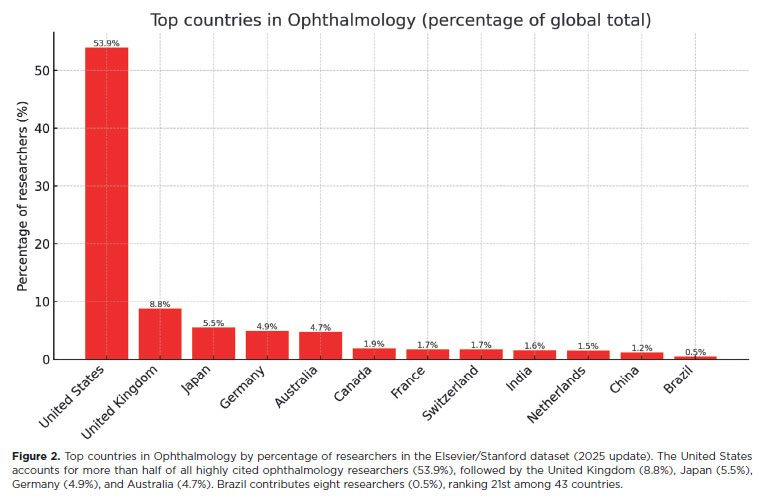
Although China has shown remarkable overall growth in science, its share in Ophthalmology remains limited to 1.2% of the global total. Brazil's representation, at 0.5%, is proportional to its overall share among the world's highly cited researchers. Notably, achieving such recognition in a highly competitive and specialized field underscores the strength of Brazilian Ophthalmology and its meaningful contribution to the international scientific dialogue.
4. MEANING FOR THE SCIENTIFIC COMMUNITY
The inclusion of Brazilian researchers among the world's most cited scientists conveys a clear message: national science can produce knowledge that resonates far beyond our borders. To be cited is to witness one's ideas and results incorporated by peers – shaping clinical practices, experimental methods, and future lines of inquiry.
In a country marked by structural inequalities and limited resources, such recognition carries additional significance. It demonstrates that when research groups coalesce around consistent, well-defined projects, they can achieve international visibility – even in fields traditionally dominated by better-funded centers.
In Ophthalmology, this achievement holds particular meaning. Although in a highly specialized medical field, Brazilian researchers have established a prominent voice in the global landscape, contributing to paradigms in diagnostics, therapeutics, and technological innovation. This accomplishment is a testament to academic maturity and evidence that Brazilian science does not merely follow global trends but actively helps shape the international debate.
5. FINAL REFLECTION
To be cited is to be recognized as relevant – someone whose work influences subsequent studies. This represents the essence of academic impact: not how frequently we publish, but how deeply our contributions transform the way science is conceived and practiced.
The presence of Brazilian researchers in Elsevier's ranking should be understood on two levels. First, as a celebration: it affirms that, despite persistent challenges, Brazilian science holds a rightful place on the global map of knowledge. Second, as a call to responsibility: every citation carries an implicit expectation of rigor, transparency, and continuity.
Being among the most cited is not merely a personal distinction but an invitation to transform prestige into collective legacy – by strengthening graduate programs, mentoring the next generation of scientists, and consolidating international collaborations. It also serves as a reminder that excellence is never improvised; it is built over decades through academic leadership, teamwork, and a commitment to ethics.
Actual impact transcends statistics. It becomes evident when ideas inform clinical protocols, inspire new lines of research, and open previously unimaginable pathways. In this light, recognition as a highly cited researcher should not be viewed as an endpoint but rather as a platform for sustained responsibility and commitment – ensuring that Brazilian science continues to grow, influence, and inspire on the world stage.
Editor's comment
The ranking is based on data from the "Updated Science-Wide Author Databases of Standardized Citation Indicators" by Ioannidis et al.(1) (Elsevier Data Repository, August 2025, Version 8), which employs the c-score – a composite indicator built from citations, h-index, and its co-authorship-adjusted variant (hm-index), authorship position, citation-to-citing article ratios, field-adjusted percentiles, and retraction analysis."
REFERENCES
1. Ioannidis, JP. August 2025 data-update for "Updated science-wide author databases of standardized citation indicators" [database on the Internet]. Elsevier Data Repository, Published 19 September 2025. Version 8. [cited 2025 Sep 27]. Available from: https://elsevier.digitalcommonsdata.com/datasets/btchxktzyw/8
2. Ioannidis JP, Hozo I, Djulbegovic B. Federal funding and citation metrics of US biomedical researchers, 1996 to 2022. JAMA Netw Open. 2022;5(12):e2245590.
3. McManus C, Neves AAB, Diniz Filho JA, Pimentel F, Pimentel D. Funding as a determinant of citation impact in scientific papers in different countries. An Acad Bras Cienc [Internet]. 2023 [cited 2025 Sep 27];95(1):e20220515. Available from: https://www.scielo.br/j/aabc/a/Y3dDfWsQX7LFdx4CxZWKLZb/?lang=en
4. Kara N. The impact factor of journals should not be so valued. Arq Bras Oftalmol [Internet]. 2024 [cited 2025 Aug 25];87(5):e20241011. Available from: https://www.scielo.br/j/abo/a/qL36YCj9s8F6Q9knJQNJfHG/?lang=en
Submitted for publication:
September 7, 2025.
Accepted for publication:
September 24, 2025.
Edited by
Editor-in-Chief: Newton Kara-Júnior
Funding: This study received no specific financial support.
Disclosure of potential conflicts of interest: The author declares no potential conflicts of interest.

How to cite this article:
 ABO is licensed under a Creative Commons Attribution-NonComercial 4.0 Internacional.