Arq. Bras. Oftalmol. 2025;88 (6 )
:1-6
| DOI: 10.5935/0004-2749.2024-0333
Abstract
PURPOSE: To assess female participation in the Brazilian Congress of Ophthalmology.
METHODS: This retrospective, descriptive-analytical study examined the profiles of individuals involved in the scientific program of the Brazilian Congress of Ophthalmology from 2016 to 2023. Data were provided by the Brazilian Council of Ophthalmology and were categorized by ophthalmology subspecialty, participant role, and geographic region of origin within Brazil. Roles were grouped into three main categories: coordinator, speaker, and moderator/discussant.
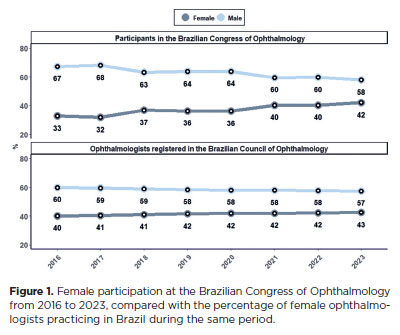
RESULTS: Female participation at the congress increased from 33% in 2016 to 42% in 2023, showing an annual upward trend of 1.33 (p<0.001). Around 64% of female participants were from the Southeast region, while 16% were from the Northeast. The coordinator role showed the largest increase in female participation, rising from 22% in 2016 to 40% in 2023 (Slope: 2; p<0.001), followed by the speaker role, which increased from 34% to 44% (Slope: 1.5; p<0.001), and the moderator/discussant role, which rose from 32% to 38% (Slope: 1.24; p=0.0586). Changes in female representation across ophthalmology subspecialties were not statistically significant.
CONCLUSION: From 2016–2023, female participation in the Brazilian Congress of Ophthalmology increased across most subspecialties and conference roles. Although gender disparity has narrowed, continuous efforts are needed to achieve greater gender equity and equality in ophthalmology conferences.
Keywords: Ophthalmology; Gender equity; Ophthalmologists/statistics & numerical data; Physicians, women/statistics & numerical data; Leadership; Congresses as topic/statistics & numerical data.
Arq. Bras. Oftalmol. 2026;89 (3 )
:1-6
| DOI: 10.5935/0004-2749.2025-0272
Abstract
PURPOSE: To assess musculoskeletal symptoms, identify the most affected body areas, and investigate factors associated with the development of musculoskeletal disorders among ophthalmologists in Brazil.
METHODS: A survey was conducted using an online questionnaire and snowball sampling. Statistical analyses were performed using Jamovi version 2.3.28, and graphs were generated using RStudio version 2023.06.2 + 561.
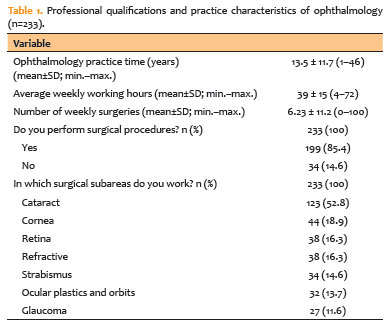
RESULTS: A total of 233 participants (42 ophthalmology residents and 191 ophthalmologists) were included, with a mean age of 40.4 years (standard deviation 11.3; range 25–73 years). Musculoskeletal symptoms were reported by 83% of participants. The cervical region (57.1%), upper back (54.5%), and lumbar region (53.6%) were the most frequently reported sites of pain. A high body mass index was identified in 54.9% of the sample, and 50.2% of participants reported using painkillers in the previous year for musculoskeletal symptoms. The mean duration of professional activity in ophthalmology was 13.5 years, and the mean weekly workload was 39 hours. A significant association was observed between weekly workload and the presence of musculoskeletal disorders (p=0.045).
CONCLUSION: This study demonstrated a high prevalence of musculoskeletal disorders among ophthalmologists in Brazil, particularly involving the cervical, lumbar, and upper back regions, consistent with findings reported in international studies. Important contributing factors include long working hours, a high patient volume, and repetitive or awkward postures during examinations and procedures. Preventive strategies and improvements in working conditions are needed to protect the health and well-being of ophthalmologists.
Keywords: Musculoskeletal Diseases/epidemiology; Back pain; Lumbar Vertebrae; Occupational diseases/epidemiology; Ergonomics; Ophthalmic practice; Ophthalmologists/statistics & numerical data; Brazil/epidemiology


 ABO is licensed under a Creative Commons Attribution-NonComercial 4.0 Internacional.