Arq. Bras. Oftalmol. 2025;88 (6 )
:1-6
| DOI: 10.5935/0004-2749.2024-0333
Abstract
PURPOSE: To assess female participation in the Brazilian Congress of Ophthalmology.
METHODS: This retrospective, descriptive-analytical study examined the profiles of individuals involved in the scientific program of the Brazilian Congress of Ophthalmology from 2016 to 2023. Data were provided by the Brazilian Council of Ophthalmology and were categorized by ophthalmology subspecialty, participant role, and geographic region of origin within Brazil. Roles were grouped into three main categories: coordinator, speaker, and moderator/discussant.
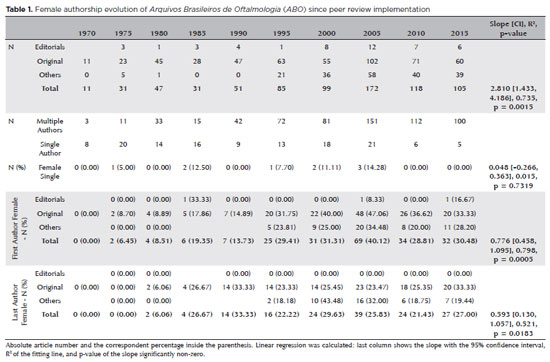
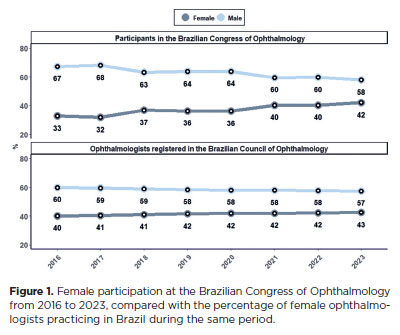
RESULTS: Female participation at the congress increased from 33% in 2016 to 42% in 2023, showing an annual upward trend of 1.33 (p<0.001). Around 64% of female participants were from the Southeast region, while 16% were from the Northeast. The coordinator role showed the largest increase in female participation, rising from 22% in 2016 to 40% in 2023 (Slope: 2; p<0.001), followed by the speaker role, which increased from 34% to 44% (Slope: 1.5; p<0.001), and the moderator/discussant role, which rose from 32% to 38% (Slope: 1.24; p=0.0586). Changes in female representation across ophthalmology subspecialties were not statistically significant.
CONCLUSION: From 2016–2023, female participation in the Brazilian Congress of Ophthalmology increased across most subspecialties and conference roles. Although gender disparity has narrowed, continuous efforts are needed to achieve greater gender equity and equality in ophthalmology conferences.
Keywords: Ophthalmology; Gender equity; Ophthalmologists/statistics & numerical data; Physicians, women/statistics & numerical data; Leadership; Congresses as topic/statistics & numerical data.
Arq. Bras. Oftalmol. 2026;89 (1 )
:1-7
| DOI: 10.5935/0004-2749.2025-0218
Abstract
PURPOSE: This study aimed to evaluate disparities in the distribution of ophthalmologists and the volume of cataract surgeries across Brazil, considering public and private health sectors and the country's federative units.
METHODS: Data on ophthalmologists were obtained from the National Medical Residency Commission and the Associação Múdica Brasileira. Information on cataract surgeries performed through the Unified Health System was collected from the DATASUS database, while data on procedures covered by private health plans were retrieved from the National Supplementary Health Agency. Population estimates from the 2024 Demographic Census of the Brazilian Institute of Geography and Statistics were used to calculate physician density and surgery rates per 100,000 inhabitants. Associations between the number of ophthalmologists and cataract surgery volume were analyzed using Spearman's correlation coefficient.
RESULTS: Brazil has 16,784 ophthalmologists, representing 8.96 specialists per 100,000 inhabitants. Marked disparities were observed: large cities (>500,000 inhabitants) had 18.75 ophthalmologists per 100,000 residents, whereas municipalities with <50,000 inhabitants had fewer than one. Across federative units, physician density ranged from 19.18 per 100,000 in the Federal District to 4.22 in Maranhão. In 2024, cataract surgery rates varied widely, from 1,012.61 per 100,000 inhabitants in the Southeast to 435.00 in the North. Nationally, Unified Health System performed 736.30 surgeries per 100,000 inhabitants, compared with 1,276.79 in the private sector. On average, each ophthalmologist performed 96.92 cataract surgeries annually.
CONCLUSION: Significant inequalities persist in the geographic distribution of ophthalmologists and in cataract surgery provision, with higher surgical volumes concentrated in the private sector. Targeted policies are required to address regional disparities and improve the equity and efficiency of cataract care delivery in Brazil.
Keywords: Ophthalmologists/supply & distribution; Ophthalmologists/statistics & numerical data; Cataract extraction; Health services accessibility/statistics & numerical data; Healthcare disparities; Health policy; Public health systems; Insurance, Heal
Arq. Bras. Oftalmol. 2024;87 (6 )
:1-6
| DOI: 10.5935/0004-2749.2022-0160
Abstract
Objetivo: Há poucos dados sobre o perfil de pacientes com blefaroespasmo essencial e espasmo hemifacial no Brasil. O objetivo deste estudo é avaliar de forma mais abrangente as características clínicas dos pacientes portadores dessas doenças acompanhados em dois centros de referência em oftalmologia no Brasil.
Métodos: Pacientes com blefaroespasmo essencial e espasmo hemifacial, acompanhados nos Departamentos de Oftalmologia da Universidade Federal de São Paulo e da Universidade de São Paulo foram incluídos neste estudo. Além dos dados clínicos e demográficos, foram avaliados também a presença de eventos estressantes relacionados ao início dos sintomas (evento desencadeante), fatores agravantes, truques sensoriais, e outros fatores de melhora.
Resultados: Cento e dois pacientes foram incluídos no estudo. A maior parte dos pacientes era do sexo feminino (67,7%). Blefaroespasmo essencial foi a condição mais frequente, observada em 51 (50%) dos pacientes. Espasmo hemifacial correspondia a 45% dos casos, enquanto 5% dos pacientes apresentavam a Síndrome de Meige. 63,5% dos pacientes associaram o início dos sintomas com um evento estressante prévio. 76,5% dos pacientes relataram fatores de melhora para os espasmos; 47% relataram truques sensoriais. Além disso, 87% dos pacientes relataram fatores de piora; estresse (51%) foi o mais frequente.
Conclusão: Este estudo fornece informações a respeito das características clínicas dos pacientes com blefaroespasmo essencial e espasmo hemifacial acompanhados nos dois maiores centros de referência em oftalmologia do Brasil.
Keywords: Blefarospasmo; Espasmo hemifacial; Síndrome de Meige
Arq. Bras. Oftalmol. 2025;88 (3 )
:1-5
| DOI: 10.5935/0004-2749.2023-0174
Abstract
PURPOSE: To compare objective and subjective intraocular pressure measurements immediately after cataract surgery and intraocular pressure measurements between less experienced surgeons (Group 1) and experienced surgeons (Group 2).
METHODS: Surgeons were asked to estimate the IOP after corneal sealing after surgery based on their tactile perception of eye tension (subjective intraocular pressure) Objective intraocular pressure was measured using a Perkins tonometer while patients were still in the surgical field. Objective intraocular pressure was compared to subjective intraocular pressure. Results from less experienced surgeons were compared to more experienced surgeons.
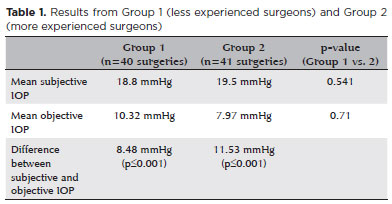
RESULTS: The study comprised 81 surgeries (81 eyes) performed by 27 surgeons. The mean objective intraocular pressure (9.14 mmHg; SD=5.86) was statistically significantly lower (p<0.001) than the mean subjective intraocular pressure (19.21 mmHg; SD=4.82). Hypotony (intraocular pressure <6mmHg) was observed in 25 eyes (30.86%). The mean subjective intraocular pressure was 18.8 mmHg (SD=5.19) for less experienced surgeons and 19.5 mmHg (SD=4.46) for more experienced, without statistically significant difference (p=0.541). No statistically significant difference (p=0.71) was observed when comparing objective intraocular pressure in Group 1 (10.32 mmHg; SD=6.65) and Group 2 (7.97 mmHg; SD=4.7).
CONCLUSION: Objective intraocular pressure was significantly lower than subjective intraocular pressure, regardless of surgeons' experience. This study showed that the subjective method is unreliable compared to the gold standard (Perkins tonometer) and does not improve with surgeons' experience. Establishing standard training methods is paramount to developing surgeons' skills.
Keywords: Cataract; Intraocular pressure; Hypotony, Tonometry; Eye diseases; Training
Arq. Bras. Oftalmol. 2026;89 (4 )
:1-5
| DOI: 10.5935/0004-2749.2025-0356
Abstract
PURPOSE: To analyze the results of the 15-gene expression profile/preferentially expressed antigen in melanoma (15-GEPP) prognostic classifier and associated survival outcomes in a series of Brazilian patients with posterior uveal melanoma.
METHODS: Patients born and raised in Brazil who were diagnosed with posterior uveal melanoma and underwent fine-needle aspiration biopsy for 15-GEPP prognostic testing using the DecisionDx-Uveal melanoma and DecisionDx-PRAME assays between September 2020 and 2023 were included. All patients were diagnosed and treated by the senior author.
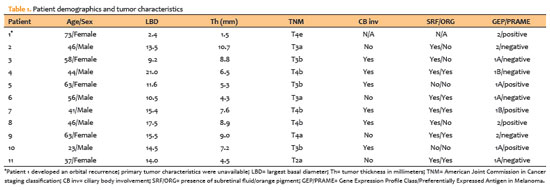
RESULTS: Of 236 patients diagnosed with posterior uveal melanoma during the study period, 11 (4.6%) met the inclusion criteria, including six males and five females. Based on 15-GEPP results, seven patients (63.6%) were classified as Class 1 and 4 (36.4%) as Class 2. Preferentially expressed antigen in melanoma (PRAME) expression was negative in six patients (54.6%) and positive in five patients (45.4%). During a mean follow-up of 36.4 ± 17.6 months, five patients developed metastasis: two with Class 2/PRAME-positive tumors, one with Class 2/PRAME-negative tumors, one with Class 1/PRAME-positive tumors, and one with Class 1/PRAME-negative tumors. Three of these patients died. The mean survival after the diagnosis of metastasis was 21.2 months (median: 17.0 months).
CONCLUSIONS: The proportions of Class 1 versus Class 2 tumors and PRAME-negative versus PRAME-positive tumors as well as the prognostic performance of these biomarkers appear similar in Brazilian patients with posterior uveal melanoma compared with large published cohorts from North America. Further studies with larger Brazilian cohorts are needed to validate these findings.
Keywords: Uveal melanoma; Fine-needle biopsy; Prognosis; Biomarkers; Neoplasms; Transcriptome; Survival; Brazil


 ABO is licensed under a Creative Commons Attribution-NonComercial 4.0 Internacional.



08-fig01.jpg)