Arq. Bras. Oftalmol. 2026;89 (1 )
:1-4
| DOI: 10.5935/0004-2749.2024-0402
Abstract
PURPOSE: This study evaluated the proportion of corneas discarded by the Eye Bank of Londrina, Paraná, due to positive serology over a 5-year period and its impact on transplant availability.
METHODS: A cross-sectional study was conducted, analyzing 1,968 corneas from 1,056 donors collected between January 2014 and December 2018 at the Eye Bank of Londrina. Serological tests for hepatitis B (HBsAg and anti-HBc), hepatitis C (anti-HCV), and HIV (anti-HIV 1 and 2) were performed using chemiluminescent microparticle immunoassays. Data were analyzed descriptively and presented in tables and graphs.
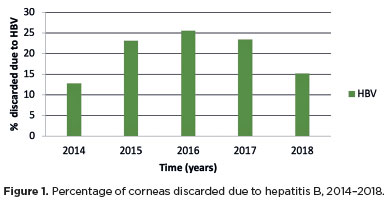
RESULTS: Of the 1,968 corneas processed, 897 (45.57%) were discarded. Among these, 333 (37.12%) tested positive for serological markers. Hepatitis B accounted for 34.67% of positive cases (15% of total donations), hepatitis C for 1.11% (0.50% of total), and HIV for 0.89% (0.4% of total). Hepatitis cases remained stable between 2014 and 2016, with a marked decline in 2017 and 2018. Most discarded corneas were positive for anti-HBc (31.88%) and negative for HBsAg; however, the anti-HBs test was not performed to confirm immunity to the hepatitis B virus.
CONCLUSION: The findings highlight the importance of serological testing to identify and eliminate contaminated corneas, thereby preventing the transmission of infectious diseases to recipients. Positive serology for hepatitis, particularly hepatitis B, was the leading cause of corneal disposal.
Keywords: Cornea; Corneal transplantation; Corneal donation; Eye banks; Hepatitis B virus; Hepatitis C virus; HIV infections; Seropositivity; Serologic tests
Arq. Bras. Oftalmol. 2026;89 (4 )
:1-9
| DOI: 10.5935/0004-2749.2025-0034
Abstract
PURPOSE: To evaluate the impact of the COVID-19 pandemic and characterize the serological profile of discarded corneal donations in the coverage area of the Banco de Olhos de Londrina, through reverse transcription-polymerase chain reaction testing for COVID-19 and serological screening of cornea donors excluded because of positive test results.
METHODS: This observational retrospective study included 776 cornea donors who’s serological and reverse transcription-polymerase chain reaction test results were processed at the Hospital of Universidade Estadual de Londrina between May 2020 and 2022. The number of corneal donations and tissue utilization rates throughout the years of operation of the Banco de Olhos de Londrina were also analyzed.
RESULTS: The mean donor age was 53.14 years; 332 donors (43%) were female, and 444 (57%) were male. Positive results were identified in 15.76% of donors for hepatitis B core antibody antibodies, 0.65% for hepatitis B surface antigen, 1.03% for hepatitis C antibodies, and 0.52% for human immunodeficiency virus and human T-lymphotropic vírus. Positive reverse transcription-polymerase chain reaction results for SARS-CoV-2 were observed in 2.7% of cases. Older adults were 2.6 times more likely to test positive for SARS-CoV-2 (95% CI, 1.06-6.34) and 3.0 times more likely to test positive for hepatitis B core antibody (95% CI, 1.95-4.41) than younger individuals. A 75.2% reduction in corneal donations was observed in 2020 compared with 2019, accompanied by a 5% increase in tissue utilization, possibly associated with the effectiveness of donor screening during the pandemic.
CONCLUSION: The COVID-19 pandemic had a profound impact on the number of corneal transplants worldwide, in Brazil, and at the Banco de Olhos de Londrina because of the substantial decline in donations during this period. Hepatitis B was the leading cause of corneal tissue discard due to positive serology in both this study and previous reports, highlighting the importance of prevention programs and improved vaccination coverage. Strict legislation, comprehensive serological screening, and appropriate processing of donated tissue remain essential to eliminate potential sources of infection and ensure transplantation safety.
Keywords: Cornea; Corneal transplantation; COVID-19; Eye banks; Serology
Arq. Bras. Oftalmol. 2026;89 (4 )
:1-5
| DOI: 10.5935/0004-2749.2025-0356
Abstract
PURPOSE: To analyze the results of the 15-gene expression profile/preferentially expressed antigen in melanoma (15-GEPP) prognostic classifier and associated survival outcomes in a series of Brazilian patients with posterior uveal melanoma.
METHODS: Patients born and raised in Brazil who were diagnosed with posterior uveal melanoma and underwent fine-needle aspiration biopsy for 15-GEPP prognostic testing using the DecisionDx-Uveal melanoma and DecisionDx-PRAME assays between September 2020 and 2023 were included. All patients were diagnosed and treated by the senior author.
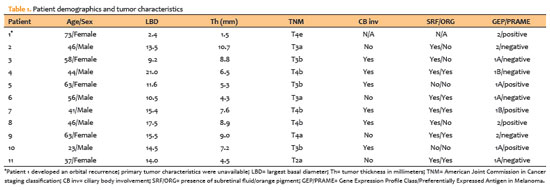
RESULTS: Of 236 patients diagnosed with posterior uveal melanoma during the study period, 11 (4.6%) met the inclusion criteria, including six males and five females. Based on 15-GEPP results, seven patients (63.6%) were classified as Class 1 and 4 (36.4%) as Class 2. Preferentially expressed antigen in melanoma (PRAME) expression was negative in six patients (54.6%) and positive in five patients (45.4%). During a mean follow-up of 36.4 ± 17.6 months, five patients developed metastasis: two with Class 2/PRAME-positive tumors, one with Class 2/PRAME-negative tumors, one with Class 1/PRAME-positive tumors, and one with Class 1/PRAME-negative tumors. Three of these patients died. The mean survival after the diagnosis of metastasis was 21.2 months (median: 17.0 months).
CONCLUSIONS: The proportions of Class 1 versus Class 2 tumors and PRAME-negative versus PRAME-positive tumors as well as the prognostic performance of these biomarkers appear similar in Brazilian patients with posterior uveal melanoma compared with large published cohorts from North America. Further studies with larger Brazilian cohorts are needed to validate these findings.
Keywords: Uveal melanoma; Fine-needle biopsy; Prognosis; Biomarkers; Neoplasms; Transcriptome; Survival; Brazil


 ABO is licensed under a Creative Commons Attribution-NonComercial 4.0 Internacional.