Arq. Bras. Oftalmol. 2021;84 (2 )
:128-132
| DOI: 10.5935/0004-2749.20210020
Abstract
OBJETIVO: Avaliar a relação entre alterações na hipermetropia e o alinhamento ocular em pacientes com esotropia acomodativa.
MÉTODOS: Foram analisados retrospectivamente prontuários médicos de pacientes consecutivos diagnosticados com esotropia acomodativa refrativa (com esotropia eliminada ou reduzida a menos de 10 D com correção completa da hipermetropia). As medidas de refração em cicloplegia obtidas dos prontuários foram convertidas em equivalentes esféricos. Avaliaram-se ainda a presença de ambliopia, alterações do erro refrativo e o alinhamento ocular à admissão e depois do período de acompanhamento.
RESULTADOS: Setenta pacientes (média de idade=6,01 ± 5,41 anos, 60,6% do sexo feminino, acompanhamento médio de 5,8 ± 3 anos) apresentaram esotropia de 40 ± 20 dioptrias prismáticas (DP) para perto à admissão. A diminuição média anual no desvio para perto e para longe com o uso de óculos foi de 1,71 ± 3,96 DP/ano e 1,09 ± 3,25 DP/ano, respectivamente. Os desvios miópicos totais dos olhos direito e esquerdo foram de 1,08 ± 1,35 D e 1,20 ± 1,40 D, respectivamente. Os desvios miópicos anuais foram de 0,22 D/ano e 0,26 D/ano para os olhos direito e esquerdo, respectivamente. A correlação entre a taxa de desvio miópico e a taxa de alteração do desvio para perto corrigido foi fraca. A correlação da taxa de desvio miópico não foi alta para os olhos direito e esquerdo (r=0,18, p=0,15).
CONCLUSÃO: A quantidade de desvio e a hipermetropia diminuem gradualmente na esotropia acomodativa durante o acompanhamento. Por outro lado, pode não ser apropriado garantir aos pacientes que o desvio diminuirá em paralelo ao erro refrativo.
Keywords: Ambliopia; Acomodação ocular; Esotropia; Refração ocular
Arq. Bras. Oftalmol. 2026;89 (1 )
:1-6
| DOI: 10.5935/0004-2749.2025-0071
Abstract
PURPOSE: This study aimed to evaluate the outcomes of strabismus surgical correction in patients with Down syndrome.
METHODS: We conducted a retrospective chart review of patients with Down syndrome who underwent strabismus surgery between January 1997 and May 2024 at an Ophthalmology Outpatient Clinic in São Paulo, Brazil. The data collected included age, sex, medical and ocular history, surgical details, and follow-up outcomes. The patients were categorized by strabismus type into esotropia, fourth nerve palsy, and mixed groups. Surgical success was defined as final alignment within 10Δ of orthotropia and, where applicable, whether there was resolution of abnormal head posture of ocular origin. Patients with postoperative follow-up <6 months were excluded.
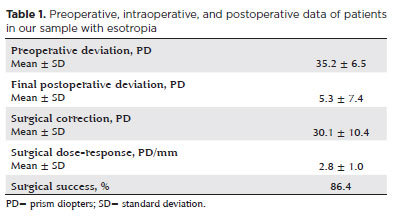
RESULTS: A total of 37 patients (21 females) were included. Of these, 22 (59.5%) were in the esotropia group, 10 (27.0%) in the fourth nerve palsy group, and 5 (13.5%) in the mixed group. The surgical success rate in the esotropia group was 86.4%, with a mean preoperative deviation of 35.2 (± 6.5)Δ, and mean surgical correction of 30.1 (± 10.4)Δ. The success rate in the fourth nerve palsy group was 40.0%, with a mean preoperative deviation of 10.4 (± 4.3)Δ. Overall, success was achieved with a single surgical procedure in 73.0% of the sample. No significant associations were found between surgical success and the clinical and demographic variables, including sex, age at surgery, oblique muscle overaction, pattern strabismus, visual acuity, amblyopia, preoperative deviation, or postoperative follow-up duration (p>0.05).
CONCLUSIONS: When standard surgical tables are applied, strabismus surgery in patients with Down syndrome appears to be safe and effective. We found high success rates, particularly among patients with esotropia. We observed no tendencies toward over- or under-correction. These findings support the use of conventional surgical protocols with this patient population.
Keywords: Down Syndrome/complications; Strabismus/surgery; Esotropia/surgery; Oculomotor nerve diseases/physiopathology; Vision disorders; Humans; Brazil.


 ABO is licensed under a Creative Commons Attribution-NonComercial 4.0 Internacional.


07-tab01tb.jpg)
10-fig01.jpg)
09-fig01.jpg)
13-fig01.jpg)
04-fig01.jpg)
14-fig01.jpg)
01-fig01.jpg)
01-fig01.jpg)
05-fig01.jpg)
02-fig01.jpg)