
Showing of 1 until 15 from 146 result(s)
Search for: Glaucoma; Primary open-angle glaucoma; Filtering surgery; Costs; Health care costs
Abstract
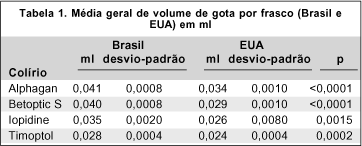
Objetivo: Comparar o exame de gotas de colírios antiglaucomatosos norte-americanos e brasileiros, e a repercussão no custo do tratamento. Métodos: Estudo volumétrico da gota e conseqüente número de gotas por mililitro, com estabelecimento da duração média de cada frasco de colírio para a posologia e custo anual do tratamento. Resultados: A gota de Alphagan® brasileiro foi em média 18% maior que a norte-americana, com duração média de 30,8 dias e custo anual de R$ 440,70; o AlphaganTM norte-americano teve duração média de 36,3 dias e custo anual de R$374,10, ou seja, 17,8% de diferença no custo anual. A gota de Betoptic S® brasileiro foi 38,4% maior que a norte-americana, com duração de 31,3 dias e custo anual de R$ 192,60; o Betoptic S TM norte-americano teve duração de 43,3 dias e custo anual de R$ 139,40, ou seja, 38,1% de diferença no custo anual. A gota de Iopidine® brasileiro foi 46,3% maior que a norte-americana, com duração de 35,7 dias e custo anual de R$ 365,00; o IopidineTM norte-americano teve duração de 52,6 dias e custo anual de R$ 248,40, ou seja, 46,9% de diferença no custo anual. A gota de Timoptol® foi 14,7% maior que a norte-americana, com duração de 45,4 dias e custo anual de R$ 58,40; o TimopticTM norte-americano teve duração de 52,1 dias e custo anual de R$ 51,00, ou seja, 14,5% de diferença no custo anual. Conclusões: Em todos os colírios o volume da gota brasileira foi estatisticamente maior, acarretando menor duração do frasco, maior custo anual do tratamento com desperdício significativo e prejuízo para o consumidor.
Keywords: Glaucoma; Glaucoma; Soluções oftálmicas; Custos de medicamentos; Qualidade de medicamentos; Estudo comparativo; Brasil; Estados Unidos
01-tab01.jpg)
Abstract
Objetivo: Investigar picos de pressão intraocular em pacientes fácicos e pseudofácicos com glaucoma primário de ângulo aberto no teste de sobrecarga hídrica.
Método: Quarenta pacientes com glaucoma primário de ângulo aberto foram avaliados; vinte eram fácicos e vinte eram pseudofácicos. Um olho (selecionado aleatoriamente) foi incluído no estudo, todos os pacientes foram submetidos às curvas da pressão intraocular imediatamente após o teste de sobrecarga hídrica.
Resultados: Observou-se uma diferença estatisticamente significante na média dos picos nas curvas da pressão intraocular para os pacientes fácicos e pseudofácicos (p=0,045). Houve diferença estatisticamente significante nos picos da pressão intraocular no teste de sobrecarga hídrica entre os grupos, sendo observados valores mais altos nos pacientes fácicos (p=0,004).
Conclusão: Os picos da pressão intraocular no teste de sobrecarga hídrica foram maiores no grupo fácico que no grupo pseudofácico.
Keywords: Glaucoma de ângulo aberto; Técnicas de diagnóstico oftalmológico; Água potável; Pressão intraocular
04-tab01.jpg)
Abstract
Objetivo: Investigar a associação do Polimorfismo de nucleotídeo único rs35934224 no gene TXNRD2 com o glaucoma primário de ângulo aberto em uma população brasileira.
Métodos: Tratou-se de um estudo transversal para verificar a associação entre o rs35934224 do TXNRD2 (tioredoxina redutase 2) e o glaucoma primário de ângulo aberto em uma população da região nordeste do Brasil. Foram incluídos 184 indivíduos: 94 casos com glaucoma primário de ângulo aberto (45 homens e 49 mulheres) e 94 controles (40 homens e 54 mulheres) do Instituto de Olhos de Recife.
Resultados: A idade média foi de 68,85 anos para os pacientes com glaucoma e 68,55 anos para os controles. O DNA genômico foi isolado usando kits comerciais disponíveis e a detecção do polimorfismo de nucleotídeo único foi realizada por PCR em tempo real usando sondas TaqMan. A população estudada estava em equilíbrio de Hardy-Weinberg. O genótipo CT foi associado à proteção ao glaucoma primário de ângulo aberto (p=0,022).
Conclusão: Nossos dados sugerem uma associação entre o polimorfismo do gene TXNRD2 (rs35934224) e o glaucoma primário de ângulo aberto em uma população brasileira. Este é o primeiro estudo a investigar esse polimorfismo de nucleotídeo único em indivíduos com glaucoma primário de ângulo aberto latino-americanos.
Keywords: Polimorfismo; Tiorredoxina redutase; Glaucoma de ângulo aberto

Abstract
PURPOSE: To report the surgical outcomes of patients with primary congenital glaucoma who underwent gonioscopy-assisted transluminal trabeculotomy.
METHODS: This retrospective, noncomparative, interventional study included consecutive patients with primary congenital glaucoma with uncontrolled intraocular pressure undergoing gonioscopy-assisted transluminal trabeculotomy between January 2017 and January 2020. The included participants were followed up for at least 24 months, and only one surgeon performed all the procedures. The number of glaucoma medications, pre- and postoperative intraocular pressure, treatment extension (in quadrants), surgical complications, and any associated events or interventions were documented.
RESULTS: This study included 13 eyes from 10 patients (mean age, 4.5 ± 3.2 years; range, 3 months to 10 years). After a 24-month follow-up, the mean intraocular pressure significantly decreased from 26.1 ± 3.7 to 11.8 ± 2.5 mmHg (p<0.001). The mean number of glaucoma medications was reduced from 3.3 ± 0.5 to 0.85 ± 1.0 (p<0.001). At the end of the follow-up interval, all eyes (13 out of 13) had an intraocular pressure between 7 and 15 mmHg. In 11 of 13 eyes (84.6%), gonioscopy-assisted transluminal trabeculotomy was performed in all quadrants (360º). The most frequent postoperative complication was transitory (self-limited) hyphema (7 out of 13 eyes [53.8%]). No sight-threatening adverse events occurred during the entire follow-up period.
CONCLUSIONS: The 2-year follow-up results indicated gonioscopy-assisted transluminal trabeculotomy as an efficient and safe option for primary congenital glaucoma treatment with minimal postoperative complications.
Keywords: Glaucoma, Open-angle/surgery; Gonioscopy; Trabeculectomy/methods; Intraocular pressure; Antihypertensive agents/therapeutic use.
Abstract
PURPOSE: This study aimed to compare the safety and effectiveness of intraocular pressure reduction between micropulse transscleral cyclophotocoagulation and “slow cook” transscleral cyclophotocoagulation in patients with refractory primary open-angle glaucoma.
METHODS: We included patients with primary open angle glaucoma with at least 12 months of follow-up. We collected and analyzed data on the preoperative characteristics and postoperative outcomes. The primary outcomes were a reduction of ≥20% of the baseline value (criterion A) and/or intraocular pressure between 6 and 21 mmHg (criterion B).
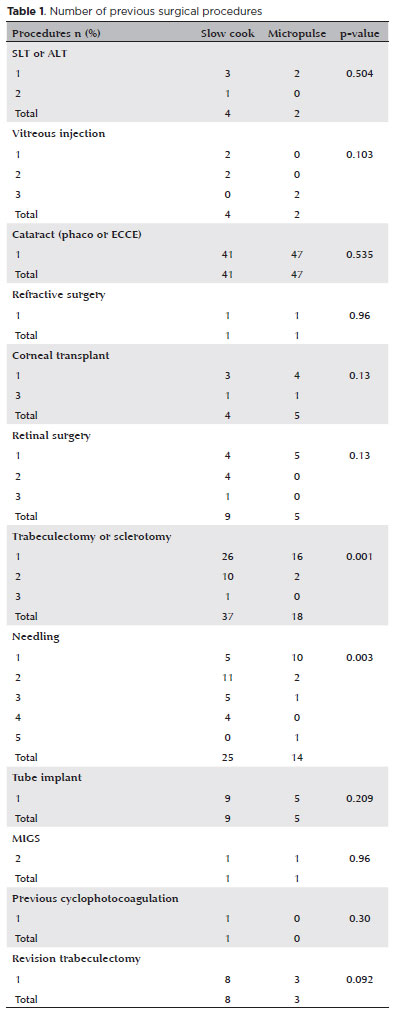
RESULTS: We included 128 eyes with primary open-angle glaucoma. The preoperative mean intraocular pressure was 25.53 ± 6.40 and 35.02 ± 12.57 mmHg in the micropulse- and “slow cook” transscleral cyclophotocoagulation groups, respectively (p<0.001). The mean intraocular pressure was reduced significantly to 14.33 ± 3.40 and 15.37 ± 5.85 mmHg in the micropulse- and “slow cook” transscleral cyclophotocoagulation groups at the last follow-up, respectively (p=0.110). The mean intraocular pressure reduction at 12 months was 11.20 ± 11.46 and 19.65 ± 13.22 mmHg in the micropulse- and “slow cook” transscleral cyclophotocoagulation groups, respectively (p<0.001). The median preoperative logMAR visual acuity was 0.52 ± 0.69 and 1.75 ± 1.04 in the micropulse- and “slow cook” transscleral cyclophotocoagulation groups, respectively (p<0.001). The mean visual acuity variation was -0.10 ± 0.35 and -0.074 ± 0.16 in the micropulse- and “slow cook” transscleral cyclophotocoagulation, respectively (p=0.510). Preoperatively, the mean eye drops were 3.44 ± 1.38 and 2.89 ± 0.68 drugs in the micropulse- and “slow cook” transscleral cyclophotocoagulation groups, respectively (p=0.017), but those were 2.06 ± 1.42 and 1.02 ± 1.46 at the end of the study in the slow cook” and micropulse transscleral cyclophotocoagulation groups, respectively (p<0.001). The success of criterion A was not significant between both groups. Compared with 11 eyes (17.74%) in the slow cook” transscleral cyclophotocoagulation group, 19 eyes (28.78%) in the micropulse transscleral cyclophotocoagulation group showed complete success (p=0.171). For criterion B, 28 (42.42%) and 2 eyes (3.22%) showed complete success after micropulse- and slow cook” transscleral cyclophotocoagulation, respectively (p<0.001).
CONCLUSION: Both techniques reduced intraocular pressure effectively.
Keywords: Sclera/surgery; Glaucoma, open-angle/surgery; Ciliary body/surgery; Intraocular pressure; Laser coagulation/methods; Lasers, semiconductor; Comparative study; Effectiveness
03-fig01.jpg)
Abstract
Objetivo: Investigar os resultados pós-operatórios e avaliar os preditores de sucesso da facoemulsificação combinada à goniotomia com o Kahook Dual Blade para o tratamento da catarata e do glaucoma em olhos com glaucoma primário de ângulo aberto.
Métodos: Série de casos retrospectivos, não comparativos e intervencionistas, em que todos os pacientes com glaucoma primário de ângulo aberto submetidos ao procedimento de facoemulsificação combinada à goniotomia com o Kahook Dual Blade entre junho de 2018 e abril de 2019 foram inscritos. Todos os participantes tiveram um acompanhamento mínimo de 6 meses. Foram registrados os valores de pressão intraocular pré e pós-operatória (em 1, 3 e 6 meses), número de medicamentos antiglaucomatosos, melhor acuidade visual corrigida, complicações cirúrgicas e quaisquer eventos ou procedimentos subsequentes relacionados. A análise de regressão logística foi usada para investigar a associação entre diferentes variáveis e resultados cirúrgicos.
Resultados: Um total de 57 olhos de 47 pacientes foram incluídos (média de idade, 70,5 ± 7 anos). A pressão intraocular média reduziu de 15,5 ± 4,2 mmHg para 12,2 ± 2,4 mmHg na última visita de acompanhamento (p<0,001). O número médio de medicamentos antiglaucomatosos diminuiu significativamente de 1,9 ± 1,0 para 0,6 ± 1,0 durante o mesmo período (p<0,001). Com base no critério predefinido (redução da pressão intraocular ≥20% e/ou redução de ≥1 medicamento), a taxa de sucesso em 6 meses foi de 86%. Um valor de pressão intraocular pré-operatório mais alto (OR= 2,01; p=0,016) e maior porcentagem de redução da pressão intraocular inicial
(30 dias) (OR= 1,02; p=0,033) foram significativamente associados ao sucesso cirúrgico.
Conclusão: Nossos resultados sugerem que o procedimento de facoemulsificação combinada à goniotomia com o Kahook Dual Blade é uma alternativa eficaz e segura para o manejo da catarata em olhos com glaucoma primário de ângulo aberto, impactando positivamente no controle da pressão intraocular e no número de medicamentos. Olhos com pressão intraocular basal mais alta e resposta inicial mais pronunciada ao procedimento parecem apresentar melhores resultados em 6 meses. Mais estudos são necessários para avaliar a eficácia em longo prazo e o perfil de segurança.
Keywords: Glaucoma; Glaucoma de ângulo aberto; Catarata; Facoemulsificação; Pressão intraocular; Goniotomia
14-tab01.jpg)
Abstract
Purpose: To assess the outcomes of the trabecular bypass as replacement therapy for medications in pharmacologically controlled vs. pharmacologically uncontrolled open-angle glaucoma patients.
Methods: This was a retrospective study of eyes treated with first- (iStent) or second-generation (iStent inject) trabecular bypass. Group 1 consisted of eyes with pharmacologically controlled intraocular pressure <18 mmHg and Group 2 consisted of eyes with pharmacologically controlled intraocular pressure ≥18 mmHg. The main outcomes measured were qualified (with or without medications) and unqualified or complete (without medications) success rates at different target intraocular pressures, mean reduction (%) in medication use, and proportion of medication-free eyes.
Results: The mean age was 70.4 years in Group 1 (n=105) and 68.1 years in Group 2 (n=65). Qualified success rates for intraocular pressure <18 mmHg, intraocular pressure <15 mmHg, and intraocular pressure <12 mmHg were similar between the groups (Group 1: 96.2%, 88.6%, and 32.4%, respectively; Group 2: 93.8%, 78.5%, and 21.5%, respectively; all p>0.05). Complete success rates were significantly higher in Group 1 than in Group 2: for intraocular pressure <18 mmHg (76.2% vs. 47.7%), intraocular pressure <15 mmHg (73.3% vs. 40.0%), and intraocular pressure <12 mmHg (14.3% vs. 4.6%). The mean reduction in medication use was higher in Group 1 than in Group 2. At the end of follow-up, 79.0% of eyes in Group 1 and 47.7% of eyes in Group 2 became medication-free.
Conclusions: Both groups showed high qualified success rates, but eyes with baseline pharmacologically controlled intraocular pressure <18 mmHg showed higher complete success rates and greater chances of achieving no need for medications.
Keywords: Procedimentos cirúrgicos oftalmológicos; Extração de catarata; Glaucoma, ângulo aberto; Glaucoma/terapia; Glaucoma/cirurgia
07-fig01.jpg)
Abstract
Objetivo: Utilizar aprendizado de máquina para predizer o risco de picos de pressão intraocular às 6 AM em pacientes com glaucoma primário de ângulo aberto e suspeitos.
Métodos: Esse estudo observacional transversal incluiu 98 olhos de 98 pacientes submetidos à curva de 24 horas de pressão intraocular (incluindo as medidas às 6 AM). A curva diurna de pressão intraocular foi definida como uma série de três medidas da curva de 24 horas de pressão intraocular às 8 AM, às 9 AM e às 11 AM. Duas novas variáveis foram apresentadas: inclinação e concavidade. A inclinação da curva às 8 AM foi calculada como a diferença entre pressão intraocular às 9 AM e 8 AM e reflete a variação da pressão intraocular na primeira hora. A concavidade da curva foi calculada como a diferença entre as inclinações às 9 AM e às 8 AM e pode ser para cima ou para baixo. Uma árvore de classificação foi usada para determinar um algoritmo multivariado a partir das medidas da curva diurna para prever o risco de pressão intraocular elevada às 6 AM.
Resultados: Quarenta e nove (50%) olhos apresentaram pressão intraocular às 6 AM >21 mmHg e a mediana do pico de pressão intraocularPIO foi 26 mmHg. Os melhores preditores de pressão intraocular às 6 AM >21 mmHg foram a pressão intraocular às 8 AM e a concavidade. O modelo proposto apresentou uma sensibilidade de 100% e uma especificidade de 86%, com uma acurácia de 93%.
Conclusões: A abordagem de aprendizado de máquina foi capaz de prever o risco de picos de pressão intraocular às 6 AM com uma boa acurácia. Essa nova abordagem para a curva diurna de pressão intraocular pode se tornar uma ferramenta amplamente utilizada na prática clínica e a indicação da curva de 24 horas de pressão intraocular pode ser racionalizada de acordo com a estratificação de risco.
Keywords: Glaucoma; Glaucoma de ângulo aberto; Suspeita de glaucoma; Pressão intraocular; Aprendizado de máquina
09-tab01.jpg)
Abstract
Objetivo: O sistema renina-angiotensina está envolvido na patogênese das condições isquêmicas retinianas e no glaucoma. Nosso objetivo foi avaliar a atividade da renina, enzima conversora de angiotensina 1 e 2 no humor aquoso, e amostras de sangue de pacientes com e sem glaucoma primário de ângulo aberto.
Métodos: Foram analisadas amostras de 56 participantes submetidos à cirurgia ocular. Os pacientes foram divididos em dois grupos: pacientes com catarata apenas (n=28), e pacientes com catarata e glaucoma primário de ângulo aberto (n=28). Amostras de sangue venoso (2ml) e humor aquoso (150 µl, via paracentese) foram coletadas durante a facoemulsificação (apenas catarata) ou cirurgia de glaucoma (catarata e glaucoma primário de ângulo aberto). As atividades sérica do humor aquoso de renina, enzima conversora de angiotensina 1 e enzima conversora de angiotensina 2 de todos os pacientes foram avaliadas por ensaios fluorimétricos, e os resultados foram analisados por regressão multivariada.
Resultados: Tanto a atividade da renina no humor aquoso quanto à razão humor aquoso/soro da atividade da renina foram significativamente menores nos pacientes com catarata e glaucoma primário de ângulo aberto do que em pacientes com catarata apenas [(média ± DP): 0,018 ± 0,006 ng/ml/h vs 0,045 ± 0,009 ng/ml/h; p<0,001 e 0,05 ± 0,02 vs 0,13 ± 0,05; p=0,025]. Análises multivariadas mostraram uma releção significativa entre menor atividade de renina no humor aquoso e glaucoma primário de ângulo aberto [coeficiente (±erro padrão): -0,029 ± 0,013; p=0,026].
Conclusões: Como a maioria dos pacientes com glaucoma primário de ângulo aberto usavam o colírio de timolol, estudos futuros envolvendo um maior número de pacientes e retirada prévia do tratamento são necessários para se discriminar o envolvimento do uso de betabloqueadores na atividade da renina no humor aquoso.
Keywords: Glaucoma de ângulo aberto; Catarata; Humor aquoso; Sistema renina-angiotensina
11-fig01.jpg)
Abstract
Objetivo: Reportar a curva de aprendizado dos 2 anos iniciais da trabeculotomia transluminal assistida por gonioscopia, usando a técnica de sutura termicamente atenuada e revisar os fatores que podem afetar o resultado.
Métodos: Este estudo retrospectivo incluiu 100 olhos de 89 participantes com glaucoma resistente ao tratamento clínico máximo, definido como tendo pressão intraocular superior a 21mmHg, além de três ou quatro drogas hipotensoras diferentes. Pressão intraocular inicial, 1 semana, primeiro, segundo, terceiro, sexto, 12 e 24 meses de acompanhamento; necessidade de medicação antiglaucoma; necessidade de mais cirurgias anti-glaucomatosas foram registradas. Olhos que necessitaram de intervenção cirúrgica adicional para o controle da pressão intraocular foram considerados como insucesso.
Resultados: Cinquenta e um olhos foram submetidos à trabeculotomia transluminal assistida por gonioscopia isolado e 49 olhos à trabeculotomia transluminal assistida por gonioscopia associado à extração de catarata no mesmo tempo cirúrgico. Houve diferença estatisticamente significativa entre a pressão intraocular média global no acompanhamento e a pressão intraocular média pré-operatória (p<0,001) em todas as visitas do acompanhamento. Ao avaliar a extensão do tratamento, os pacientes com extensão de 360 graus não apresentaram pressão intraocular média menor estatisticamente significativa em comparação com outras extensões. O hifema foi a única complicação presente em 50 olhos (50%), contudo todos tiveram resolução espontânea em quatro semanas. Um total de 26 olhos (26%) teve que ser submetido a trabeculectomia convencional adicional devido à pressão intraocular descontrolada, principalmente aqueles previamente submetidos à cirurgia vitreorretiniana.
Conclusões: A trabeculotomia transluminal assistida por gonioscopia, além de ser um procedimento aparentemente seguro, apresenta taxas de sucesso satisfatórias, mesmo durante a curva de aprendizado inicial do cirurgião. A técnica foi efetiva em reduzir a pressão intraocular e uso de medicamentos.
Keywords: Trabeculotomia/métdos; Glaucoma de ângulo aberto/cirurgia; Gonioscopia/métodos; Resultado de tratamento
Abstract
PURPOSE: Glaucoma is a chronic and progressive disease that requires long-term treatment and continuous monitoring. The Kahook Dual Blade, a device used to perform goniotomy in adults, is designed to improve intraocular pressure control in patients with glaucoma. This study aimed to evaluate the long-term efficacy and safety of kahook dual blade goniotomy in glaucoma patients undergoing cataract surgery over a 36-month follow-up.
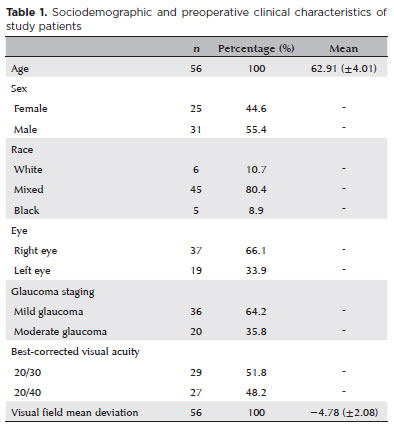
METHODS: This was a retrospective case series including 56 eyes from 56 patients with mild-to-moderate primary open-angle glaucoma who underwent phacoemulsification combined with kahook dual blade goniotomy. Mean intraocular pressure values, number of preoperative and postoperative hypotensive eye drops, procedure survival, and complications were evaluated over 36 months. Surgical success was defined as either a reduction in intraocular pressure of ≥20% with intraocular pressure between 6 and 18 mmHg without additional medication or a reduction of ≥1 eye drop with intraocular pressure between 6 and
18 mmHg.
RESULTS: The mean preoperative intraocular pressure decreased from 15.96 ± 2,83) mmHg to 13.14 ± 2,11) mmHg at 36 months, representing a 14.9% reduction (p<0.001). The mean number of eye drops decreased from 1.91 ± 0,75) to 1.34 ± 0,92), a 29.8% reduction (p<0.001). The overall success rate was 69.6% at 36 months.
CONCLUSION: Kahook dual blade goniotomy combined with cataract surgery significantly reduced intraocular pressure and the number of hypotensive eye drops required in patients with mild-to-moderate primary open-angle glaucoma, with a favorable success rate maintained at 36 months.
Keywords: Glaucoma, open-angle/surgery; Gonioscopy/methods; Intraocular pressure/physiology; Lens implantation, intraocular; Phacoemulsification/methods; Trabeculectomy/instrumentation; Treatment outcome
Abstract
PURPOSE: This study aimed to report the surgical outcomes and success predictors of micropulse transscleral cyclophotocoagulation in eyes with refractory glaucoma.
METHODS: This was a noncomparative, interventional case series. Patients with refractory glaucomas, defined as eyes with prior incisional glaucoma surgery failure and uncontrolled intraocular pressure, who underwent micropulse transscleral cyclophotocoagulation between March 2017 and June 2021 were enrolled. A minimum follow-up period of 6 months was required. Preoperative and postoperative intraocular pressure, number of hypotensive medications, surgical complications, and any subsequent related events were recorded. Success criteria were as follows: 1) intraocular pressure reduction ≥20% and intraocular pressure ≤18 mmHg; 2) intraocular pressure reduction ≥30% and intraocular pressure ≤15 mmHg. The need for topical hypotensive medications was not considered a failure.
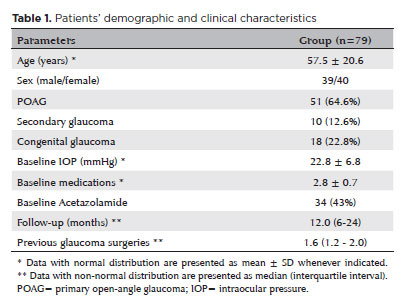
RESULTS: Seventy-nine (79) eyes (79 patients; mean age, 57.5 ± 20.6 years) were included. Overall, the median follow-up duration was 12.0 (interquartile interval, 6–24) months, and the mean intraocular pressure was reduced from 22.8 ± 6.8 mmHg to 15.5 ± 5.6 mmHg at the last follow-up visit (p<0.001). The mean number of medications was reduced from 2.8 ± 0.7 to 2.0 ± 1.0 (p<0.01). At 12 months postoperatively, the success rates for criteria 1 and 2 were 54.9% and 49.7%, respectively. Aside from one case of corneal ulcer, which fully resolved with clinical treatment, and two cases of persistent hypotony (with no visual acuity loss during follow-up), no other vision-threatening complications were observed during the postoperative period. The magnitude of intraocular pressure reduction at 1 month (adjusted to preoperative intraocular pressure; HR=1.01; p=0.002).
CONCLUSION: Our findings suggest that micropulse transscleral cyclophotocoagulation is a relatively effective alternative for managing refractory glaucomas, with minor postoperative complications. In addition, the initial intraocular pressure reduction was a statistically significant predictor of 1-year success in patients undergoing micropulse transscleral cyclophotocoagulation.
Keywords: Intraocular pressure/physiology; Glaucoma, open-angle/surgery; Trabeculectomy; Laser coagulation/methods; Tonometry, ocular/methods; Postoperative complications; Antihypertensive agents/therapeutic use.
Abstract
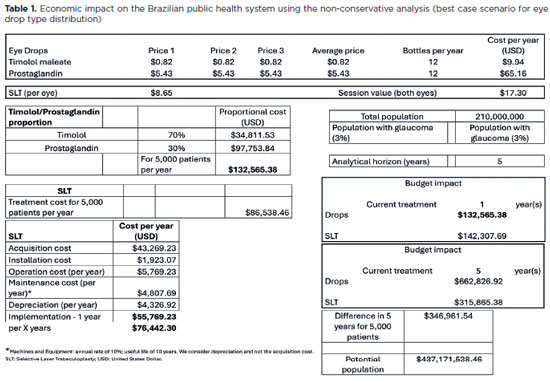
PURPOSE: To evaluate the economic impact of the following initial treatment scenarios for glaucoma on the Brazilian Public Health System (SUS): (1) traditional continuous instillation of hypotensive eye drops and (2) single session of selective laser trabeculoplasty.
METHODS: Economic impact was analyzed in three scenarios, from the least to the most conservative, for a hypothetical cohort of 5,000 individuals with open-angle glaucoma. Thereafter, projections were made on the basis of a glaucoma prevalence of 3% in the 2021 Brazilian population size.
RESULTS: All three scenarios demonstrated that selective laser trabeculoplasty exhibited a significantly lower economic impact than the eye drops on SUS over one and five years. Furthermore, the difference was more than United States Dollar 8 billion at five years when considering 3% of the Brazilian population aged >40 years in 2021.
CONCLUSION: As the initial treatment for primary open-angle glaucoma, selective laser trabeculoplasty exhibited a lower economic impact on SUS than latanoprost and timolol maleate eye drop instillation in all the studied scenarios over one and five-year periods.
Keywords: Glaucoma; Trabeculotomy; Laser therapy; Cost analysis; Health care cost Unified Health System; Brazil
Abstract
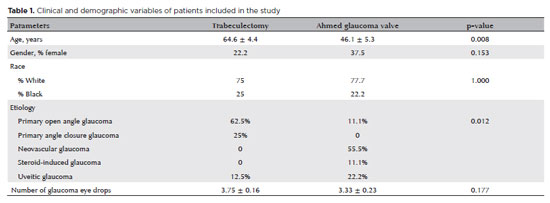
PURPOSE: This study aims to compare the initial ocular discomfort symptoms resulting from trabeculectomy and Ahmed glaucoma valve implantation surgeries.
METHODS: A prospective comparative study was conducted. The evaluation of ocular discomfort employed a questionnaire designed to identify the frequency and severity of distinct symptoms: ocular pain, general discomfort, tearing, foreign body sensation, and burning. This questionnaire was administered prior to surgery as a baseline, and subsequently at 7, 30, and 90 days post-surgery. Simultaneously, the Ocular Surface Disease Index (OSDI) was applied at these same time intervals.
RESULTS: The study encompassed a total of 17 patients (9 undergoing trabeculectomy and 8 undergoing Ahmed glaucoma valve implantation). The Ahmed glaucoma valve implantation group exhibited higher tearing levels at baseline (p=0.038). However, no statistically significant differences in symptoms were observed between the two surgeries at 7 and 30 days post-surgery. At the 90-day mark following surgery, patients who had undergone trabeculectomy reported a significantly higher foreign body sensation (p=0.004). Although OSDI scores did not differ between groups at baseline, the trabeculectomy group showed significantly higher OSDI scores than the Ahmed glaucoma valve implantation group at 7, 30, and 90 days after surgery (p<0.05).
CONCLUSION: Post-surgery, patients who had undergone trabeculectomy experienced increased foreign body sensation. Trabeculectomy appears to cause greater early postoperative ocular discomfort compared to the Ahmed glaucoma valve implantation group.
Keywords: Glaucoma/surgery; Paresthesia; Trabeculectomy; Glaucoma drainage implants; Postoperative care
05-fig01.jpg)
Abstract
O objetivo deste estudo é apresentar os resultados da trabeculotomia ab-interno com Kahook Dual Blade em pacientes com glaucoma congênito primário. Foi realizada trabeculotomia ab-interno com dispositivo de lâmina dupla em 3 olhos de 2 pacientes com diagnóstico de glaucoma congênito primário. Um deles no olho esquerdo e o outro paciente nos dois olhos. No primeiro paciente, houve resposta adequada uma vez que a pressão intraocular diminuiu de 36 mmHg para 14mmHg. O segundo paciente não respondeu adequadamente ao procedimento, mantendo altos níveis de pressão intraocular em ambos os olhos após o procedimento. A indicação da trabeculotomia ab-interno com o Kahook Dual Blade no glaucoma congênito primário deve ser cautelosa e são necessários mais estudos para estabelecer a eficácia e as melhores indicações. Parece que esse procedimento não deve ser indicado no tratamento do glaucoma congênito primário.
Keywords: Glaucoma congênito primário; Kahook Dual Blade; Trabeculotomia ab-interno; Malha trabecular; Cirurgia incisional de glaucoma
 ABO is licensed under a Creative Commons Attribution-NonComercial 4.0 Internacional.
About
Issues
Editorial Board
Submission

Arquivos Brasileiros de Oftalmologia
Official publication of Brazilian Council of Ophthalmology - Conselho Brasileiro de Oftalmologia (CBO)
Rua Casa do Ator, 1.117 - 2nd floor - Zip Code: 04546-004
São Paulo - SP, Brazil
TEL: +55 11 3266-4000
E-mail: [email protected]