Arq. Bras. Oftalmol. 2020;83 (4 )
:294-298
| DOI: 10.5935/0004-2749.20200050
Abstract
Objetivo: Avaliar os resultados da destreza da microcirurgia de duas avaliações sequenciais de treinamento usando a tecnologia de realidade virtual.
Métodos: Estudo transversal multicêntrico em que todos os candidatos que foram aceitos como residentes de primeiro ano em uma de seis instituições de ensino de oftalmologia. Os residentes foram submetidos a duas séries idênticas de testes de destreza padronizados e reprodutíveis usando equipamento de realidade virtual (Eyesi®): “sequência 1” e “sequência 2”. Cada sequência consistiu em 5 níveis de dificuldade que foram avaliados usando um sistema de pontuação proprietário. Os dados foram testados quanto à normalidade utilizando o teste de Shapiro-Wilk. As diferenças entre os testes nas sequências 1 e 2 foram avaliadas com o teste de Wilcoxon signed-rank.
Resultados: Os dados não seguiram uma distribuição normal. Houve melhora da sequência 1 em todos os testes (todos os valores de p<0,05). A soma de todas as pontuações (pontuação total) melhorou da sequência 1 (mediana= 152,50) para a sequência 2 (mediana= 256,00; p<0.001). Não houve correlação entre os valores da sequência delta e as pontuações médias.
Conclusão: Duas avaliações sequenciais de treinamento utilizando a tecnologia de realidade virtual mostraram melhora relevante nas quantificações da destreza da microcirurgia. Essas informações devem ser consideradas se abordagens de realidade virtual forem utilizadas para fins de teste, pois a experiência prévia pode levar a melhores resultados.
Keywords: Destreza motora; Realidade virtual; Competência clínica; Procedimentos cirúrgicos oftalmológicos/educação
Arq. Bras. Oftalmol. 2023;86 (3 )
:1-8
| DOI: 10.5935/0004-2749.20230034
Abstract
Purpose: To assess the outcomes of the trabecular bypass as replacement therapy for medications in pharmacologically controlled vs. pharmacologically uncontrolled open-angle glaucoma patients.
Methods: This was a retrospective study of eyes treated with first- (iStent) or second-generation (iStent inject) trabecular bypass. Group 1 consisted of eyes with pharmacologically controlled intraocular pressure <18 mmHg and Group 2 consisted of eyes with pharmacologically controlled intraocular pressure ≥18 mmHg. The main outcomes measured were qualified (with or without medications) and unqualified or complete (without medications) success rates at different target intraocular pressures, mean reduction (%) in medication use, and proportion of medication-free eyes.
Results: The mean age was 70.4 years in Group 1 (n=105) and 68.1 years in Group 2 (n=65). Qualified success rates for intraocular pressure <18 mmHg, intraocular pressure <15 mmHg, and intraocular pressure <12 mmHg were similar between the groups (Group 1: 96.2%, 88.6%, and 32.4%, respectively; Group 2: 93.8%, 78.5%, and 21.5%, respectively; all p>0.05). Complete success rates were significantly higher in Group 1 than in Group 2: for intraocular pressure <18 mmHg (76.2% vs. 47.7%), intraocular pressure <15 mmHg (73.3% vs. 40.0%), and intraocular pressure <12 mmHg (14.3% vs. 4.6%). The mean reduction in medication use was higher in Group 1 than in Group 2. At the end of follow-up, 79.0% of eyes in Group 1 and 47.7% of eyes in Group 2 became medication-free.
Conclusions: Both groups showed high qualified success rates, but eyes with baseline pharmacologically controlled intraocular pressure <18 mmHg showed higher complete success rates and greater chances of achieving no need for medications.
Keywords: Procedimentos cirúrgicos oftalmológicos; Extração de catarata; Glaucoma, ângulo aberto; Glaucoma/terapia; Glaucoma/cirurgia
Arq. Bras. Oftalmol. 2020;83 (4 )
:305-311
| DOI: 10.5935/0004-2749.20200042
Abstract
Objetivo: A deposição de colágeno e a diferenciação de miofibroblastos são fatores chaves relacionados à cicatrização excessiva em cirurgias oculares. Este estudo avaliou a atividade anti-fibrótica do ácido rosmarínico nos fibroblastos da cápsula de Tenon de coelhos estimulados com o fator de crescimento transformador-β2.
Métodos: Culturas primárias de fibroblastos da cápsula de Tenon de coelhos foram tratadas com várias concentrações de ácido rosmarínico por 12h, na presença e na ausência do fator de crescimento transformador-β2. Após 48h, o índice de proliferação dos fibroblastos da cápsula de Tenon de coelhos e a diferenciação dos miofibroblastos foram investigados por coloração por imunofluorescência para proliferação de antígeno nuclear celular e α-actina de músculo liso, respectivamente. Um contador automático de células e um ensaio de atividade metabólica colorimétrica foram utilizados para avaliar o número e a viabilidade das células. A expressão e produção do colágeno foram determinadas por reação quantitativa em cadeia da polimerase em tempo real e ensaio de hidroxipro-lina, respectivamente.
Resultados: Fibroblastos da cápsula de Tenon de coelhos não estimulados tratados com qualquer concentração de ácido rosmarínico exibiram diminuiçãode colágeno (p<0,01), mas não mostraram diferenças no índice de proliferação. A exposição ao fator de crescimento transformador- β2 induziu a diferenciação de miofibroblastos e aumentou a produção de colágeno. A exposição ao ácido rosmarínico nas concentrações de 1,0 e 3,0 μM reduziu o índice de proliferação (p<0,02), bem como a expressão de colágeno e a quantificação de hidroxiprolina (p<0.05). A exposição a 3,0 μM de ácido rosmarínico reduziu a viabilidade (p=0,035) de fibroblastos da cápsula de Tenon de coelhos não estimulados e o número de células (p=0,001) em culturas de fibroblastos da cápsula de Tenon de coelhos estimuladas e não estimuladas.
Conclusões: A exposição ao ácido rosmarínico 1,0 µM foi não citotóxica e levou à expressão reduzida de colágeno e menor proliferação de fibroblastos da cápsula de Tenon estimulados pelo fator de crescimento transformador-β2. Esses achados sugerem que o ácido rosmarínico é um composto antifibrótico relativamente não lesivo aos fibroblastos da cápsula de Tenon de coelhos, com potencial aplicação como agente adjuvante em procedimentos oculares, particularmente em cirurgias de glaucoma.
Keywords: Glaucoma; Procedimentos cirúrgicos oftalmológicos; Fibroblastos; Cicatrização; Ácido rosmarínico
Arq. Bras. Oftalmol. 2023;86 (1 )
:38-45
| DOI: 10.5935/0004-2749.20230009
Abstract
Objetivo: Avaliar o processo de adaptação de uma lente escleral que permite vários ajustes de parâmetros durante os testes e após o período inicial do seu uso; verificar quais os ajustes foram necessários, quais foram os mais utilizados, as suas indicações, a frequência com que estes recursos foram utilizados, e avaliar os resultados das mudanças realizadas.
Métodos: A adaptação da lente de contato escleral foi analisada prospectivamente, de forma sequencial, não aleatória e não comparativa. Todos os pacientes foram submetidos a um exame oftalmológico completo e tinham indicação para o uso de lentes esclerais. Foi utilizada a lente Zenlens (Alden Optical).
Resultados: Foi analisada a adaptação de lentes de contato esclerais em 80 olhos de 45 pacientes. Quanto ao diagnóstico, 72% tinham ceratocone, 12% tinham sido submetidos a ceratotomia radial, 5% tinham ectasia pós-cirurgia refrativa, 5% tinham olho seco, e 3%, alta miopia. Em 66 dos 80 olhos estudados (82,5%), os parâmetros foram modificados quando as lentes foram encomendadas. As razões foram: toque apical ou diminuição da altura sagital, aumento da altura sagital, sobre-refração cilíndrica, baixa acuidade visual, flexão da lente, toque periférico, compressão da borda em 360° e compressão da borda horizontal e/ou vertical.
Conclusão: O uso de lentes esclerais Zenlens demonstrou ser uma forma de correção muito promissora para os pacientes que requerem o uso de lentes esclerais. Embora o estudo sugira uma curva de aprendizagem, é possível personalizar as lentes de acordo com as necessidades de cada pacientes. Este fato melhora a adaptação e aumenta a chance de sucesso do uso.
Keywords: Lentes de contato; Adaptação; Ceratocone; Ceratotomia radial; Lente escleral, adaptação de lente escleral; Procedimentos cirúrgicos refrativos; Reabilitação; Curva de aprendizado
Arq. Bras. Oftalmol. 2025;88 (6 )
:1-9
| DOI: 10.5935/0004-2749.2024-0381
Abstract
PURPOSE: This study aimed to examine factors related to the professionalism of ophthalmology residents.
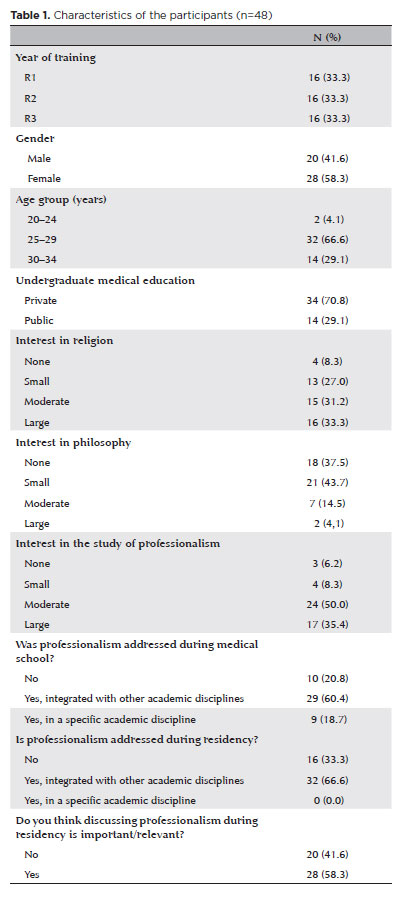
METHODS: A cross-sectional study was carried out involving 48 ophthalmology residents in Brazil. Professionalism was assessed using the professionalism mini-evaluation exercise, completed by both preceptors and residents, and the Pennsylvania State College of Medicine Professionalism Questionnaire, completed by the residents. The association between the professionalism score assigned by the preceptor through the professionalism mini-evaluation exercise and various sociodemographic and educational variables was assessed. The correlation between the residents’ self-assessment across both instruments and the preceptor’s assessments was measured using Spearman’s Rho.
RESULTS: All 48 residents were included, with equal representation across the 3 years of residency. The majority were female (58.3%) and between 25 and 29 years old (66.7%). The average professionalism score on the professionalism mini-evaluation exercise given by the preceptors was 3.0 (75%). A significant association was found between the year of training and the score in the doctor-patient relationship domain, with first-year residents showing lower scores (p=0.002). Male residents had higher scores in the “Interprofessional” domain (p=0.031). Graduates from private medical schools scored higher in both the “doctor-patient relationship” (p=0.015) and “reflective skills” (p=0.033) domains. Lower interest in professionalism was linked to lower scores in the “Interprofessional relationships” (p=0.033) and “time management” (p=0.003) domains. A strong correlation was observed between preceptor’s professionalism mini-evaluation exercise scores and residents’ self-assessed professionalism mini-evaluation exercise scores (r=0.917). However, the correlation between the self-assessed professionalism mini-evaluation exercise and the Pennsylvania questionnaire scores was weak (r=0.226).
CONCLUSION: Professionalism scores among ophthalmology residents were associated with year of training, gender, type of undergraduate education, and level of interest in the topic.
Keywords: Internship and residency; Ophthalmology; Professional competence; Education, professional; Physician-patient relations; Surveys and questionnaires
Arq. Bras. Oftalmol. 2018;81 (1 )
:42-6
| DOI: 10.5935/0004-2749.20180011
Abstract
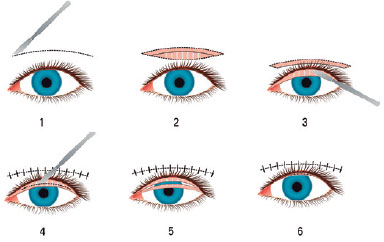
Objetivo: Compartilhar os resultados dos pacientes submetidos à rotação de retalho tarsal anterior, combinados com a reposição lamelar anterior devido à entrópio cicatricial da pálpebra superior e determinar a eficácia e a confiabilidade desta técnica cirúrgica.
Métodos: Foram incluídos neste estudo quinze olhos de 11 pacientes em quem realizamos cirurgia de rotação de retalho tarsal anterior combinada com reposição lamelar anterior devido ao entrópio cicatricial. Os registros médicos dos pacientes foram analisados retrospectivamente e as causas da entrópio cicatricial, bem como os achados do exame oftalmológico pré-operatório e pós-operatório foram registrados. A integridade anatômica e funcional da pálpebra foi considerada como sucesso cirúrgico.
Resultados: A idade média foi de 59,81 ± 18 anos. O período médio de seguimento foi de 21,72 ± 14 meses (intervalo 5-43 meses). As causas da entrópio cicatricial foram o desenvolvimento de cicatrizes pós-operatórias devido a eletrólises múltiplas para triquíase e/ou distiquiase em 7 olhos, tracoma em 6 olhos e trauma em 2 olhos. Todos os pacientes foram tiveram irritação e lacrimejamento pré-operatório, enquanto que 10 pacientes apresentavam opacidade e erosão da córnea e 1 paciente apresentava apenas erosão epitelial. O sucesso total anatômico e funcional foi alcançado em todos os casos.
Conclusão: A rotação do retalho tarsal anterior combinada com a reposição lamelar anterior no reparo da entrópio cicatricial é um procedimento cirúrgico alternativo efetivo e confiável.
Keywords: Tracoma/complicações; Pálpebras/cirurgia; Entrópio/cirurgia; Cicatriz; Retalhos cirúrgicos; Procedimentos cirúrgicos oftalmológicos/métodos
Arq. Bras. Oftalmol. 2025;88 (4 )
:1-6
| DOI: 10.5935/0004-2749.2024-0236
Abstract
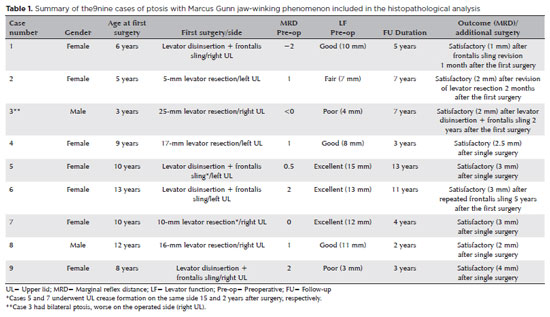
PURPOSE: This study was conducted to report the histopathological and clinical features of the Marcus Gunn phenomenon and other similar conditions of upper eyelid misfiring.
METHODS: This was a retrospective study of patients with congenital ptosis with Marcus Gunn phenomenon who have undergone surgical repair over a period of 12 years and another two patients with upper eyelid misfiring in association with extraocular movements to identify their histopathological findings as subtypes representing ocular congenital cranial dysinnervation disorder.
RESULTS: Among 136 patients with congenital ptosis, 11 (8%) patients with Marcus Gunn phenomenon or misfiring were identified, of whom 9 (6.6%) had typical known Marcus Gunn phenomenon and 2 (1.4%) had eyelid misfiring similar to Marcus Gunn phenomenon. In all patients, the histopathological changes of the excised levator muscle included overall loss and/or atrophy of muscle fibers and irregular-modified Gomori trichrome staining.
CONCLUSION: The Marcus Gunn phenomenon and similar misfiring conditions with synkinetic extraocular muscle movements share findings that are consistent with the neurogenic type of muscle atrophy. This result suggests a common underlying etiology with variable clinical findings, representing the ocular counterpart of congenital cranial dysinnervation disorder, which has been reported as ocular congenital cranial dysinnervation disorder.
Keywords: Eyelid diseases; Ocular motility disorders/surgery; Ophthalmologic surgical procedures
Arq. Bras. Oftalmol. 2025;88 (6 )
:1-4
| DOI: 10.5935/0004-2749.2025-0033
Abstract
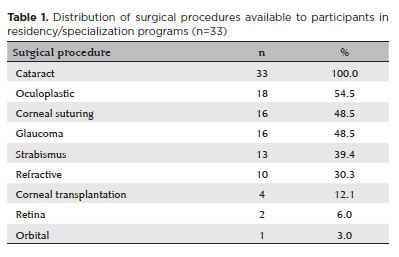
PURPOSE: In Brazil, it has traditionally been standard practice to teach a wide range of surgical techniques to all ophthalmology residents, with the aim of equipping them to manage most ocular conditions. However, with modern developments, access to subspecialists has expanded to nearly the entire country. This raises the question of whether it is still necessary to teach numerous surgical techniques to every resident. This study evaluates the effectiveness of surgical training in Brazilian ophthalmology residency programs to determine if comprehensive surgical training for all residents is truly effective, thereby providing evidence to inform educational policy decisions.
METHODS: A cross-sectional study using a questionnaire distributed to physicians engaged in eye care.
RESULTS: A total of 137 physicians responded to the survey, with 104 (76.0%) having already completed their specialization. The findings indicate that most practicing ophthalmologists received surgical training during residency in cataract, glaucoma, oculoplastic, and strabismus surgeries. Nonetheless, many of these specialists no longer perform most of these surgeries in practice, except for cataract surgery. While 53.8% of those who completed residency reported satisfaction with their training, 35.6% indicated that they wished they had received better surgical preparation.
CONCLUSION: The training of ophthalmology specialists must be made more efficient. Training efficiency is reduced when time and resources are devoted to surgical procedures that many specialists will not perform in their careers.
Keywords: Opthalmologists; Teaching; Education, medical; Ophthalmological surgical procedures; Simulation training; Wet lab; Surveys and questionnaires
Arq. Bras. Oftalmol. 2026;89 (1 )
:1-8
| DOI: 10.5935/0004-2749.2025-0109
Abstract
PURPOSE: To evaluate the preferred surgical practice patterns for glaucoma among members of the Latin American Glaucoma Society.
METHODS: A cross-sectional study was conducted using an electronic survey distributed in July 2023 via email to members of the Latin American Glaucoma Society. The questionnaire comprised four sections addressing the specialists' profiles, preferred surgical procedures for open-angle glaucoma, and choices in 10 different clinical scenarios, including congenital glaucoma.
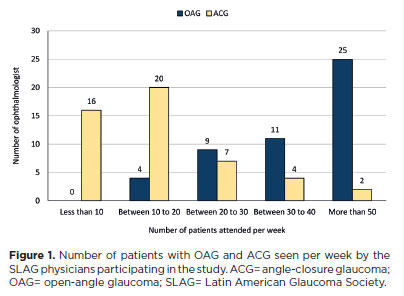
RESULTS: Of the 63 members, 49 physicians (77.7%) responded – 13 women and 36 men – from nine Latin American countries. Thirty-one respondents (63.26%) had more than 20 yr of professional experience. For the surgical management of open-angle glaucoma, trabeculectomy was the most preferred procedure (48 physicians), followed closely by glaucoma drainage devices (47 physicians) and minimally invasive glaucoma surgery (29 physicians). Across the 10 clinical scenarios, glaucoma drainage devices were selected most frequently (203 preferences), followed by trabeculectomy (118), ciliary body laser procedures (107), and minimally invasive glaucoma surgery (40). However, minimally invasive glaucoma surgery was the preferred option for primary open-angle glaucoma with mild-to-moderate cataracts.
CONCLUSION: Among specialists of the Latin American Glaucoma Society, trabeculectomy and glaucoma drainage devices remain the most commonly performed surgical procedures. Minimally invasive glaucoma surgery is primarily used in combination with cataract surgery, while ciliary body laser procedures are generally reserved for cases of previous glaucoma drainage device failure or as an initial option for newly diagnosed glaucoma cases.
Keywords: Glaucoma; Ophthalmologic surgical procedures; Latin America; Practice patterns, physicians; Surveys and questionnaires
Arq. Bras. Oftalmol. 2024;87 (5 )
:1-5
| DOI: 10.5935/0004-2749.2023-0343
Abstract
PURPOSE: To determine and analyze the usability metrics of a free mobile learning app for ophthalmology in Brazil.
METHODS: Metric data from the management dashboard of the CBOQUIZ app were used. All users registered on the platform between March 2019 and June 30, 2021 were included. The number of questions answered, number of correct answers, number of questions answered and correct answers by subject area, and user performance by geographic region were analyzed.
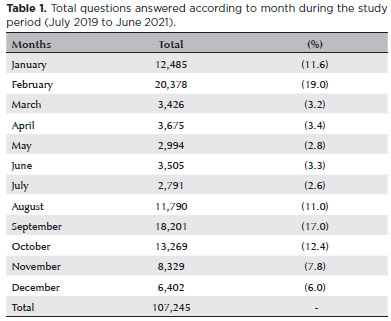
RESULTS: There were 458 active users during the research period and 107,245 questions answered (average, 234.16 questions per user). Of the questions answered, 81,600 (75.5%) were correct and 2,645 were incorrect. The states in Brazil with the best performance were Espírito Santo, Paraiba, and Paraná. The subject area with the lowest hit rate was basic sciences (69.1%), within which embryology demonstrated the lowest hit rate (58.28%). The posterior segment had the highest number of questions answered, followed by miscellaneous topics and the anterior segment. Questions on strabismus were the least answered.
CONCLUSION: The app was used consistently throughout the period studied, and participants adhered to this teaching modality. Performance asymmetry was observed across the Brazil states. The CBOQUIZ app can be used to homogenize ophthalmology teaching in the country.
Keywords: Ophthalmology; Mobile applications; Teaching; Smartphone; Education, distance; Internship and residency; Brazil
Arq. Bras. Oftalmol. 2025;88 (5 )
:1-7
| DOI: 10.5935/0004-2749.2024-0368
Abstract
PURPOSE: To compare endothelial corneal cell changes following cataract surgery performed by phacoemulsification with intraocular lens implantation, conducted by surgeons with varying levels of experience.
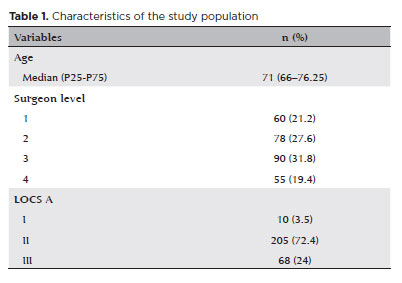
METHODS: Two hundred and eighty-three eyes diagnosed with cataract were included. Lens opacity was classified into three categories (I, II, and III). Surgeons were categorized into four experience levels (1, 2, 3, and 4), based on years of practice and lifetime surgeries performed. Corneal endothelial characteristics were assessed using non-contact specular microscopy, with measurements taken before surgery and 30-60 days post-surgery.
RESULTS: Pre- and postoperative endothelial analysis showed no significant differences between surgeon levels regarding visual acuity achieved, corneal thickness, and endothelial hexagonality. However, the central endothelial cell density index showed a significantly greater reduction among level 1 surgeons (p=0.026). Grade II cataracts exhibited significant variations in the central endothelial cell density (p=0.011) and average cell size, with level 1 surgeons showing the largest increases (p=0.024).
CONCLUSIONS: The analysis revealed significant differences in visual acuity and endothelial indices between surgeon experience levels, with less experienced surgeons showing greater variations and poorer performance. Clinical protocols should consider these data to establish safer training protocols.
Keywords: Cataract extraction; Phacoemulsification; Endothelium; corneal; Lens implantation, intraocular; Visual acuity; Internship and residency; Surgeons
Arq. Bras. Oftalmol. 2025;88 (3 )
:1-5
| DOI: 10.5935/0004-2749.2024-0084
Abstract
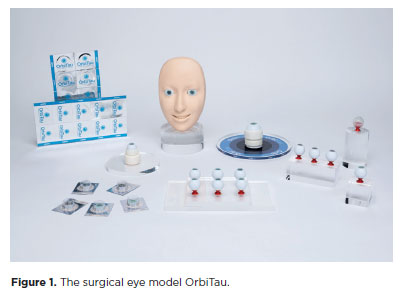
PURPOSE: The OrbiTau surgical simulator is a synthetic eye model developed to enhance cataract surgical training. Herein, we aimed to describe the perspectives of Harvard’s Ophthalmology faculty and residents regarding the effectiveness of OrbiTau.
METHODS: A cross-sectional study was conducted in which 11 surgeons from the Massachusetts Eye and Ear Infirmary, with prior experience utilizing simulated phacoemulsification platforms, conducted cataract surgery with the OrbiTau. Subsequently, they completed a satisfaction questionnaire using the Likert scale.
RESULTS: Regarding the various OrbiTau components, 90.90% of the participants reported that the OrbiTau lens capsule was comparable to that of the human lens during capsulotomy. Furthermore, 72.72% of the participants found that the OrbiTau lens consistency was analogous to that of the human lens nucleus. Approximately 63.63% of the participants reported that the model’s posterior lens capsule resembled the native posterior capsule, and 72.72% of the participants noted that the model’s red reflex was similar to that of the dilated human pupil. Most participants believed that the OrbiTau was easier to use and more realistic than other commercially available simulators.
CONCLUSION: Our single-institution survey of the Orbitau demonstrated that this model realistically replicates ocular structures and may be a viable option for cataract surgery training.
Keywords: Cataract extraction/education; Simulation training/methods; Ophthalmology/education; Phacoemulsification/education; Ophthalmologists/education; Surgeons/education; High fidelity simulation training
Arq. Bras. Oftalmol. 2024;87 (3 )
:1-5
| DOI: 10.5935/0004-2749.2023-0038
Abstract
PURPOSE: To assess the effect of the coronavirus disease 2019 (COVID-19) pandemic on cataract surgery by residents who had mandatory surgical simulator training during residency.
METHODS: In this retrospective, observational analytical study, the total number of cataract surgeries and surgical complications by all senior residents of 2019 (2019 class; prepandemic) and 2020 (2020 class; affected by the reduced number of elective surgeries due to the COVID-19 pandemic) were collected and compared. All residents had routine mandatory cataract surgery training on a virtual surgical simulator during residency. The total score obtained by these residents on cataract challenges of the surgical simulator was also evaluated.
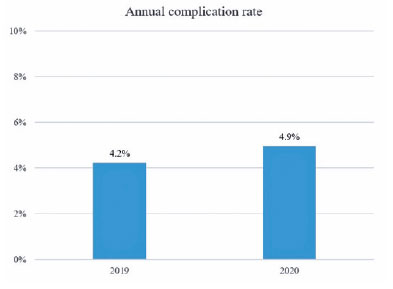
RESULTS: The 2020 and 2019 classes performed 1275 and 2561 cataract surgeries, respectively. This revealed a reduction of 50.2% in the total number of procedures performed by the 2020 class because of the pandemic. The incidence of surgical complications was not statistically different between the two groups (4.2% in the 2019 class and 4.9% in the 2020 class; p=0.314). Both groups also did not differ in their mean scores on the simulator’s cataract challenges (p<0.696).
CONCLUSION: Despite the reduction of 50.2% in the total number of cataract surgeries performed by senior residents of 2020 during the COVID-19 pandemic, the incidence of surgical complications did not increase. This suggests that surgical simulator training during residency mitigated the negative effects of the reduced surgical volume during the pandemic.
Keywords: COVID-19; Pandemics; Cataract extraction/education; Internship and residency/methods; Simulation training/methods; Phacoemulsification/education; Surgery, computer-assisted; Computer simulation; Clinical competence; Ophthalmology/education


 ABO is licensed under a Creative Commons Attribution-NonComercial 4.0 Internacional.


05-fig01.jpg)
14-tab01.jpg)
07-fig01.jpg)
07-tab01.jpg)
06-fig01.jpg)