Arq. Bras. Oftalmol. 2021;84 (6 )
:549-553
| DOI: 10.5935/0004-2749.20210081
Abstract
Objetivo: Identificar manifestações oculares em pacientes na fase crônica da febre Chikungunya e descrever seu perfil sociodemográfico.
Métodos: Estudo transversal com a inclusão de pacientes com confirmação sorológica de febre Chikungunya. Todos os pacientes foram submetidos a exame oftalmológico completo, incluindo testes específicos de função lacrimal (teste de ruptura do filme lacrimal, teste de Schirmer e teste da lissamina verde).
Resultados: Foram avaliados 64 olhos de 32 pacientes. A maioria dos pacientes eram do sexo feminino (71,9%) e a idade média foi 50,0 ± 13,7 anos. O intervalo médio entre a confirmação sorológica e o exame oftalmológico foi de 12,7 ± 7,7 meses. Vinte pacientes (62%) apresentaram olho seco. Não houve significância estatística na associação entre olho seco e o tempo de diagnóstico da infecção (p=0,5546), idade (p=0,9120), sexo (p=1,00), raça (p=0,2269), artralgia durante a infecção aguda (p=0,7930), dor retro-orbitária (p=0,3066) e conjuntivite (p=1,00).
Conclusão: A presença de olho seco foi a manifestação mais prevalente observada. Não foram observados sinais de inflamação intraocular ou baixa acuidade visual.
Keywords: Febre Chikungunya; Vírus Chikungunya; Síndromes do olho seco; Infecções oculares virais; Infecção por Arbovírus; Manifestações oculares.
Arq. Bras. Oftalmol. 2025;88 (1 )
:1-4
| DOI: 10.5935/0004-2749.2022-0375
Abstract
PURPOSE: This study aimed to assess grating visual acuity and functional vision in children with congenital Zika syndrome.
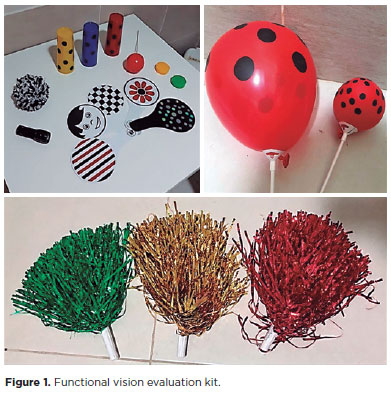
METHODS: Initial and final grating visual acuity was measured using Teller acuity cards. Cerebral vision impairment standardized tests were used to assess functional vision. Patients were referred to the early visual intervention program for visually disabled children. Neuroimaging was performed.
RESULTS: In this study, 10 children were included with an age range of 1–37 months. Eight patients presented with macular atrophic scars. Neuroimaging revealed microcephaly and cerebral abnormalities in all patients. Low vision and cerebral vision impairment characteristics were observed in all children. The final grating visual acuity in this group varied from 3.00 to 0.81 logMAR.
CONCLUSIONS: The grating visual acuity test revealed low vision in all children with congenital Zika syndrome. Functional vision evaluation revealed cerebral vision impairment characteristics in all patients, who were referred to the early visual intervention program. Visual acuity improved in six children.
Keywords: Zika virus infection/congenital; Low vision; Vision disorders; Atrophy, Microcephaly; Visual acuity; Child
Arq. Bras. Oftalmol. 2026;89 (1 )
:1-4
| DOI: 10.5935/0004-2749.2024-0402
Abstract
PURPOSE: This study evaluated the proportion of corneas discarded by the Eye Bank of Londrina, Paraná, due to positive serology over a 5-year period and its impact on transplant availability.
METHODS: A cross-sectional study was conducted, analyzing 1,968 corneas from 1,056 donors collected between January 2014 and December 2018 at the Eye Bank of Londrina. Serological tests for hepatitis B (HBsAg and anti-HBc), hepatitis C (anti-HCV), and HIV (anti-HIV 1 and 2) were performed using chemiluminescent microparticle immunoassays. Data were analyzed descriptively and presented in tables and graphs.
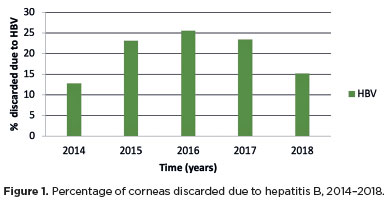
RESULTS: Of the 1,968 corneas processed, 897 (45.57%) were discarded. Among these, 333 (37.12%) tested positive for serological markers. Hepatitis B accounted for 34.67% of positive cases (15% of total donations), hepatitis C for 1.11% (0.50% of total), and HIV for 0.89% (0.4% of total). Hepatitis cases remained stable between 2014 and 2016, with a marked decline in 2017 and 2018. Most discarded corneas were positive for anti-HBc (31.88%) and negative for HBsAg; however, the anti-HBs test was not performed to confirm immunity to the hepatitis B virus.
CONCLUSION: The findings highlight the importance of serological testing to identify and eliminate contaminated corneas, thereby preventing the transmission of infectious diseases to recipients. Positive serology for hepatitis, particularly hepatitis B, was the leading cause of corneal disposal.
Keywords: Cornea; Corneal transplantation; Corneal donation; Eye banks; Hepatitis B virus; Hepatitis C virus; HIV infections; Seropositivity; Serologic tests
Arq. Bras. Oftalmol. 2023;86 (6 )
:1-8
| DOI: 10.5935/0004-2749.2021-0419
Abstract
Objetivo: Investigar sintomas oculares subjetivos e medir a secreção lacrimal objetivamente em pacientes com diagnóstico confirmado da doença coronavírus 2019 (COVID-19).
Métodos: Vinte e quatro pacientes que sobreviveram à infecção pela COVID-19 e 27 controles saudáveis foram incluídos neste estudo transversal prospectivo. Citologia de impressão da conjuntiva, teste de Schirmer, tempo de separação do filme lacrimal, pontuações de coloração da córnea foram aplicados a todos os participantes.
Resultados: Concluiu-se que não houve diferença significativa em relação ao gênero e idade média entre os dois grupos (p=0,484 e p=0,599, respectivamente). A análise dos resultados da citologia de impressão da conjuntiva revelou que a densidade das células do cálice diminuiu, enquanto os linfócitos e neutrófilos aumentaram nos pacientes do grupo COVID-19 quando comparados com os do grupo controle. Quando a classificação de Nelson foi aplicada às amostras de citologia de impressão da conjuntiva, determinou-se que 25% dos pacientes do grupo COVID-19 e 14,8% dos pacientes do grupo controle apresentaram alterações consistentes com grau 2 ou superior. O tempo médio de separação do filme lacrimal, teste de Schirmer e os resultados das pontuações de coloração da córnea foram determinados, diferindo entre o grupo COVID-19 e o grupo controle (p=0,02, p<0,001, and p=0,003, respectivamente).
Conclusões: As análises realizadas neste estudo revelaram as alterações conjuntivais patológicas de pacientes com diagnóstico confirmado de COVID-19 e mostraram que é possível que alterações patológicas da superfície ocular ocorram mesmo no final da infecção pela COVID-19, sem a ocorrência de manifestações oculares clínicas significativas.
Keywords: Infecções por coronavirus; COVID-19; SARS-CoV-2; Manifestações oculares; Lágrimas.


 ABO is licensed under a Creative Commons Attribution-NonComercial 4.0 Internacional.


04-tab01.jpg)
14-fig01.jpg)
02-fig01.jpg)
04-fig01.jpg)
08-fig01.jpg)
14-fig01tb.jpg)
04-fig01.jpg)
01-fig01.jpg)
03-fig01.jpg)