
Arq. Bras. Oftalmol. 2026; 89 (5): 10.5935/0004-2749.2026-0067
Total: 930
Eric Pinheiro de Andrade1; Mauro C. Gobira Guimarães Filho2; Leonardo Provetti Cunha3,4; Kenzo Hokazono5; André Márcio Vieira Messias6; Clara Lima Afonso4; Marcela Bareira7; Mário Luiz Ribeiro Monteiro4
DOI: 10.5935/0004-2749.2026-0067
ABSTRACT
PURPOSE: Neuro-ophthalmology is a highly specialized subspecialty at the interface of neurology and ophthalmology. Globally, workforce shortages and geographic maldistribution limit access to neuro-ophthalmic care. Although Brazil has a large ophthalmology workforce, regional disparities may restrict access to subspecialty services. The national distribution of neuro-ophthalmologists has not previously been quantified. This study aimed to characterize the geographic distribution of neuro-ophthalmologists in Brazil and identify potential gaps in access to neuro-ophthalmic care.
METHODS: This cross-sectional, population-based study used data from the registry of the Brazilian Neuro-Ophthalmology Association (Associação Brasileira de Neuro-Oftalmologia [ABNO]) to identify practicing neuro-ophthalmologists (data extracted on January 1, 2026). Municipal- and state-level population estimates were obtained from the Brazilian Institute of Geography and Statistics. Specialist density was calculated as the number of neuro-ophthalmologists per million inhabitants. States were classified according to the presence or absence of at least one specialist and were further grouped into Brazil's five macroregions for comparative analyses. Descriptive statistical analyses were performed.
RESULTS: A total of 66 neuro-ophthalmologists were identified across 14 of Brazil's 27 states. Thirteen states had no registered neuro-ophthalmologists, representing approximately 49.4 million people (23.2% of the national population). Five states—São Paulo (n=31), Rio de Janeiro (n=6), Minas Gerais (n=6), Pernambuco (n=4), and Paraná (n=4)—accounted for more than two-thirds of all specialists. Specialist density ranged from 0 to more than 0.7 per million inhabitants, with higher concentrations in the Southeast and no specialists in several states in the North and Northeast. The distribution was highly clustered in metropolitan areas.
CONCLUSION: Brazil exhibits marked geographic maldistribution of neuro-ophthalmologists, with nearly one-quarter of the population lacking local access to specialized care. The concentration of specialists in urban and economically developed regions mirrors international trends and may exacerbate inequities within the public health system. Expanding the workforce and integrating teleophthalmology into neuro-ophthalmic services may help reduce regional disparities and improve access to specialized care.
Keywords: Ophthalmologists; Public health; Health policy; Workforce; Professional practice location; Telemedicine; Teleophthalmology; Brazil
INTRODUCTION
Neuro-ophthalmology is a subspecialty dedicated to the diagnosis and management of visual disorders of neurological origin and requires advanced training at the interface of neurology and ophthalmology(1). Despite its clinical importance, neuro-ophthalmology remains one of the smallest ophthalmic subspecialties worldwide, creating a structural imbalance between population needs and specialist availability(1). Limited access to specialized neuro-ophthalmic care has been associated with delayed diagnosis and poorer visual outcomes in population-based studies(2).
In the United States, the neuro-ophthalmology workforce is insufficient to meet current demand, with an estimated density of approximately one specialist per 1-2 million inhabitants(2). This shortage is reflected in prolonged waiting times for consultations and limited access for patients with urgent neuro-ophthalmic conditions(1). In addition, the aging workforce poses a growing challenge, as a substantial proportion of practicing neuro-ophthalmologists are approaching retirement age(2).
Geographic maldistribution further compounds workforce shortages. Recent cross-sectional studies have shown that most counties in the United States lack resident neuro-ophthalmologists, requiring patients to travel considerable distances to obtain specialized care(3). A substantial proportion of the population lives more than two hours from the nearest neuro-ophthalmologist, with underserved areas frequently overlapping regions of greater socioeconomic disadvantage(3). These geographic inequities have been associated with a higher prevalence of visual impairment in population-based analyses(4-6). Brazil presents a similar pattern of pronounced regional inequality in the distribution of medical specialists. Although the country has a large number of ophthalmologists, their concentration in metropolitan and economically developed regions limits access to advanced ophthalmic care in many parts of the country(7). National data demonstrate considerable variation in ophthalmologist-to-population ratios across states and municipalities, with several regions exhibiting critically low specialist availability(7). However, the geographic distribution of neuro-ophthalmologists in Brazil has not previously been evaluated.
This cross-sectional, population-based study aimed to characterize the geographic distribution of neuro-ophthalmologists in Brazil and identify areas with potential gaps in access to neuro-ophthalmic care. By integrating national provider data with population estimates from the Brazilian Institute of Geography and Statistics, we sought to estimate specialist availability across states and municipalities(6). Our findings are intended to inform health policy, workforce planning, and strategies to reduce inequities in access to neuro-ophthalmic services.
METHODS
Study design
This cross-sectional, population-based study was conducted to evaluate the geographic distribution of neuro-ophthalmologists in Brazil and identify areas with potential gaps in access to neuro-ophthalmic care. The methodological framework was adapted from previous workforce and geospatial analyses of neuro-ophthalmology services conducted in the United States (3). The study was reported in accordance with the Strengthening the Reporting of Observational Studies in Epidemiology (STROBE) guidelines for cross-sectional studies.
Data sources and neuro-ophthalmologist identification
Data on practicing neuro-ophthalmologists were obtained from the official registry of the Brazilian Neuro-Ophthalmology Association (Associação Brasileira de Neuro-Oftalmologia [ABNO]). For the purposes of this study, a neuro-ophthalmologist was operationally defined as an ophthalmologist or neurologist who had completed at least 1 yr of formal training in neuro-ophthalmology at an ABNO-accredited center.
According to the ABNO bylaws, membership is classified into five categories: Founding Members, who are signatories of the association's founding charter; Full Members, who hold board certification in ophthalmology or neurology, are licensed by their respective Regional Medical Council, have completed at least 1 yr of training in neuro-ophthalmology at an ABNO-accredited center, and are supported by two letters of recommendation from founding or full members; Associate Members, who include physicians practicing ophthalmology or neurology, physicians from other specialties, foreign ophthalmologists and neurologists, and residents or trainees in ophthalmology programs whose applications have been approved by the association; Honorary Members, who are physicians or other professionals recognized for outstanding contributions to neuro-ophthalmology; and Beneficent Members, consisting of individuals or institutions that have supported the association through donations.
Membership in ABNO is voluntary. The registry includes physicians formally affiliated with the association who were actively practicing neuro-ophthalmology in Brazil at the time of data extraction. Data were extracted on January 1, 2026. Each record included the municipality in which the physician practiced. Duplicate records and entries lacking valid geographic information were excluded before analysis. Only physicians with an identifiable practice location within Brazil were included.
Population data
Population estimates were obtained from publicly available demographic data provided by the Brazilian Institute of Geography and Statistics(6). Municipal population estimates were used as the primary denominator for all analyses. When appropriate, municipal populations were aggregated to higher geographic units to facilitate regional comparisons. Population figures were based on the most recent census or official intercensal estimates available at the time of the analysis. These data have been widely used in Brazilian studies evaluating the health workforce and access to healthcare services(5).
Geographic units and measures of access
Analyses were performed at the municipal, state, and macroregional levels. Neuro-ophthalmologist availability was expressed as the number of specialists per million inhabitants. Municipalities were classified according to the presence or absence of at least one neuro-ophthalmologist. States were further grouped into Brazil's five geographic macroregions (North, Northeast, Central-West, Southeast, and South) to enable regional comparisons. Regions without resident neuro-ophthalmologists were considered potentially underserved. This approach is consistent with previous geospatial workforce studies that evaluated specialist coverage based on provider location relative to population distribution(3). No assumptions were made regarding referral patterns or interregional patient flow.
Statistical analysis
Descriptive statistics were used to summarize the geographic distribution of neuro-ophthalmologists and population characteristics across geographic units. Specialist-to-population ratios were calculated for each geographic unit and reported as counts, proportions, and rates per million inhabitants. Inferential statistical analyses were not performed because the study was designed as a descriptive workforce mapping analysis(3). Data management and statistical analyses were performed using standard statistical software. All analyses were conducted using aggregate data, and no individual-level patient information was included.
Ethical Considerations
This study used publicly available aggregate demographic data and de-identified physician registry information. No patient-level data were collected or analyzed. Therefore, in accordance with Brazilian national regulations, institutional review board approval was not required.
RESULTS
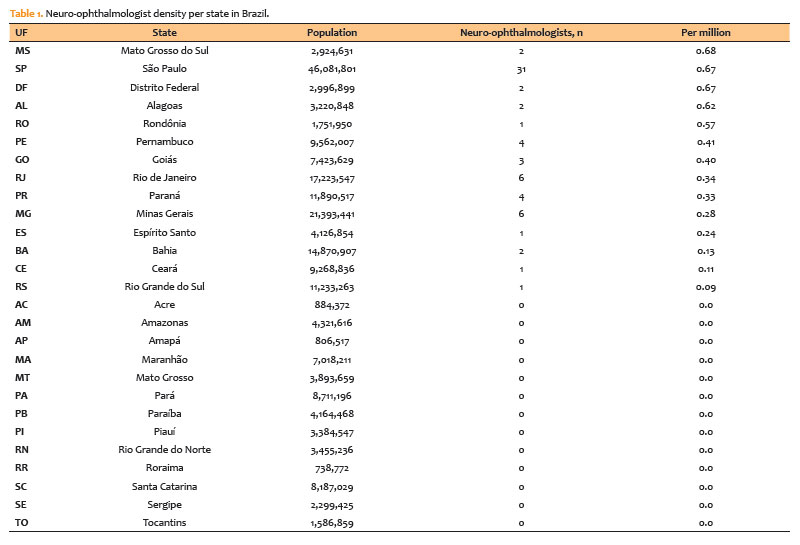
A total of 66 neuro-ophthalmologists were identified in the national registry. These specialists were distributed across 14 of Brazil's 27 federative units, whereas 13 states had no registered neuro-ophthalmologists. Collectively, these states had an estimated population of approximately 49.4 million inhabitants, representing 23.2% of the Brazilian population according to national population estimates.
The distribution of neuro-ophthalmologists was markedly uneven across the country. Five states accounted for the majority of specialists. São Paulo had the highest number of neuro-ophthalmologists (n=31), followed by Rio de Janeiro (n=6), Minas Gerais (n=6), Pernambuco (n=4), and Paraná (n=4). Together, these five states accounted for more than three-quarters of all identified specialists nationwide. São Paulo alone represented approximately 47.0% (31/66) of the national workforce, while the five states combined accounted for 77.3% (51/66), highlighting the marked concentration of specialists in a limited number of federative units.
When adjusted for population size, the density of neuro-ophthalmologists varied substantially among states, ranging from 0 to more than 0.7 specialists per million inhabitants. States in the Southeast had the highest specialist-to-population ratios, whereas several states in the North and Northeast had no registered neuro-ophthalmologists (Table 1).
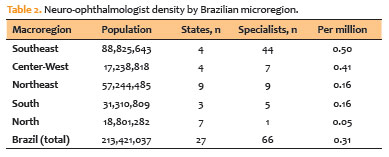
At the macroregional level, the Southeast had the highest specialist density, with 44 neuro-ophthalmologists serving a population of 88,825,643 (0.50 specialists per million inhabitants). This was followed by the Central-West (7 specialists; 17,238,818 inhabitants; 0.41 per million), the Northeast (9 specialists; 57,244,485 inhabitants; 0.16 per million), the South (5 specialists; 31,310,809 inhabitants; 0.16 per million), and the North (1 specialist; 18,801,282 inhabitants; 0.05 per million). Specialist density in the Southeast was approximately nine times higher than that in the North (Table 2).
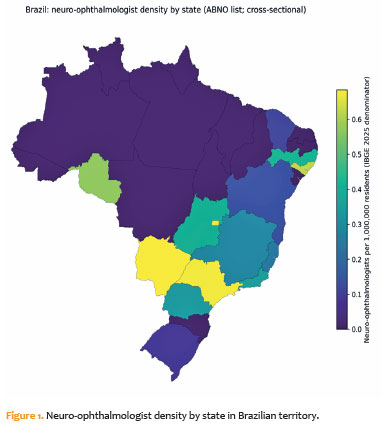
Heatmap analysis demonstrated higher neuro-ophthalmologist density in states containing major urban centers and large population concentrations. In contrast, several contiguous states exhibited low or zero specialist density, reflecting the absence of resident neuro-ophthalmologists across extensive geographic areas (Figure 1).
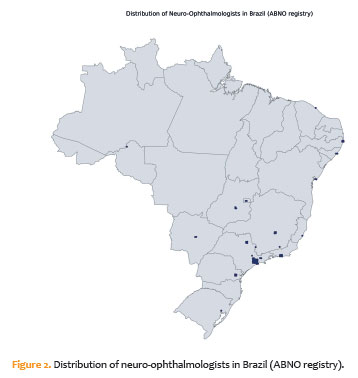
The dot map illustrated the municipal distribution of neuro-ophthalmologists. Individual markers were concentrated in a relatively small number of municipalities, predominantly within metropolitan areas. São Paulo alone accounted for nearly half of all identified specialists, whereas most states contained few or no markers, underscoring the limited geographic distribution of neuro-ophthalmologists across much of the country (Figure 2).
DISCUSSION
This cross-sectional, population-based study demonstrates a marked geographic maldistribution of neuro-ophthalmologists in Brazil, with specialists concentrated in a limited number of states and metropolitan areas. Nearly one-quarter of the Brazilian population resides in states without an identified neuro-ophthalmologist, highlighting a substantial gap in access to subspecialty eye care. These findings are consistent with previous national studies demonstrating pronounced regional inequalities in the distribution of ophthalmologists and ophthalmic services, with a concentration in economically developed regions and large urban centers(1,3).
Our findings also corroborate previous descriptive assessments of neuro-ophthalmology practice in Brazil. In a national overview of the subspecialty, Monteiro reported a limited number of formally trained neuro-ophthalmologists, few dedicated training centers, and a concentration of expertise within major academic institutions, predominantly located in the Southeast and South regions(7). The author also noted that most neuro-ophthalmic care in Brazil was provided by general ophthalmologists and that access to subspecialty services was largely restricted to referral centers. The present study extends these observations by providing quantitative evidence that this concentration translates into substantial geographic barriers to access, particularly in the North and Northeast.
The geographic maldistribution observed for neuro-ophthalmologists mirrors broader inequalities in the distribution of the ophthalmology workforce in Brazil. Scheffer and colleagues documented marked regional disparities in ophthalmologist availability, with a substantial concentration of specialists in the Southeast and limited availability in the North and Northeast(5). Our findings suggest that these disparities are even more pronounced in neuro-ophthalmology, as 13 states, representing 23.2% of the Brazilian population, had no registered specialist.
Comparable patterns have been reported in the United States, where shortages and geographic disparities in neuro-ophthalmic care persist despite a substantially larger workforce. National surveys have demonstrated an imbalance between specialist supply and patient demand, resulting in prolonged waiting times and inadequate specialist availability(1,3). More recent geospatial analyses have shown that most U.S. counties lack resident neuro-ophthalmologists, leaving extensive geographic areas without local subspecialty coverage(3). In addition, workforce demographic studies suggest that the relatively small and aging neuro-ophthalmology workforce may further limit future access to care(4).
International evidence indicates that the geographic maldistribution of ophthalmic specialists is a widespread challenge. In Canada, workforce analyses have demonstrated considerable provincial variation in ophthalmologist-to-population ratios, with persistently limited specialist availability in some regions despite a well-resourced healthcare system(8). Similarly, studies from India have documented marked urban-rural disparities, with most ophthalmologists concentrated in urban centers while rural populations remain underserved and often require long-distance travel to obtain specialized care(9). Comparable challenges have also been reported in Australia, where remote and rural communities continue to experience chronic shortages of ophthalmic specialists, contributing to delays in diagnosis and treatment(10).
The consequences of limited geographic access extend beyond inconvenience and may adversely affect visual outcomes at the population level. A large cross-sectional study conducted in California found that greater availability of eye care clinicians was associated with a lower prevalence of visual impairment, supporting a relationship between workforce availability and visual health outcomes(2). In neuro-ophthalmology, delayed diagnosis may result in irreversible vision loss caused by optic neuropathies, compressive lesions, or neuroinflammatory disorders. Consequently, the absence of locally available specialists may have particularly serious clinical implications.
The organization of eye care within the Brazilian Unified Health System (Sistema Único de Saúde [SUS]) may further amplify the effects of the geographic disparities identified in this study(11,12). As a universal healthcare system, SUS relies on hierarchical referral networks and the availability of tertiary care services, which are unevenly distributed across the country(11,12). As a universal healthcare system, SUS relies on hierarchical referral networks and the availability of tertiary care services, which are unevenly distributed across the country(11,12). Previous national studies have shown that disparities in specialist availability within SUS are closely associated with regional socioeconomic development and the geographic distribution of training centers(11,12). Consequently, the absence of locally available neuro-ophthalmologists across large areas of Brazil is likely to disproportionately affect populations that depend exclusively on SUS, thereby reinforcing existing inequities in access to specialized eye care(11,12).
Teleophthalmology represents a promising strategy to reduce the geographic disparities identified in this study. In Brazil, the TeleOftalmo program demonstrated that a substantial proportion of ophthalmic conditions presenting in primary care could be managed through structured teleconsultations, thereby reducing the need for in-person specialist referrals(13,14). Additional Brazilian studies have shown that telemedicine-supported eye care can improve access while maintaining diagnostic reliability and reducing healthcare costs, particularly in underserved regions(13-16). Additional Brazilian studies have shown that telemedicine-supported eye care can improve access while maintaining diagnostic reliability and reducing healthcare costs, particularly in underserved regions(10). Systematic reviews further support teleophthalmology as a reliable and cost-effective approach for delivering ophthalmic services to underserved populations, although successful implementation depends on adequate infrastructure, workforce training, and integration into existing healthcare systems(16-18).
Several limitations should be considered when interpreting these findings. First, the operational definition of a neuro-ophthalmologist was based exclusively on the ABNO registry. Because membership in ABNO is voluntary, the registry may not include all practicing neuro-ophthalmologists, particularly ophthalmologists or neurologists with substantial neuro-ophthalmology practices who are not formally affiliated with the association. Consequently, the size of the national workforce may have been underestimated. Second, physician location was treated as a fixed geographic point and may not accurately reflect outreach activities or practice across multiple clinical sites. Third, the analysis did not account for cross-state patient referral patterns or private referral networks, both of which may partially mitigate local workforce shortages. Fourth, the ABNO registry does not distinguish between public- and private-sector practice. Some of the identified specialists may practice predominantly or exclusively in the private sector, thereby reducing the effective availability of neuro-ophthalmology services for patients dependent on SUS. Because most Brazilians rely on the public healthcare system and many underserved regions have limited private healthcare infrastructure, actual public-sector access to neuro-ophthalmologists may be substantially lower than suggested by the overall workforce density. These limitations are inherent to geospatial workforce studies and have been acknowledged in similar investigations conducted in other countries(3,10).
Despite these limitations, our findings provide important evidence to inform health policy and workforce planning in Brazil. Monteiro previously reported approximately 37 formally trained neuro-ophthalmologists in Brazil in 2015(7). The 66 specialists identified in the present study represent an approximate 78% increase over that estimate. However, this comparison should be interpreted cautiously. During the same period, the Brazilian population increased by approximately 5%, and the overall physician workforce expanded substantially, partly as a result of national policies promoting increased medical school enrollment(6). Therefore, the observed increase in the number of neuro-ophthalmologists may largely reflect the overall expansion of the medical workforce rather than a proportional improvement in population access to subspecialty care. Nevertheless, the marked state-level disparities and the concentration of specialists within relatively few municipalities underscore the need for targeted strategies to improve access in underserved regions. Potential approaches include incentives for subspecialty practice outside major urban centers, expansion of fellowship training opportunities, and integration of neuro-ophthalmology into structured teleophthalmology networks. Evidence from Brazil and other countries suggests that these strategies may help reduce geographic inequities and improve timely access to specialized neuro-ophthalmic care(2,3,7,15).
In conclusion, neuro-ophthalmologists in Brazil are unevenly distributed, with a substantial proportion of the population residing in regions without local access to this subspecialty. Specialist availability is concentrated in a small number of urban and economically developed states, resulting in extensive geographic gaps in neuro-ophthalmic care. These findings highlight a structural imbalance between population needs and the distribution of the specialist workforce. Targeted workforce policies, expansion of specialist training, and integration of teleophthalmology into regional referral networks may help improve access to care and reduce geographic inequities in neuro-ophthalmic services.
AUTHORS' CONTRIBUTIONS
Significant contribution to conception and design: Eric Pinheiro de Andrade, Mauro César Gobira Guimarães Filho, Leonardo Provetti Cunha, Kenzo Hokazono, André Márcio Vieira Messias, Clara Lima Afonso, Marcela de Cássia Barreira, Mário Luiz Ribeiro Monteiro.
Data Acquisition: Eric Pinheiro de Andrade, Mauro César Gobira Guimarães Filho.
Data Analysis and Interpretation: Eric Pinheiro de Andrade, Mauro César Gobira Guimarães Filho, Leonardo Provetti Cunha, Kenzo Hokazono, André Márcio Vieira Messias, Clara Lima Afonso, Marcela de Cássia Barreira, Mário Luiz Ribeiro Monteiro.
Manuscript Drafting: Eric Pinheiro de Andrade, Mauro César Gobira Guimarães Filho, Leonardo Provetti Cunha, Kenzo Hokazono, André Márcio Vieira Messias, Clara Lima Afonso, Marcela de Cássia Barreira, Mário Luiz Ribeiro Monteiro.
Significant intellectual content revision of the manuscript: Eric Pinheiro de Andrade, Mauro César Gobira Guimarães Filho, Leonardo Provetti Cunha, Kenzo Hokazono, André Márcio Vieira Messias, Clara Lima Afonso, Marcela de Cássia Barreira, Mário Luiz Ribeiro Monteiro.
Have given final approval of the submitted manuscript (mandatory participation for all authors): Eric Pinheiro de Andrade, Mauro César Gobira Guimarães Filho, Leonardo Provetti Cunha, Kenzo Hokazono, André Márcio Vieira Messias, Clara Lima Afonso, Marcela de Cássia Barreira, Mário Luiz Ribeiro Monteiro.
Statistical analysis: Eric Pinheiro de Andrade, Mauro César Gobira Guimarães Filho.
Obtaining funding: not applicable.
Supervision of administrative, technical, or material support: Eric Pinheiro de Andrade, Mauro César Gobira Guimarães Filho, Leonardo Provetti Cunha, Kenzo Hokazono, André Márcio Vieira Messias, Clara Lima Afonso, Marcela de Cássia Barreira, Mário Luiz Ribeiro Monteiro.
Research group leadership: Eric Pinheiro de Andrade.
REFERENCES
1. DeBusk A, Subramanian PS, Scannell Bryan M, Moster ML, Calvert PC, Frohman LP. Mismatch in supply and demand for neuro-ophthalmic care. J Neuroophthalmol. 2022;42(1):62-7.
2. Wang KM, Tseng VL, Liu X, Pan D, Yu F, Baker R, et al. Association between geographic distribution of eye care clinicians and visual impairment in California. JAMA Ophthalmol. 2022;140(6):577-84.
3. Franco JJ, Fazal O, Oke I, Gaier ED. Geographic distribution and coverage of US neuro-ophthalmologists. JAMA Ophthalmol. 2025;143(12):1068-70.
4. Pakravan P, Lai J, Cavuoto KM. Demographics, practice analysis, and geographic distribution of neuro-ophthalmologists in the United States in 2023. Ophthalmology. 2024;131(3):333-40.
5. Scheffer M, Moreira JP, Bahia L, Borges SA, Cassenote AJ, Gameiro GR, et al. Regional inequalities in the supply of ophthalmologists and the volume of cataract surgeries between the public and private health sectors in Brazil. Arq Bras Oftalmol. 2025;89(1):e2025-0218.
6. Instituto Brasileiro de Geografia e Estatística (IBGE). Estimativas da população residente para os municípios e para as unidades da federação. Rio de Janeiro: IBGE; 2025 [citado 2026 Jun 30]. Disponível em: https://www.ibge.gov.br/estatisticas/sociais/populacao/9103-estimativas-de-populacao.html
7. Monteiro ML. Neuro-Ophthalmology in Brazil. J Neuroophthalmol. 2015 Jun;35(2):e20-3.
8. Buys YM, Bellan L. Updated inventory and projections for Canada's ophthalmology workforce. Can J Ophthalmol. 2023;58(6):523-31.
9. Thomas R, Paul P, Rao GN, Muliyil JP, Mathai A. Present status of eye care in India. Surv Ophthalmol. 2005;50(1):85-101.
10. Kiburg KV, Turner A, He M. Telemedicine and delivery of ophthalmic care in rural and remote communities: experience from Western Australia. Clin Exp Ophthalmol. 2022;50(7):793-800.
11. Paim J, Travassos C, Almeida C, Bahia L, Macinko J. The Brazilian health system: history, advances, and challenges. Lancet. 2011;377(9779):1778-97.
12. Viacava F, Oliveira RA, Carvalho CC, Laguardia J, Bellido JG. SUS: supply, access to and use of health services over the last 30 years. Cien Saude Colet. 2018;23(6):1751-62.
13. Moreira TC, Chagas ME, Pagano CG, Araújo AL, Umpierre RN, Oliveira BC, et al. TeleOftalmo: estratégia de ampliação da oferta de telediagnósticos oftalmológicos para a atenção primária à saúde no Sul do Brasil. Cad Saude Publica. 2022;38(6):e00281321.
14. Lutz de Araujo A, Moreira TC, Varvaki Rados DR, Gross PB, Molina-Bastos CG, Katz N, et al. The use of telemedicine to support Brazilian primary care physicians in managing eye conditions: The TeleOftalmo Project. PLoS One. 2020;15(4):e0231034.
15. Muccioli C, et al. Teleophthalmology — The Brazilian experience and future directions. In: Yogesan K, Kumar S, Goldschmidt L, Cuadros J, editors. Teleophthalmology. Berlin, Heidelberg: Springer; 2006.
16. Taleb AC, Böhm GM, Avila M, Wen CL. The efficacy of telemedicine for ophthalmology triage by a general practitioner. J Telemed Telecare. 2005;11(Suppl 1): 83-5.
17. Dolar-Szczasny J, Barańska A, Rejdak R. Evaluating the efficacy of teleophthalmology in delivering ophthalmic care to underserved populations. A literature review. J Clin Med. 2023;12(9):3161.
18. Gunasekeran DV, Ting DS, Tan GS, Wong TY. Artificial intelligence for diabetic retinopathy screening, prediction and management. Curr Opin Ophthalmol. 2020;31(5):357-365.
Submitted for publication:
March 23, 2026.
Accepted for publication:
June 23, 2026.
Data Availability Statement: The datasets generated and/or analyzed during the current study are included in this published article.
Edited by
Editor-in-Chief: Newton Kara-Júnior
Associate Editor: Carolina P. B. Gracitelli
Funding: This study received no specific financial support.
Disclosure of potential conflicts of interest: The authors declare no potential conflicts of interest.

How to cite this article:
 ABO is licensed under a Creative Commons Attribution-NonComercial 4.0 Internacional.