Arq. Bras. Oftalmol. 2018;81 (2 )
:120-124
| DOI: 10.5935/0004-2749.20180027
Abstract
Objetivos: Avaliar se as concentrações séricas da lectina ligante de manose da via das lectinas do sistema complemento estão associadas à degeneração macular relacionada à idade.
Métodos: Pacientes com degeneração macular relacionada à idade a controles pareados realizaram exame oftalmológico completo e imagens de tomografia de coerência óptica. As concentrações de lectina ligante de manose foram aferidas em amostras de sangue pelo método "time-resolved Immunofluorometric assay".
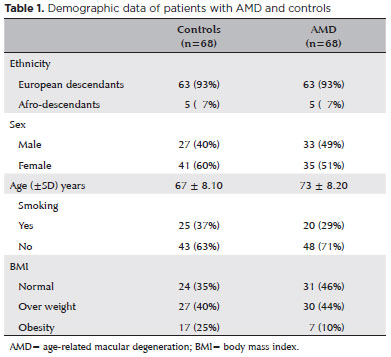
Resultados: Um total de 136 indivíduos foram avaliados incluindo 68 com degeneração macular relacionada à idade (34 exsudativa e 34 não-exsudativa) e 68 controles. Concentrações medianas de lectina ligante de ma-nose foram 608 ng/mL (30-3,415 ng/mL) nos casos e 739 ng/mL (30-6,039 ng/mL) nos controles, não havendo diferença entre os grupos. Comparando degeneração macular relacionada a idade exsudativa (mediana de lectina ligante de manose 476 ng/mL; 30-3,415 ng/mL) e não-exsudativa (692 ng/mL; 30-2,587 ng/mL) também não apresentaram diferença.
Conclusões: Concentrações séricas de lectina ligante de manose não estão relacionadas à degeneração macular relacionada a idade ou às formas exsudativa e não-exsudativa.
Keywords: Degeneração macular relacionada à idade; Drusas; Imunoregulação; Lectina de ligação a manose; Inflamação; Retina
Arq. Bras. Oftalmol. 2024;87 (4 )
:1-5
| DOI: 10.5935/0004-2749.2022-0335
Abstract
PURPOSE: To clarify the postoperative incidence of macular edema in patients undergoing surgery to repair rhegmatogenous retinal detachment and identify the associated risk factors.
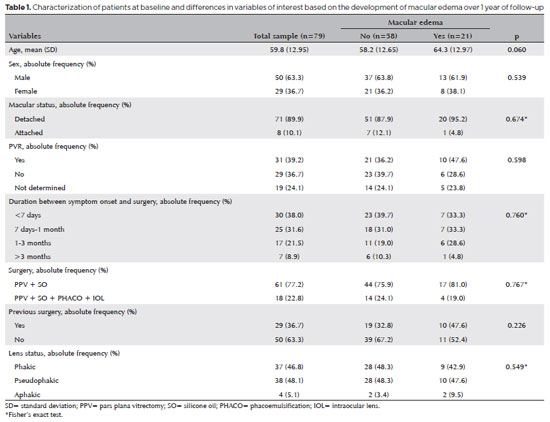
METHODS: In this prospective, observational study, 79 patients who underwent surgery to correct rhegmatogenous retinal detachment using pars plana vitrectomy with silicone oil injection were analyzed. Patients were followed up postoperatively at 7, 30, 90, 180, and 365 days. At each visit, optical coherence tomography was performed to assess the presence or absence of macular edema. were analyzed as possible risk factors for macular edema: age, sex, macular status (attached or detached), presence of vitreoretinal proliferation, history of previous intraocular surgery, reported time of symptoms suggestive of rhegmatogenous retinal detachment up to the date of surgery, and the surgical modality performed.
RESULTS: The 1-year macular edema prevalence rate was 26.6%. In the adjusted analysis, older patients had a higher risk of macular edema, and each 1-year increase in age increased the risk of macular edema by 6% (95% confidence interval = 1.00-1.12). The macular status, vitreoretinal proliferation, the surgical technique used, prior intraocular surgery, and the intraocular lens status were not identified as risk factors. However, the incidence of macular edema increased up to 180 days after surgery, peaking at 10.6%, and then decreased until 365 days after surgery.
CONCLUSION: Macular edema was a common complication after surgery to treat rhegmatogenous retinal detachment, with its incidence peaking between 30 and 180 days after surgery. Age was an important risk factor for macular edema in this cohort.
Keywords: Macular edema; Retinal detachment; Vitrectomy; Tomography, optical coherence; Incidence; Risk factors


 ABO is licensed under a Creative Commons Attribution-NonComercial 4.0 Internacional.