Arq. Bras. Oftalmol. 2023;86 (4 )
:322-329
| DOI: 10.5935/0004-2749.20230058
Abstract
Introdução: Os oftalmologistas têm alto risco de contrair a doença do Coronavírus-19 devido à proximidade com os pacientes durante os exames com lâmpada de fenda. Usamos um modelo de computação para avaliar a eficácia das proteções para lâmpadas de fenda e propusemos uma nova proteção ergonomicamente projetada.
Métodos: As simulações foram realizadas no software comercial Star-CCM +. Os aerossóis de gotículas foram considerados 100% de água em fração de volume com distribuição de diâmetro de partícula representada por uma média geométrica de 74,4 ± 1,5 (desvio padrão) μm ao longo de uma duração de quatro minutos. A massa total de gotículas de água acumulada no manequim e a massa expelida pela boca do paciente foram medidas em três condições diferentes: 1) Sem protetor de lâmpada de fenda, 2) com protetor padrão, 3) Com o novo protetor proposto.
Resultados: A massa total acumulada das gotas de água (kg) e a porcentagem da massa expelida acumulada no escudo para cada uma das respectivas condições foram; 1) 5,84e-10 kg (28% do peso total da partícula emitida que assentou no manequim), 2) 9,14e-13 kg (0,045%), 3,19e-13 (0,015%). O escudo padrão foi capaz de proteger 99,83% das partículas que, de outra forma, teriam se depositado no manequim, o que é semelhante a 99,95% para o projeto proposto.
Conclusão: Protetores com lâmpada de fenda são ferramentas eficazes de controle de infecção contra gotículas respiratórias. O protetor proposto mostrou eficácia comparável em comparação com os protetores de lâmpada de fenda convencionais, mas potencialmente oferece uma melhor ergonomia para oftalmologistas durante o exame de lâmpada de fenda.
Keywords: Oftalmologistas; Infeções por coronavírus/prevenção & controle; Pandemias; Gotículas lipídicas; SARS-CoV-2; Lâmpada de fenda; Simulação por computador; Equipamentos de proteção; Desenho de equipamento.
Arq. Bras. Oftalmol. 2025;88 (4 )
:1-6
| DOI: 10.5935/0004-2749.2024-0249
Abstract
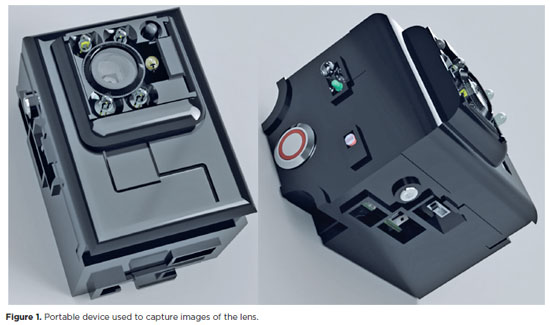
PURPOSE: Access to cataract treatment and diagnostic tools continues to be hindered by financial and logistical barriers. Thus, photography-based cataract analysis via portable devices offers a promising solution for the detection of cataracts in remote regions. In this study, the accuracy of a portable device that is based on the Lens Opacities Classification III System for diagnosing cataracts was analyzed.
METHODS: Photographs of the anterior segment of the eye were taken in a low-light environment, and the pupillary region markings were automatically delineated using infrared photography. The captured images were automatically analyzed using a convolutional neural network. The study group included patients with cataracts, and the control group included patients without cataracts.
RESULTS:A total of 270 eyes were analyzed, which included 143 eyes with cataracts and 127 control eyes. A total of 599 photos were analyzed. The isolated nuclear cataract was the most frequently detected subtype (37.5%), followed by a nuclear cataract associated with a cortical cataract (30.3%). The device's accuracy was 88.5% (Confidence intervals (CI), 83.19%–94.69%), specificity was 84.62% (CI 71.79%–97.30%), positive predictive value was 91.78% (CI 74.36%–97.30%), and negative predictive value was 82.50% (CI 74.36%–97.30%).
CONCLUSION: The portable device is a simplified user-friendly cataract screening technique that can interpret results in remote regions. This innovation could mitigate the occurrence of cataract-induced blindness and prevent premature surgical interventions in early-stage cataracts.
Keywords: Cataract/diagnosis; Diagnostic techniques ophthalmological/instrumentation; Optical devices; Equipment and supplies; Eye-tracking technology
Arq. Bras. Oftalmol. 2024;87 (6 )
:1-5
| DOI: 10.5935/0004-2749.2021-0482
Abstract
OBJETIVO: Nos últimos 20 anos, o número de escolas médicas no Brasil aumentou, mas as vagas para especialização em Oftalmologia não acompanharam a demanda crescente. Este estudo quer estimar a demanda por especialização e avaliar a oferta de oportunidades de aprendizado em Oftalmologia.
MÉTODOS: Estudo epidemiológico com pesquisa em banco de dados provenientes do Ministério da Educação e Conselho Brasileiro de Oftalmologia. Estes dados foram checados através de 120 editais publicados pelos serviços de Residência em 2021.
RESULTADOS: De 2002 a 2021, o número de vagas em faculdades de Medicina aumentou 370%, enquanto o número de vagas certificadas de especialização em Oftalmologia aumentou 64%. Houve um desalinhamento de 11.4% entre os dados do Conselho Brasileiro de Oftalmologia e do Ministério da Educação.
CONCLUSÃO: A proporção de graduados em Medicina aumentou muito mais do que a oferta de oportunidades de especialização em Oftalmologia, o impacto disto na busca por vagas de especialização não acreditadas é desconhecido, políticas de monitoramento das vagas de especialização em Oftalmologia devem ser estabelecidas.
Keywords: Oftalmologia; Ensino; Educação médica; Especialização
Arq. Bras. Oftalmol. 2025;88 (5 )
:1-6
| DOI: 10.5935/0004-2749.2024-0270
Abstract
PURPOSE: Standard automated perimetry has been the standard method for measuring visual field changes for several years. It can measure an individual’s ability to detect a light stimulus from a uniformly illuminated background. In the management of glaucoma, the primary objective of perimetry is the identification and quantification of visual field abnormalities. It also serves as a longitudinal evaluation for the detection of disease progression. The development of artificial intelligence-based models capable of interpreting tests could combine technological development with improved access to healthcare.
METHODS: In this observational, cross-sectional, descriptive study, we used an artificial intelligence-based model [Inception V3] to interpret gray-scale crops from standard automated perimetry that were performed in an ophthalmology clinic in the Brazilian Amazon rainforest between January 2018 and December 2022.
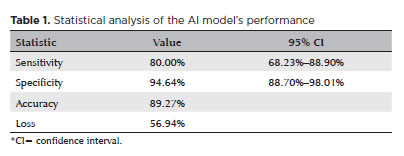
RESULTS: The study included 1,519 standard automated perimetry test results that were performed using Humphrey HFA-II-i-750 (Zeiss Meditech). The Subsequently, 70%, 10%, and 20% of the dataset were used for training, validation, and testing, respectively. The model achieved 80% (68.23%–88.9%) sensitivity and 94.64% (88.8%–98%) specificity for detecting altered perimetry results. Furthermore, the area under the receiver operating characteristic curve was 0.93.
CONCLUSIONS: The integration of artificial intelligence in the diagnosis, screening, and monitoring of pathologies represents a paradigm shift in ophthalmology, enabling significant improvements in safety, efficiency, availability, and accessibility of treatment.
Keywords: Glaucoma; Disease progression; Perimetry; Visual Fields; Visual field tests; Artificial intelligence; Neural networks, computers; Machine learning
Arq. Bras. Oftalmol. 2024;87 (5 )
:1-5
| DOI: 10.5935/0004-2749.2023-0343
Abstract
PURPOSE: To determine and analyze the usability metrics of a free mobile learning app for ophthalmology in Brazil.
METHODS: Metric data from the management dashboard of the CBOQUIZ app were used. All users registered on the platform between March 2019 and June 30, 2021 were included. The number of questions answered, number of correct answers, number of questions answered and correct answers by subject area, and user performance by geographic region were analyzed.
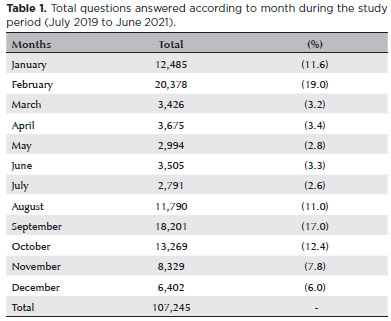
RESULTS: There were 458 active users during the research period and 107,245 questions answered (average, 234.16 questions per user). Of the questions answered, 81,600 (75.5%) were correct and 2,645 were incorrect. The states in Brazil with the best performance were Espírito Santo, Paraiba, and Paraná. The subject area with the lowest hit rate was basic sciences (69.1%), within which embryology demonstrated the lowest hit rate (58.28%). The posterior segment had the highest number of questions answered, followed by miscellaneous topics and the anterior segment. Questions on strabismus were the least answered.
CONCLUSION: The app was used consistently throughout the period studied, and participants adhered to this teaching modality. Performance asymmetry was observed across the Brazil states. The CBOQUIZ app can be used to homogenize ophthalmology teaching in the country.
Keywords: Ophthalmology; Mobile applications; Teaching; Smartphone; Education, distance; Internship and residency; Brazil


 ABO is licensed under a Creative Commons Attribution-NonComercial 4.0 Internacional.


13-for01.jpg)
12-tab01.jpg)