Arq. Bras. Oftalmol. 2026;89 (2 )
:1-6
| DOI: 10.5935/0004-2749.2025-0224
Abstract
PURPOSE: To evaluate the academic and professional trajectories of graduates from the Graduate Program in Ophthalmology and Visual Sciences at the Escola Paulista de Medicina, Universidade Federal de São Paulo, including geographic distribution, occupational characteristics, and scientific productivity.
METHODS: This descriptive, retrospective, quantitative study included 498 alumni who completed the program between 1979 and 2021. Data were obtained from institutional records and supplemented by public databases (Google Scholar, Lattes Platform, and LinkedIn). The analyzed variables included demographic characteristics, academic background, current professional role, and bibliometric indicators (citation count and h-index). Statistical analyses comprised nonparametric tests and linear regression, with a significance level set at 5%.
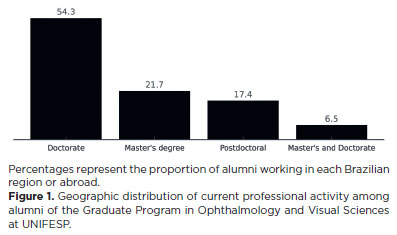
RESULTS: Most alumni were Brazilian (96.6%) and physicians (90.7%), predominantly located in the Southeast region (66.9%). Doctoral training was completed by 80.5% of participants. Alumni with current institutional ties to Universidade Federal de São Paulo or Hospital São Paulo demonstrated significantly higher citation counts and h-index values. No significant correlation was observed between time since graduation and citation count (p=0.185). Alumni engaged in academic roles or with postdoctoral training showed greater scientific productivity.
CONCLUSIONS: The findings highlight the strong academic performance and professional integration of alumni from Universidade Federal de São Paulo, particularly within public institutions and the Southeast region of Brazil. Doctoral training and institutional affiliation were associated with higher scientific productivity. Alumni tracking provides valuable insights into the impact of postgraduate programs and informs strategic planning and development.
Keywords: Factual databases; Program evaluation; Medical education; Graduate education; Ophthalmology; Linear models
Arq. Bras. Oftalmol. 2024;87 (4 )
:1-7
| DOI: 10.5935/0004-2749.2023-0047
Abstract
PURPOSE: We aimed to evaluate retinal nerve fiber and choroidal layer alterations in adolescents with anorexia nervosa using spectral-domain optical coherence tomography.
METHODS: Thirty patients with anorexia nervosa and 30 healthy adolescents aged 12-18 years were included in this study. Their age, sex, body mass index, anorexia nervosa type, disease duration, and spectral-domain optical coherence tomography data were recorded.
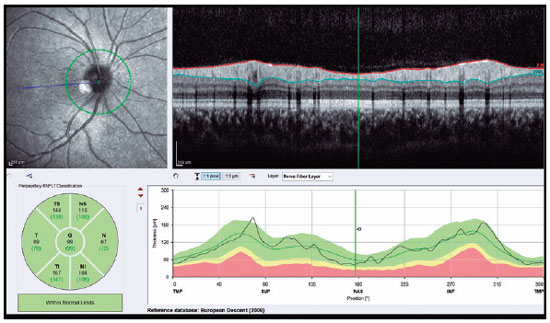
RESULTS: Central macular thickness and retinal nerve fiber layer thickness in the temporal and inferior regions were significantly lesser in patients with anorexia than in healthy controls (p<0.05). Moreover, significant choroidal thinning around the foveal and subfoveal regions in patients with anorexia was observed (p<0.05). In addition, a statistically significant relation between the increase in disease duration and the thinning of the inferior retinal nerve fiber layer was detected (p<0.05).
CONCLUSION: The retinal nerve fiber layer and choroidal layer thicknesses were lesser in patients with anorexia than in healthy controls. Screening for retinal indices might prevent the development of irreversible retinal pathologies in adolescents with anorexia nervosa. In addition, thinning of the retinal nerve fiber and choroidal layers could reflect structural or functional changes in the brain of adolescents with anorexia nervosa.
Keywords: Tomography; Optical coherence; Nerve fibers; Choroid; Adolescents


 ABO is licensed under a Creative Commons Attribution-NonComercial 4.0 Internacional.