Arq. Bras. Oftalmol. 2026;89 (4 )
:1-5
| DOI: 10.5935/0004-2749.2025-0356
Abstract
PURPOSE: To analyze the results of the 15-gene expression profile/preferentially expressed antigen in melanoma (15-GEPP) prognostic classifier and associated survival outcomes in a series of Brazilian patients with posterior uveal melanoma.
METHODS: Patients born and raised in Brazil who were diagnosed with posterior uveal melanoma and underwent fine-needle aspiration biopsy for 15-GEPP prognostic testing using the DecisionDx-Uveal melanoma and DecisionDx-PRAME assays between September 2020 and 2023 were included. All patients were diagnosed and treated by the senior author.
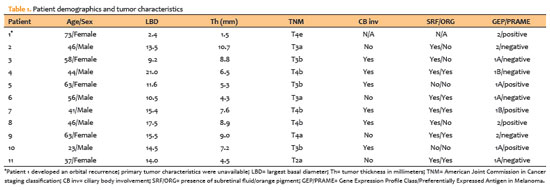
RESULTS: Of 236 patients diagnosed with posterior uveal melanoma during the study period, 11 (4.6%) met the inclusion criteria, including six males and five females. Based on 15-GEPP results, seven patients (63.6%) were classified as Class 1 and 4 (36.4%) as Class 2. Preferentially expressed antigen in melanoma (PRAME) expression was negative in six patients (54.6%) and positive in five patients (45.4%). During a mean follow-up of 36.4 ± 17.6 months, five patients developed metastasis: two with Class 2/PRAME-positive tumors, one with Class 2/PRAME-negative tumors, one with Class 1/PRAME-positive tumors, and one with Class 1/PRAME-negative tumors. Three of these patients died. The mean survival after the diagnosis of metastasis was 21.2 months (median: 17.0 months).
CONCLUSIONS: The proportions of Class 1 versus Class 2 tumors and PRAME-negative versus PRAME-positive tumors as well as the prognostic performance of these biomarkers appear similar in Brazilian patients with posterior uveal melanoma compared with large published cohorts from North America. Further studies with larger Brazilian cohorts are needed to validate these findings.
Keywords: Uveal melanoma; Fine-needle biopsy; Prognosis; Biomarkers; Neoplasms; Transcriptome; Survival; Brazil


 ABO is licensed under a Creative Commons Attribution-NonComercial 4.0 Internacional.