Arq. Bras. Oftalmol. 200871
| DOI: 10.1590/S0004-27492008000200002
PURPOSE: To compare the effect of preserving sclera samples in either 95% ethanol or freeze-dried.
METHODS: Ninety-six samples of human sclera were studied. Half of them were freeze-dried and half preserved in 95% ethanol. Preservation periods of 18, 45, 90 or 174 days were studied. Automated immunostaining was carried out in the Ventana BenchMarkR LT platform using collagen 1 and fibronectin antibodies. Histological staining was also performed with hematoxilin-eosin and Masson trichrome. Samples were classified according to the degree of collagen fiber parallelism (0-2), intensity of Masson staining (0-2), and the expression of both antibodies (0-3). Friedman and Wilcoxon tests were applied to compare preservation methods and p-values below 0.05 were considered to ensure statistical significance.
RESULTS: Relevant results were found in three situations: (i) Friedman's test showed better collagen fiber integrity in the freeze-dried group rehydrated after 174-days as compared to the 90-day group; (ii) Wilcoxon's test showed better collagen fiber integrity in the freeze-dried group after 18 and 174 days as compared to the ethanol group; (iii) the freeze-dried group disclosed higher immunohistochemical expression for COL-1 antibody in the sclera samples rehydrated after 45, 90 and 174 days as compared to the ones rehydrated after 18 days.
CONCLUSION: Histological and immunohistochemical analysis showed freeze-drying to be a superior method for sclera preservation as compared to 95% ethanol. This technique provides an easy method to manipulate tissue, with longer shelf life, and storage at room temperature.
Keywords: Freeze-drying; Sclera; Tissue preservation; Dose-response relationship, drug; Ethanol; Immunohistochemistry; Collagen
Arq. Bras. Oftalmol. 200871
| DOI: 10.1590/S0004-27492008000200003
PURPOSE: To compare sensitivity and specificity of achromatic perimetry with size I stimulus (WW-I) with standard automated perimetry (SITA strategy) and blue on yellow perimetry (SWAP) for early diagnosis of glaucoma.
METHODS: Seventy-three eyes of 73 suspects, glaucomatous and normal subjects underwent automated perimetry with SITA 24-2, WW-I and SWAP. After application of specific criteria of abnormality, sensitivity, specificity, and the area under ROC (Receiver Operating Characteristic) curve were calculated for each of the examinations. The areas under the ROC curve were compared pair-wisely with the univariable Z test and significance set at 5%.
RESULTS: WW-I displayed the greatest sensitivity (100%) and the lowest specificity (75.7%). SWAP revealed less sensitivity (69.4%); specificity, however, was higher (89.2%). Pairwise comparison of ROC curves showed no difference.
CONCLUSION: WW-I revealed good sensitivity for the detection of early glaucomatous visual field defects. This technique adds to the available armamentarium for early functional diagnosis of glaucomatous optic neuropathy.
Keywords: Perimetry; Glaucoma; Sensitivity and specificity; Visual fields
Arq. Bras. Oftalmol. 200871
| DOI: 10.1590/S0004-27492008000200004
PURPOSE: To evaluate the epidemiology of superficial corneal foreign body.
METHODS: Patients who were seen at the Emergency Service of the Federal University of São Paulo, from April/05 to June/05, were screened and those with superficial corneal foreign body were interviewed. Data regarding gender, age, occupation, employment status, availability and use of protective devices and supervision of their use were collected. Awareness of the possible complications was also assessed. Results were analyzed using chi-square or Fisher exact test.
RESULTS: One hundred twenty-three patients were interviewed. Only 3 patients were female. The mean age was 36 years. Most injuries occurred at the workplace (86.2%), and 58.4% of the patients did not have a legal employment registration. The occupational activities most frequently reported were construction related activities (44.3%) and welding/soldering (11.3%). In most workplaces (79.8%) protective devices were available and 85.3% of the patients were instructed to use them. A safety device was being used during the accident in 34.2% of the cases and this was more frequent among patients that had legal employment registry (p=0.008) and among those under supervision (p=0.0415). The majority of the patients (68.9%) were aware of the risk of severe complications. CONCLUSIONS: Most patients with superficial corneal foreign body are aware of its severe complications and injuries usually occur in places where safety devices are available and often during their use. Our findings suggest that prevention should focus on supervision and correct use of safety devices.
Keywords: Eye foreign bodies; Accidents, occupational; Emergency service, hospital
Arq. Bras. Oftalmol. 200871
| DOI: 10.1590/S0004-27492008000200005
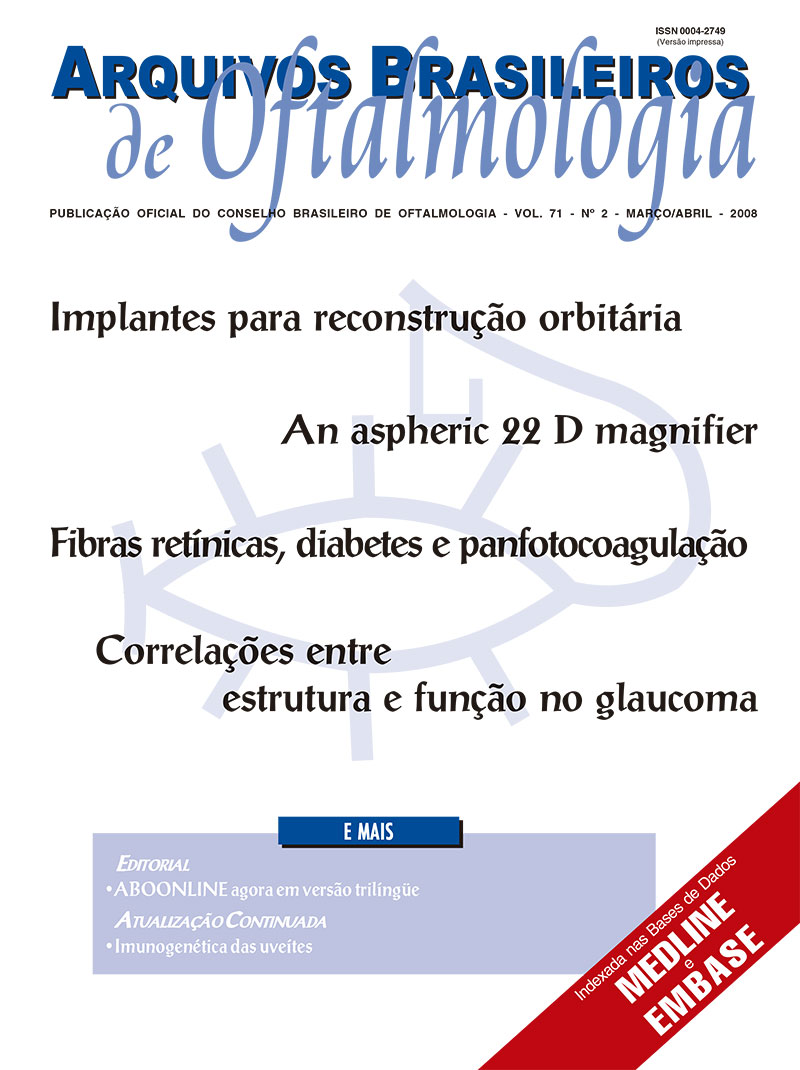
PURPOSE: To evaluate through clinical and tomographic parameters implant behavior in orbital zygomatic reconstruction in six patients.
METHODS: The subjects for this preliminary study consisted of six anophthalmic socket patients (3 patients presented residual orbital zygomatic deformities after complex facial fractures and 3 patients presented orbital zygomatic retraction after enucleation and radiotherapy to treat retinoblastoma in infancy). These deformities were surgically corrected with this composite implant. This study was approved and authorized by the Universidade Federal de Minas Gerais Ethical Committee for Research in Human Subjects (ETIC 203/04). Clinical data and tomographic images were utilized to assess the outcome of this study.
RESULTS: There were no complications and tomographic findings revealed no implant reactions or migration and a good maintenance of soft tissue projection in the operated areas was achieved. Success of outcome in this preliminary study were encouraging.
CONCLUSION: This study will be continued enrolling a larger sample and longer follow-up. Composite biomaterials have presented a good outcome in facial reconstructive surgery. The composite implants in this group have a good biocompatibility and combined with national technology can reduce costs providing more possibilities to many more patients.
Keywords: Surgery, plastic; Surgery, plastic; Biocompatible materials; Protheses and implants; Clinical trial, phase I
Arq. Bras. Oftalmol. 200871
| DOI: 10.1590/S0004-27492008000200006
PURPOSE: To identify in patients with branch retinal vein occlusion using ambulatory blood pressure monitoring and clinical blood pressure measures: hypertension prevalence, and nocturnal profile of blood pressure.
METHODS: Prospectively, 93 eyes of 83 patients with branch retinal vein occlusion were submitted to ophthalmological examination. Afterwards the patients were submitted to clinical evaluation and blood pressure monitoring. Non-dipper was defined as a fall in systolic blood pressure < 10%, and dipper when this value was higher.
RESULTS: Disease affected one eye in 73 (88%) patients. The temporal superior branch was the site of occlusion in 61 (65.6%) eyes, while in the others the infero-temporal branch was affected. Seventy six (92%) patients were diagnosed as hypertensive after clinical evaluation. Ambulatory blood pressure monitoring identified 76 hipertensives, 5 normotensives, 1 white-coat hypertensive and one masked hypertensive subjects. The two latter were excluded from the analysis. Of the 81 analyzed patients, forty (49%) were dippers and 41 (51%) were non-dippers. Among the HT (n=76), 36 (47%) were dippers and 40 (53%) were non-dippers.
CONCLUSION: Prevalence of hypertension in our series was extremely high (92%) which suggests that physiopathology of the disease has a close relationship with changes promoted by hypertension. A little more than half of the hypertensives were non-dippers (n=40; 52,6%). These evidences suggest that a 24-hour sustained level of blood pressure may be an additional risk factor for branch retinal vein occlusion.
Keywords: Hypertension; Blood pressure; Retinal vein occlusion; Retinal vein; Retinal diseases
Arq. Bras. Oftalmol. 200871
| DOI: 10.1590/S0004-27492008000200007
PURPOSE: To evaluate eye manifestations in mansonelliasis patients from Coari, AM, rural area on the middle Amazonas River.
METHODS: Cross-sectional study consisted of evaluation of 543 subjects from Coari rural area on Solimões River right margin. All subjects were submitted to blood test for microfilaria and the subjects who had a positive test also were submitted to skin biopsies and ophthalmologic examination. Histopathology and PCR research for microfilaria were done on eye biopsies of suspect lesions.
RESULTS: Mansonella ozzardi was found in peripheral blood of 103 (18.9%) subjects. Ninety-five mansonelliasis patients were examined. Punctate keratitis was observed in 12 of them, nummular keratitis in one subject and sclerosing keratitis in another one. Skin biopsies were negative in all subjects. Conjunctival and limbal biopsies were done in five mansonelliasis patients and corneal biopsy in another three patients. Conjunctival and limbal biopsies of two patients and corneal biopsy of one patient showed no microfilaria or alterations due to its presence on histopathology. PCR showed no evidence of microfilaria in the other biopsies.
CONCLUSION: Association between Mansonella ozzardi infection and corneal lesions with no evident etiology was observed in this study, but the lack of conclusive findings on histopathology and PCR make us doubt the corneal involvement in mansonelliasis. Large studies of high mansonelliasis prevalence populations and extensive employment of microfilaria identification tests in ocular tissue are needed to evaluate the microfilaria corneal pathogenicity.
Keywords: Mansonelíase; Eye infections, parasitic; keratitis; Microfilaria
Arq. Bras. Oftalmol. 200871
| DOI: 10.1590/S0004-27492008000200008
PURPOSE: To evaluate the prevalence and severity of diabetic retinopathy among patients cared for in a screening program in Pernambuco, Brazil, comparing regional differences between urban and rural zones.
METHODS: The charts of 2,223 diabetic patients (1,568 females and 655 males; mean age 59.3 ± 12.0 years; mean duration of diabetes 8.1 ± 6.3 years) that took part in a screening program for diabetic retinopathy at Altino Ventura Foundation from June 2004 to June 2005 were reviewed for the presence of the disease. Patients were divided into two groups: group I, patients living in Recife and the metropolitan area; group II, patients living in the interior of Pernambuco state.
RESULTS: In group I, 477 (24.2%) patients had diabetic retinophathy, while in group II, 89 (39.4%) patients (p<0.0001). The frequency of proliferative diabetic retinophathy, macular edema, vitreous hemorrhage and retinal detachment was higher in group II patients (p<0.05). CONCLUSIONS: Patients living in the interior of Pernambuco state have a higher incidence of diabetic retinophathy and the advanced forms than patients living in Recife and the metropolitan area when examined in a screening program for diabetic retinopathy at the Altino Ventura Foundation. Telemedicine and descentralization actions are recommended for improvement of screening quality in patients living in the interior of Pernambuco state.
Keywords: Diabetic retinopathy; Diabetic retinopathy; Prevalence; Triage
Arq. Bras. Oftalmol. 200871
| DOI: 10.1590/S0004-27492008000200009
BACKGROUND: Despite all efforts towards the improvement of the eye bank system, the shortage of corneal tissue for transplant is still an important issue in Brazil. The Hospital São Paulo Eye Bank aims to provide high-quality ocular tissues for surgery starting with rigorous selection of donors.
PURPOSE: To investigate the characteristics of cornea donors to the Hospital São Paulo Eye Bank during a 10-year period.
METHODS: Retrospective analysis of Hospital São Paulo Eye Bank records from January 1996 to December 2005. RESULTADS: 3,624 corneas were evaluated by the Hospital São Paulo Eye Bank during this 10-year period. Mean age of donors was 56.8 years the highest proportion being in the 70-79 years age category. The most common cause of death was cardiovascular disease followed by cancer and trauma. Mean "enucleation" and "preservation" times were 3.8 and 3.6 hours, respectively. The number of corneas received by our eye bank from other eye banks decreased substantially whereas the number of corneas harvested by the Hospital São Paulo Eye Bank staff increased. Optisol GS® were the most utilized preservation media and a high proportion of corneas classified as "Excellent" or "Good" came from young donors. CONCLUSIONS: In a period of 10 years, there was a decreasing trend in the number of donated corneas provided by other eye banks to the Hospital São Paulo Eye Bank and an increase in the number of corneas harvested and processed by the Hospital São Paulo Eye Bank staff with a significant reduction of preservation time. Most donors were male and the main cause of death was cardiovascular disease. Although a great proportion of donated corneas came from older donors, the majority of corneas used for optical transplants came from younger ones.
Keywords: Eye banks; Corneal transplantation; Endothelium corneal; Tissue transplantation; Tissue donors
Arq. Bras. Oftalmol. 200871
| DOI: 10.1590/S0004-27492008000200010
PURPOSE: To evaluate the functional outcome and macular index in patients with macular hole who underwent surgery with internal limiting membrane removal.
METHODS: Fifteen eyes of 15 patients with idiopathic macular hole stages 2, 3 or 4 were enrolled in this study. All patients underwent conventional macular hole surgery with trypan blue staining to remove the internal limiting membrane. The best-corrected visual acuity and cross-sectional images of macular hole measured by optical coherence tomography (OCT) were evaluated pre- and postoperatively. The macular hole index (ratio of hole height to base diameter of the hole) was calculated and correlated with minimum diameter of the macular hole and postoperative gain in visual acuity.
RESULTS: Macular hole closure was observed in all operated patients. In 86.7%, there was a visual gain of at least three lines. Macular hole index was significantly negative correlated with the minimum diameter of the macular hole (r=0.811). There was no significant correlation between macular index and postoperative gain in visual acuity (r=0.351).
CONCLUSION: Functional outcomes with internal limiting membrane removal were good in this group of patients. Macular index was compatible with spatial configuration of the macular hole, however visual outcomes were not predictable.
Keywords: Macula lutea; Macula lutea; Tomography; Optical coherence; Vitrectomy; Epiretinal membrane; Epiretinal membrane
Arq. Bras. Oftalmol. 200871
| DOI: 10.1590/S0004-27492008000200011
PURPOSE: To evaluate the alterations in the retinal nerve fiber layer in diabetic retinopathy treated by argon laser panphotocoagulation.
METHODS: Prospective study of patients with diabetic retinopathy submitted to retinal panphotocoagulation. Initially, complete ophthalmologic examination and optical coherence tomography were performed. All patients were submitted to panphotocoagulation with argon laser in one of the eyes. The retinal fiber layer was evaluated by means of optical coherence tomography in the first week, in the first, third and sixth months after treatment.
RESULTS: The sample was composed of 27 patients (27 eyes) with type 2 diabetes mellitus. The age varied from 41 to 64 years (mean of 53.7 ± 6.2 years), with 10 (37%) males and 17 (63%) females. Regarding the retinopathy, 22.2% presented proliferative DR and 77.8% very severe non proliferative DR. There was a significant increase in the fiber layer thickness measurements, remaining in the temporal sectors, 3 and 4 hours, after 6 months of follow-up. Reduction of thickness was not observed in any of the analyzed parameters. CONCLUSIONS: Reduction of the fiber layer thickness, identifiable by means of optical coherence tomography, in short and average term, was not observed in patients with diabetic retinopathy treated with panphotocoagulation. On the other hand, some sectors showed thickness increase during the follow-up.
Keywords: Nerve fibers; Diabetic retinopathy; Diabetic retinopathy; Laser coagulation; Diabetes mellitus; Glaucoma; Tomography, optical coherence
Arq. Bras. Oftalmol. 200871
| DOI: 10.1590/S0004-27492008000200012
PURPOSE: To evaluate alterations of the conjunctival flora after the use of 0.3% ciprofloxacin and gatifloxacin in the prophylaxis of patients undergoing cataract surgery.
METHODS: 40 patients undergoing cataract surgery were distributed into two groups according to the use of antibiotic eye drops: Group A: 0.3% ciprofloxacin and Group B: 0.3% gatifloxacin. Both groups used antibiotic eye drops 1 hour before surgery and 14 days after surgery. Conjunctival material was collected at 5 time points: 1 hour before surgery, without any topical medication (t0); immediately before the application of povidone-iodine (PVPI) (t1), before the beginning of surgery, after povidone-iodine (t2), 14 days (t3) and 28 days after surgery (t4).
RESULTS: Preoperative antibiotics reduced the positivity of the cultures before the use of PVPI in both groups, although in Group A this reduction was not significant (Group A - p=0.07 and Group B - p=0.04). The number of positive cultures was reduced in all groups after the use of povidone-iodine and on the 14th postoperative day (p<0.05). In t4 there was a reduction in the frequency of coagulase-negative Staphylococcus in Group A compared with Group B (p<0.05); the susceptibility to ciprofloxacin was also reduced in all groups, when compared with t0. CONCLUSIONS: Gatifloxacin eye drops applied one hour before surgery significantly reduced the number of positive conjunctival cultures. Both antibiotics reduced the conjunctival flora when administered in the postoperative period.
Keywords: Conjunctiva; Antibiotic prophylaxis; Ciprofloxacin; Povidone-iodine; Drug resistance, microbial; Cataract extraction; Ophthalmic solutions; Endophthalmitis
Arq. Bras. Oftalmol. 200871
| DOI: 10.1590/S0004-27492008000200013
PURPOSE: To develop the instrumentation and software for wide-angle corneal topography using a Placido-based videokeratographer. The objective is to allow the measurement of a greater area of the cornea using a simple adaptation to the Placido mire.
METHODS: Using the traditional Placido disc of a commercial corneal topographer, 9 LEDs (Light Emitting Diodes) were installed on the conic mire so that the voluntary patient could gaze in different directions. For each direction Placido images were acquired and processed to form, using a sophisticated computer graphics algorithm, a tridimensional map of the whole cornea.
RESULTS: It was shown that up to 100% more area of the cornea may be mapped using the here described technique. We present results for a spherical surface calibration and also for a highly astigmatic cornea and analyze quantitatively the additional area that is recovered in terms of curvature and true elevation. CONCLUSIONS: We believe that this new technique opens opportunities for the improvement of other applications which might benefit from this additional information, such as: contact lens adaptation and design improvement, algorithms for customized refractive surgery, among others.
Keywords: Corneal topography; Cornea; Cornea; Equipment design; Contact Lenses; Optic disc; Astigmatism; Refractive errors; Image processing, computer-assisted; Algorithms
Arq. Bras. Oftalmol. 200871
| DOI: 10.1590/S0004-27492008000200014
INTRODUCTION: The treatment of glaucoma is made initially with the use of eyedrops, with the purpose to decrease intraocular pressure and to minimize the damages to the optic nerve. The lack of compliance with drug therapy can be influenced by factors related to patients, doctors and medicines. PURPOSES: To estimate the rate of noncompliance with the treatment with antiglaucoma eyedrops and to verify the intervenience of possible factors for noncompliance.
METHODS: A study of the transversal type was carried out, in the Ophthalmologic Clinic of the Hospital Governador Israel Pinheiro, in Belo Horizonte, Minas Gerais. Questionnaires were applied to 102 glaucoma patients to collect information about the level of noncompliance and the intervenience of possible factors for noncompliance with drug therapy.
RESULTS: The rate of noncompliance was 21.5%. The factors: not using the eyedrops due to money shortage (p=0.035) and accomplishment of corrective surgery (p=0.049), significantly contributed to noncompliance.
CONCLUSION: More than one fifth of the glaucoma patients does not follow the drug treatment in an adequate way. Donation of eyedrops to all the glaucoma patients without favorable economic conditions, governmental actions for the reduction of the prices of the eyedrops, information on the continuity of the use of the eyedrops after the accomplishment of corrective surgeries would help to decrease the rates of noncompliance.
Keywords: Glaucoma; Patient compliance; Treatment refusal; Ophthalmic solutions
Arq. Bras. Oftalmol. 200871
| DOI: 10.1590/S0004-27492008000200015
PURPOSE: To assess the self-esteem of Graves' ophthalmopathy patients in the inactive phase.
METHODS: Thirty euthyroid patients were evaluated in the inactive phase of disease with age ranging from 26 to 65 years, average of 43 ± 11,0 years, called study group and 39 individuals without Graves' ophthalmopathy with age ranging from 18 to 67 years, average of 41 ± 13,4 years, selected from the general population called control group. To evaluate the self-esteem the Rosenberg UNIFESP/EPM self-esteem scale, applied by means of an interview, was utilized. The self-esteem scores in the two studied groups were compared by means of the non-parametric Mann-Whitey test. The same test was applied to compare the obtained scores in the Graves' ophthalmopathy group considering disease severity.
RESULTS: No alteration with statistical significance in Graves' ophthalmopathy patients' self-esteem was observed (P=0.057). The study group presented, on average, lower self-esteem values when compared with the control group. There was no difference of self-esteem mild and moderate-severe patients (P=0.2710).
CONCLUSION: Graves' ophthalmopathy in the inactive phase did not affect the patients' self-esteem in the group studied.
Keywords: Autoimmune diseases; Graves' disease; Self-concept; Quality of life; Cost of illness
Arq. Bras. Oftalmol. 200871
| DOI: 10.1590/S0004-27492008000200016
PURPOSE: To evaluate outcome and complications in LASIK with reprocessed blades.
METHODS: Retrospective analysis of patients' charts submitted to complete custom LASIK from January 2004 to June 2005. Inclusion criteria comprised surgical description of blade use and minimum follow-up of 1 month. The blade was reprocessed following a clinic protocol, from 1 to 3 times (reprocessed group) and results compared with patients that underwent LASIK with first-use blades (first-use group).
RESULTS: Two hundred fifty-one eyes of 135 patients were analyzed (spherical equivalent of -3.69 (D). There was no statistical differences between first-use group and reprocessed blade group regarding intraoperative (5.5% vs 8.8%), early (50.5% vs 49.5%) and late complications (33% vs 27.5%), respectively. Uncorrected visual acuity > 20/20 (68.1% vs 66.9%), aberrometry analysis (total RMS: 0.62 vs 0.64 µm) and safety (85.7% vs 83.1%) were similar between groups (p>0.05).
CONCLUSION: Reprocessed blades following rigid sterilization protocol may have similar outcomes and complications rates in LASIK surgery compared to first-use blades.
Keywords: Keratomileusis, laser in situ; Postoperative complications; Refractive surgical procedures; Refractive errors; Equipment reuse
Arq. Bras. Oftalmol. 200871
| DOI: 10.1590/S0004-27492008000200017
PURPOSE: To verify the reproducibility of Rolando's classification of the tear ferning test using five different examiners and to compare the patterns of crystallization found in Sjögren's syndrome patients and normal subjects.
METHODS: Tear ferning analysis of 29 patients with Sjögren's syndrome and of 45 patients without ocular disease were done using polarized light microscopy and the Rolando classification for tear ferning. Five examiners classified the ferning patterns of all the patients. ROC curve (Receiver Operating Characteristic) was used to find out the best score for the correct syndrome diagnosis. Kappa index (p<0.0001) was used to compare the results of the examiners among them and check the test's reproducibility. Charts were drawn to compare the two groups' results.
RESULTS: Throught the ROC curve the score of 2.50 for diagnosis of Sjögren's syndrome was stabilished. Considering the aggregated patterns I with II and III with IV, the examinors' level of pattern agreement was excellent (Kappa ranging from 0.82 to 0.97, p<0.0001). The group with Sjögren's syndrome was classified mostly as patterns III and IV and the patients without ocular disease mostly as I and II.
CONCLUSION: The patterns associated with Sjögren's syndrome and normal patients matched the ones in the literature. The tear ferning test classification is reproductible when the Rolando classification was used for Sjögren's syndrome patients.
Keywords: Sjögren's syndrome; Crystallization; Crystallization; Tears; Diagnostic techniques, ophthalmological; Reproducibility of results
Arq. Bras. Oftalmol. 200871
| DOI: 10.1590/S0004-27492008000200018
PURPOSE: To develop in an interdisciplinary approach between ophthalmology and design areas an ergonomic +22-diopter 50-mm aspheric hand magnifier for low vision.
METHODS: An aluminum cylinder was cut, processed using a lathe and carved to produce a ring that accommodated a 50-mm aspheric lens, with an external depression not to slide from the holder's fingers. A cylindrical steel bar was cut, processed using a lathe and carved in order to form an externally turned ring to be screwed into the internal thread of the aluminum ring, to maintain the lens in a steady position. Both rings were submitted to electrostatic painting with a dull black electrostatic Epoxi ink, except the lower border of the external ring, to indicate the correct side of the magnifier to face the material to be read.
RESULTS: A 22-diopter 50-mm diameter aspheric lens magnifier with a black ring to be hold at its external circular depression was obtained in order to safely search the adequate reading focus with an inferior aluminum colored ring to face the object to be read and allow a less distorted reading. This is the first Brazilian high-magnification great-diameter magnifier for low vision that permits basically the focusing on an entire word, not only syllables, in order to allow a faster and more comfortable reading. CONCLUSIONS: By an interdisciplinary approach a 22-diopter 50-mm aspheric lens magnifier was developed with image and ergonomic characteristics such as to permit comfortable and adequate reading performance in cases of low vision.
Keywords: Vision, low; Lenses; Visual acuity; Equipment design
Arq. Bras. Oftalmol. 200871
| DOI: 10.1590/S0004-27492008000200019
PURPOSE: To analyze the results in a series of children submitted to unilateral cataract surgery.
METHODS: A retrospective study was conducted through the analysis of 35 patient files from the Congenital Cataract Service of UNIFESP/EPM.
RESULTS: The main cause of unilateral cataract was idiopathic, the second cause was ocular trauma and the third cause was congenital rubella. Initial visual acuity was very poor in 51.4% of the cases (did not fix or follow), and the best corrected final visual acuity was better than 20/200 in 42.8% of the eyes. DISCUSSION: Although controversial, the surgical treatment of unilateral cataract, in this study, showed improvement in many cases.
Keywords: Cataract; Cataract extraction; Visual acuity; Vision tests; Prognosis; Treatment outcome; Child; Child, preschool
Arq. Bras. Oftalmol. 200871
| DOI: 10.1590/S0004-27492008000200020
PURPOSE: To evaluate the correlation between Armaly's structural systems with Brusini's functional staging in glaucomatous patients.
METHODS: Seventy-eight eyes of forty-two patients with primary open-angle glaucoma underwent visual field testing with the Humphrey Field Analyzer II (program SITA 24-2) and optic disc evaluation with the 78D Volk lens by two independent observers. Optic disc was stratified according to cup/disc ratio (C/D), from 0.1 to 1.0. Mean deviation (MD) and pattern standard deviation (PSD) values from each eye were plotted on Brusini's staging system to derive a value for glaucoma severity. Both cup/disc ratio and Brusini's values were plotted on a diagram to assess correlation (Spearman's rho correlation coefficient). Armaly's values were logged in a logarithmic figure and the data plotted on a diagram with Brusini's values for each patient.
RESULTS: Armaly's and Brusini's systems dysplayed a poor correlation (rho=0.340). Both unlogged and logged, Armaly's versus Brusini's plots resulted in a linear and weak correlation.
CONCLUSION: Despite the weak correlation, Armaly's structural system and Brusini's staging system provided non-independent measures for glaucoma evaluation.
Keywords: Glaucoma; Glaucoma; Visual fields; Perimetry
Arq. Bras. Oftalmol. 200871
| DOI: 10.1590/S0004-27492008000200021
PURPOSE: To determine prevalence and causes of visual impairment, blindness, ocular disorders and cataract surgery outcomes in a low-income elderly population from a metropolitan area in the city of São Paulo, Brazil.
METHODS: Observational study where 801 individuals of 60 years and older underwent presented and best corrected visual acuity measurements as well as ophthalmologic examination. Definition of blindness and visual impairment followed studies conducted in Nepal, China and India.
RESULTS: The prevalence of presented and best-corrected visual acuity worse than 20/400 in both eyes was 1.38% (95% CI: 0.69% - 2.45%) and 1.25% (95% CI: 0.60% - 2.29%). Prevalence of visual impairment considering presented and best-corrected visual acuity was, respectively, 24.16% (95% CI: 21.22% - 27.28%) and 12.77% (95% CI: 10.53% - 15.28%). Cataract was the main cause of blindness (30.00%) and visual impairment (54.90%). A total of 54 participants (6.74%) had previous cataract surgery and, with best-corrected visual acuity, 35.12% showed visual acuity better than 20/60 in both eyes. Rates of visual impairment and blindness in this low-income elderly population were high. There was a considerable decrease in prevalence after optical correction emphasizing the importance of uncorrected refractive errors.
CONCLUSION: Cataract was the main cause of blindness; poor visual outcomes in eyes previously operated for cataract reinforce the need to seek good quality cataract services and to provide careful postoperative follow-up.
Keywords: Blindness; Visual disorders; Refractive errors; Cataract; Aged; Brazil
Arq. Bras. Oftalmol. 200871
| DOI: 10.1590/S0004-27492008000200022
A rare case of hyperlipropoteinemia in a 35-day-old infant who presented not only high blood levels of cholesterol and triglycerides but also an ocular manifestation described as lipemia retinalis. The fundoscopic abnormality cleared as the levels of chilomicrons in plasma dropped. Lipemia retinalis is an important and reliable parameter of high levels of chilomicrons and triglycerides and should be considered as a significant clue while diagnosing.
Keywords: Hyperlipropoteinemia type I; Hyperlipidemias; Eye manifestations; Retinal diseases; Retinal vessels; Human; Infant, newborn; Case reports
Arq. Bras. Oftalmol. 200871
| DOI: 10.1590/S0004-27492008000200023
PURPOSE: To describe 9 eyes in 8 patients who received Dohlman-Doane type 1 keratoprosthesis (KPro) with a mean follow-up of 11.2 months (2 to 25 months).
METHODS: A retrospective, non-comparative interventional case series. Previous corneal disease was alcaline burn in 4 eyes, multiple graft failure in 3 eyes, Stevens-Johnson syndrome in 1 eye and thermal injury in 1 eye. Best corrected visual acuity (BCVA) was hand motions or worse in all patients. Glaucoma was present preoperatively in 3 eyes and received Ahmed valve implantation.
RESULTS: 88,9% eyes achieved BCVA of better than or equal to 20/100, and 44,4% better than or equal to 20/40. In the postoperative period, 3 eyes developed posterior capsule opacity treated with YAG laser capsulotomy; 3 retroprosthetic membrane treated with tPA injection or steroids; 2 glaucoma in clinical treatment; 1 corneal melting, treated with donor cornea bottom exchange; and 1 fungic endophthalmitis, treated with corneal transplant, anterior vitrectomy, KPro and intraocular lens explantation, and specific intravitreal and endovenous treatment.
CONCLUSION: Dohlman-Doane K-Pro seems to be a good option for cases of corneal blindness with poor prognosis for traditional penetrating keratoplasty. Its main advantage is not requesting systemic immunossuppression. Best results were achieved in non-immune diseases.
Keywords: Prostheses and implants; Keratoplasty, penetrating; Prosthesis implantation; Corneal diseases; Blindness; Case reports
Arq. Bras. Oftalmol. 200871
| DOI: 10.1590/S0004-27492008000200024
We report the case of an 11-year-old girl with sickle cell disease who presented to the emergency room after being hit by a mud pie in the left frontal region. Examination evidenced left eye proptosis, eyelid swelling, reduced visual acuity and afferent pupillary defect, without any inflammatory signs such as fever, hyperemia or tenderness. Computed tomography of the orbits showed a large superomedial subperiosteal hematoma in the left orbit. The patient was treated with canthotomy, cantholysis and surgical draining of the hematoma. Two days after drainage she persisted with a subperiosteal hematoma and low visual acuity. A wide exploration of the orbital roof through a lid crease approach disclosed a thickened superior orbital rim with multiple bone defects along the roof and with continuous bleeding. Hemostasis was accomplished with bone wax. Orbital compression was resolved and the patient recovered her previous normal visual acuity.
Keywords: Hematoma; Craniocerebral trauma; Orbit; Anemia, sickle-cell; Optic nerve injuries; Frontal bone; Case reports
Arq. Bras. Oftalmol. 200871
| DOI: 10.1590/S0004-27492008000200025
Ocular complications in dengue fever are uncommon but may result in visual loss. The authors report the first documented case of a patient with dengue fever who presented with simultaneous bilateral acute angle closure glaucoma. The disease was confirmed by specific serological tests. Despite the treatment, severe visual impairment occurred in this case.
Keywords: Dengue; Glaucoma; Intraocular pressure; Brazil; Case reports
Arq. Bras. Oftalmol. 200871
| DOI: 10.1590/S0004-27492008000200026
Fraser syndrome is a systemic condition characterized by cryptophthalmos, syndactyly and abnormal genitalia, which may be associated with urinary tract, ear, nose, larynx and skeletal abnormalities. Cryptophthalmos can be an isolated finding (that has been reported as an autosomal dominant trait) or associated with other congenital anomalies (reported as an autosomal recessive disorder). RMSA, female, 3 m.o., evaluated in the general clinic of the Instituto Brasileiro de Oftalmologia e Prevenção à Cegueira. Child of consanguineous parents. The same finding was observed in an uncle and one of her brothers. Her physical examination showed total unilateral cryptophthalmos (right side), depressed nasal bridge, low set ears, atresia of the external auditory canal, enlarged clitoris, prominent labia majora and syndactyly of the fingers and toes. Ultrasonography of the abdomen showed renal agenesis (left side). Ocular ultrasonography showed a reduced anterior-posterior ocular diameter, anterior segment disorganization, absence of the lens and total retinal detachment in the right eye. The pathogenesis of cryptophthalmia has not as yet been determined, but consanguinity has been reported by many authors as a very important factor. Doctors should be attentive to the clinical findings and the correct diagnosis in order to offer these patients a thorough follow-up and realistic genetic counseling to their parents.
Keywords: Abnormalities, multiple; Eye abnormalities; Eyelids; Syndrome; Syndactyly; Infant, newborn; Case reports
Arq. Bras. Oftalmol. 200871
| DOI: 10.1590/S0004-27492008000200027
The use of multifocal intraocular lenses (IOLs) is a great advance in the treatment of patients with cataract allowing near and distance uncorrected visual acuity recovery. However patients with some degrees of corneal astigmatism have some limitations. We present 3 cases that were indicated for phacoemulsitfication and multifocal intraocular lens implant (AcrySof® Restor®, Alcon Labs) after limbal relaxing incision (LRI) in the dominant eye and axis topographic incision in the fellow eye. There was no similar case report in the literature. It is believed that this association can extend the indications for multifocal intraocular lens implants in patients with significant corneal astigmatism and this possibility should be confirmed by future studies.
Keywords: Lens implantation, intraocular; Phacoemulsification; Limbus corneae; Astigmatism; Corneal topography; Visual acuity; Human; Male; Female; Adult; Middle aged; Case reports
Arq. Bras. Oftalmol. 200871
| DOI: 10.1590/S0004-27492008000200028
The purpose is to report an unusual case of orbital non-Hodgkin lymphoma. A 75-year-old man presented with bilateral chronic epiphora complaint and inferior eyelid tumors, axial proptosis, without previous systemic manifestation. The patient was submitted to bilateral endonasal dacryocystorhinostomy twice and the epiphora complaint persisted. The inferior eyelid and bone marrow biopsy revealed non-Hodgkin lymphoma. The patient was treated with systemic chemotherapy and dacryocystorhinostomy with good resolution. The precise diagnosis and the treatment were very important to reach a good resolution of the bilateral epiphora complaint.
Keywords: Lymphoma, non-Hodgkin; Lymphoma, small-cell; Leukemia, lymphocytic; Orbit; Orbital neoplasms; Male; Aged; Case reports
Arq. Bras. Oftalmol. 200871
| DOI: 10.1590/S0004-27492008000200029
The antiphospholipid syndrome (APS) has been related to venous and arterial thrombosis of large and small vessels. Ocular vessels can also be involved causing transient visual loss, diplopia, ischemic optic neuropathy and central artery and venous occlusion. We describe here a case of antiphospholipid syndrome with occlusion of central retinal artery and vein to call the attention to this diagnosis.
Keywords: Antibodies, anticardiolipin; Retinal vein occlusion; Retinal vein; Human; Female; Adult; Case reports
Arq. Bras. Oftalmol. 200871
| DOI: 10.1590/S0004-27492008000200030
X-linked juvenile retinoschisis (XLRS) is a recessively inherited vitreoretinal degeneration characterized by macular pathology and splitting of the neuroretinal layers that is associated with alterations in the XLRS1 gene. There have been no therapeutic interventions known to be effective for patients with X-linked juvenile retinoschisis, but some studies are trying to determine the importance of dorzolamide for the treatment of foveal lesions in this disease. The authors, using optical coherence tomography, describe findings in a patient with X-linked juvenile retinoschisis, before and after a topical use of dorzolamide. Besides the improvement in his visual acuity, further studies are required to elucidate the real prevalence of nonresponse to dorzolamide and the frequency with which there may be a recurrence of foveal cystic changes during continued treatment.
Keywords: Retinoschisis; Retinal degeneration; Macular degeneration; Tomography, optical coherence; Carbonic anhydrase inhibitors; Human; Male; Adolescent; Case reports
Arq. Bras. Oftalmol. 200871
| DOI: 10.1590/S0004-27492008000200031
We report a case of choroidal metastasis simulating uveal effusion syndrome. This patient with uveal metastasis from lung carcinoma presented with decreased vision in the left eye. Fundoscopic examination revealed pigmentary clumping, multiple choroidal nodules and serous retinal detachment. Fluorescein angioraphy revealed a leopard spots pattern similar to uveal effusion syndrome. Ultrasound revealed the presence of choroidal nodules with moderate internal reflectivity, choroidal thickening and serous retinal detachment. Optical coherence tomography showed retinal pigment epithelium tear and hyper-reflective nodules within the choroid and areas of serous retinal detachment. Image investigation demonstrated the presence of a solitary pulmonary nodule at the left apical lung. Choroidal metastasis can lead to a scenario that simulates uveal effusion syndrome. This possibility must be considered when having an atypical uveal effusion symptomatoloy and a systemic screening for systemic cancer should be performed.
Keywords: Choroid neoplasms; Neoplasm metastasis; Uveal diseases; Uvea; Case reports
Arq. Bras. Oftalmol. 200871
| DOI: 10.1590/S0004-27492008000200032
Cytokines are molecules involved in intercellular communication in immune and inflammatory responses, playing an important role in uveitis. Genetic polymorphisms responsible for the production of certain cytokines have been associated with the occurrence and the severity of uveitis. Therefore, the present study has the purpose of describing these possible associations, pointing out the individual genetic background in the prognosis of uveitis.
Keywords: Uveitis; Polymorphism, genetic; Cytokines; Paraparesis, tropical spastic; HTLV-I infections; HLA antigens; Eye diseases; Prognosis


 ABO is licensed under a Creative Commons Attribution-NonComercial 4.0 Internacional.