
Showing of 1 until 15 from 181 result(s)
Search for: Artificial eye, artificial; Anophthalmos; Psychosocial impact; Quality of life; Questionnaires
02-fig01.jpg)
Abstract
Objetivo: Desenvolver a versão em Português do Keratoconus Outcomes Research Questionnaire (KORQ). O Keratoconus Outcomes Research Questionnaire é um instrumento psicometricamente válido e robusto para avaliação do impacto do ceratocone na limitação de atividades e sintomas.
Métodos: Foi realizado no estudo a tradução, adaptação transcultural e validação em Português do Keratoconus Outcomes Research Questionnaire. A tradução inicial da versão em inglês para o idioma português foi realizada por dois tradutores de língua nativa inglesa independentes, seguida de uma avaliação interdisciplinar da versão traduzida. Após isso, a versão em Português foi traduzida novamente para o inglês por dois tradutores nativos de língua portuguesa independentes, seguida de avaliação e comparação com a versão original em inglês pelo mesmo painel interdisciplinar. Para a subsequente validação, o questionário traduzido foi aplicado em dois tempos diferentes em uma população de 30 indivíduos, e os resultados foram comparados em uma análise de concordância.
Resultados: O processo de tradução para a língua portuguesa e tradução reversa do questionario Keratoconus Outcomes Research Questionnaire foi conduzido de maneira satisfatória. Trinta participantes foram incluídos no estudo (média idade, 29.23 ± 7.56 anos). Nove questões (31%) com concordância quase perfeita (questões 3, 4, 5, 8, 18, 22, 27, 28 e 29), cinco questões (51.7%) com concordância substancial (questões 1, 2, 6, 7, 9, 12, 14, 15, 16, 17, 20, 21, 23, 25 e 26), quatro questões (13.8%) com concordância moderada (questões 10, 11, 19 e 24) e uma questão (3.5%) com concordância razoável (questão 13). Os altos coeficientes de correlação obtidos ao comparar os resultados da aplicação inicial com a re-aplicação do questionário em uma amostra de 30 indivíduos indicam a excelente concordância em relação aos resultados, repetibilidade e confiabilidade.
Conclusão: Esse questionário traduzido e validado pode ser aplicado em populações maiores com o objetivo de avaliar a qualidade de vida em pacientes com ceratocone na população brasileira em geral, assim como em regiões distintas do país.
Keywords: Ceratocone; Cornea; Qualidade de vida; Questionário; Ectasia corneana
08-fig01.jpg)
Abstract
Objetivo: Este estudo tem como objetivo avaliar a eficácia de lentes de contato híbridas de nova geração nos resultados visuais e na qualidade de vida relacionada à visão em pacientes com ceratocone com intolerância ou insucesso dos métodos de correção habituais, tais como lentes flexíveis de silicone-hidrogel ou rígidas permeáveis a gases.
Métodos: Foram incluídos neste estudo transversal prospectivo 42 olhos de 28 pacientes com ceratocone. Uma lente Airflex (Swisslens) foi aplicada nos olhos de acordo com as instruções do fabricante. Um exame oftalmológico, incluindo refração manifesta, melhor acuidade visual corrigida para longe, biomicroscopia com lâmpada de fenda e a aplicação do National Eye Institute Visual Function Questionnaire-25 (NEI-VFQ-25), foi realizado no início do estudo e na visita de 6 meses.
Resultados: Foi possível obter um ajuste adequado em 39 olhos (92,9%) de 26 pacientes. Foram excluídos do estudo 6 olhos de 3 pacientes devido à cessação do uso de lentes. A idade média dos usuários bem-sucedidos era de 20,3 ± 4,9 anos. A média da melhor acuidade visual corrigida para longe foi melhorada estatisticamente de 0,62 ± 0,30 para 0,11 ± 0,06 logMAR com as lentes de contato híbridas Airflex (p<0,001). A pontuação média geral composta no questionário NEI-VFQ-25 aumentou de forma estatisticamente significativa com a lente de contato híbrida Airflex na visita de 6 meses, em comparação com a pontuação inicial (de 77,1 ± 16,3 para 90,9 ± 7,3, p=0,036). As lentes de contato híbridas Airflex apresentaram pontuações melhores com significância estatística em todos os itens das sub-escalas do NEI-VFQ-25 (todos com p<0,05). Nenhum efeito adverso significativo foi observado.
Conclusões: Lentes de contato híbridas de nova geração podem ser usadas como uma alternativa eficaz para a correção do astigmatismo irregular em pacientes com ceratocone com intolerância ou insucesso dos métodos habituais. Com essas lentes, pode-se alcançar uma melhora significativa na qualidade de vida relacionada à visão em pacientes com ceratocone.
Keywords: Lentes de contato; Ceratocone; Refração ocular; Acuidade visual; Qualidade de vida; Inquéritos e questionários
Abstract
PURPOSE: To analyze the quality of life and treatment adherence of patients with glaucoma at different disease stages, considering factors such as sex, visual acuity, disease severity, and treatment characteristics.
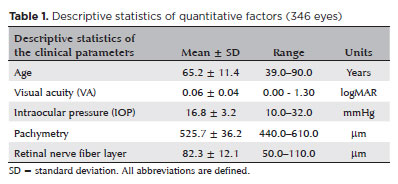
METHODS: This cross-sectional study included 174 patients (346 glaucomatous eyes) recruited from clinical records and routine follow-ups at a specialized ophthalmology center. Their mean age was 39–90 years, and 60.9% of them were women. Their quality of life and adherence were assessed using the NEI-VFQ25 and MMAS-8 questionnaires, respectively. Complementary tests included 24:2 visual field test, retinography, and optical coherence tomography. Patients diagnosed with glaucoma for at least 6 months were included, whereas pregnant patients and those with ocular diseases were excluded.
RESULTS: Among the participants, 59.2% adhered to the treatment whereas 40.8% showed low adherence. The mean quality of life score was 81.87. Patients with low adherence had slightly higher quality of life scores (mean 83.1) than those with good adherence (mean 81.0), but the difference was not statistically significant. Disease severity was associated with increased optic nerve cupping, reduced thickness of the nerve fiber and ganglion cell layers, and great visual field loss. No significant correlation was observed between adherence and quality of life, indicating the independence of these factors and the influence of psychological or social elements.
CONCLUSION: The absence of a correlation between quality of life and treatment adherence highlights the need for tailored interventions for psychological and social aspects. These findings indicate the importance of a comprehensive approach to managing glaucoma, preserving visual function, strengthening doctor–patient relationships, and considering psychosocial factors to enhance quality of life and treatment adherence.
Keywords: Glaucoma; Quality of life; Patient health questionnaire; Patient acuity; Antiglaucoma agents; Visual acuity; Treatment adherence and compliance; Surveys and questionnaires
13-tab01.jpg)
Abstract
Objetivo: Avaliar o impacto dos tumores córneo-conjuntivais na superfície ocular e na qualidade de vida dos pacientes antes e após o tratamento cirúrgico.
Métodos: Este estudo prospectivo conduziu uma avaliação pré-operatória e com 30 e 90 dias de pós-operatório de pacientes com diagnóstico de tumores de córnea e conjuntiva. Os dados demográficos foram coletados no pré-operatório. Os questionários Health Survey Short-Form (SF-12) e Ocular Surface Disease Index (OSDI) foram aplicados para avaliar a qualidade de vida dos pacientes e a percepção de suas funções relacionadas à visão. Os testes tear break-up time (TBUT) e Schirmer foram realizados para avaliação da superfície ocular. A extensão do tumor foi medida usando o programa ImageJ.
Resultados: Vinte e três pacientes foram incluídos. A média de idade foi de 52,8 ± 17,3 anos (27-79 anos). O tipo mais comum de tumor foi o carcinoma de células escamosas (61,5%). A acuidade visual dos pacientes melhorou significativamente em 1 mês e 3 meses (p=0,018 e p=0,036, respectivamente). Não houve diferenças significativas entre os testes tear break-up time e Schirmer no pré-operatório e com 3 meses de pós-operatório (p=0,150 e p=0,490, respectivamente). Os escores do SF-12 demonstraram que o componente mental apresentou diferença estatisticamente significante entre o pré-operatório e no 30 e 90 dias de pós-operatório (p=0,008 e p=0,026, respectivamente). A extensão do tumor foi de 868,7 ± 344,9 pixels (intervalo, 224,6-1481,6 pixels) e foram significativamente correlacionados com o componente mental de SF-12 no pré-operatório (p=0,011), 30 (p=0,017) e 90 dias de pós-operatório (p=0,012), e o componente emocional no 30º dia de pós-operatório (p=0,016).
Conclusão: Pacientes com tumores córneo-conjuntivais melhoraram os sintomas oculares, a acuidade visual e o componente emocional da qualidade de vida após a excisão cirúrgica do tumor.
Keywords: Neoplasias oculares; Neoplasias da túnica conjuntiva; Doenças da córnea; Acuidade visual; Qualidade de vida.
15-tab01.jpg)
Abstract
Objetivos: Validar a versão em português do Catquest-9SF através de sua aplicação em uma população nativa do Brasil com catarata e determinar a correlação da pontuação obtida no questionário com a acuidade visual pré-operatória.
Métodos: Realizou-se um estudo prospectivo para validação de questionário. O Catquest-9SF foi traduzido e retro traduzido gerando uma versão final em português. Um total de 120 pacientes brasileiros que aguardavam realização de cirurgia de catarata foram recrutados para responder ao questionário e para documentação de dados pré-operatórios e acuidade visual. Análise Rasch foi utilizada para acessar as propriedades psicométricas do instrumento.
Resultados: A versão em português do Catquest-9SF demonstrou ajuste aceitável dos itens (item fit statistics variando entre 0,7 e 1,3), unidimensionalidade (Principal Component Analisis) e boa organização nas categorias de resposta dos itens (limiares das categorias: -2,79; 0,57; 2,22). O questionário contém itens com relação estável, se considerado um mesmo nível de deficiência visual, na comparação entre dois grupos (ausência de differential item functioning). Existe adequada separação de pessoas (Person Separation Index 3,07). A acuidade visual em LogMAR no melhor olho com melhor correção óptica mostrou correlação estatisticamente significativa com a pontuação
em logit do Catquest-9SF (r=0,282 e p=0,004).
Conclusões: A versão em português do Catquest-9SF apresenta evidência de validade e confiabilidade, além de ser linguística e culturalmente compreensível para pacientes de língua portuguesa naturais do Brasil. Trata-se de questionário de fácil entendimento e rápida aplicação, sendo capaz de estimar de maneira adequada o funcionamento visual subjetivo em pacientes com catarata. Existe correlação significativa com a acuidade visual e a pontuação obtida no questionário.
Keywords: Extração de catarata; Perfil do impacto da doença; Acuidade visual; Inquéritos e questionários; Qualidade de vida.
Abstract
PURPOSE: This study aimed to evaluate the practices employed by oculoplastic surgeons in the assessment and management of anophthalmic sockets and external ocular prostheses.
METHODS: Oculoplastic surgeons from two countries, who specialized in the management of anophthalmic sockets, participated in a web-based survey. Data collected included demographics, types of surgery, implant use, external ocular prostheses management (including fabrication and cleaning), complications encountered, and follow-up times. The frequencies and distributions of the responses were statistically analyzed.
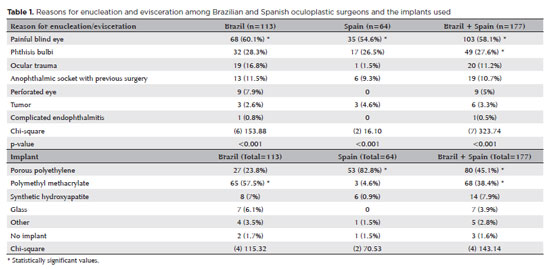
RESULTS: A total of 177 oculoplastic surgeons participated, 113 (63.8%) from Brazil, the remainder from Spain. Evisceration was the preferred surgical procedure of 149 (84.2%) surgeons. The most commonly reported indication for enucleation was a painful blind eye (n=103, 58.1%; both Brazil and Spain, p<0.001). Brazilian surgeons preferred polymethyl methacrylate implants (n=65, 57.5%), while Spanish surgeons favored porous polyethylene implants (n=53, 82.8%; p<0.001). Discharge was the most frequently observed clinical feature during socket evaluation (n=164, 92.6%; p<0.001). Brazilian surgeons recommended daily (n=53, 46.9%) or weekly (n=41, 36.2%) cleaning of external ocular prostheses, while Spanish surgeons more commonly recommended monthly cleaning (n=31, 48.4%; p<0.001). The majority of Brazilian surgeons (n=83, 73.4%) advised patients to remove their external ocular prostheses at night. Only a small number of Spanish surgeons (n=3, 4.6%) suggested this practice (p<0.001). Overall, the follow-up recommendations varied, with 70 (39.5%) surgeons recommending follow-up based on individual case needs, and 59 (33.3%) suggesting annual visits (p<0.001). The primary indications for external ocular prostheses replacement were edge damage (n=75, 42.3%) and loss of volume (n=68, 38.4%). The replacement intervals given typically ranged from 1 to 5 years (n=92, 51.9%; p<0.001).
CONCLUSION: Oculoplastic surgeons in Brazil and Spain demonstrated similar practices in the management of anophthalmic sockets. However, notable differences were observed in the choice of implant materials, cleaning protocols, and recommendations regarding external ocular prostheses removal during sleep.
Keywords: Anophthalmos; Eye, artificial; Polymethyl methacrylate; Polyethylene; Surgeons; Surveys and questionnaires; Brazil; Spain.
Abstract
PURPOSE: This clinical study aimed to assess the effectiveness of microemulsion artificial tears containing povidone and propylene glycol in the management of dry eye disease. Secondary objectives included evaluating improvements in tear-film stability, measured by tear break-up time and corneal staining scores, along with the tolerability and safety of the formulation.
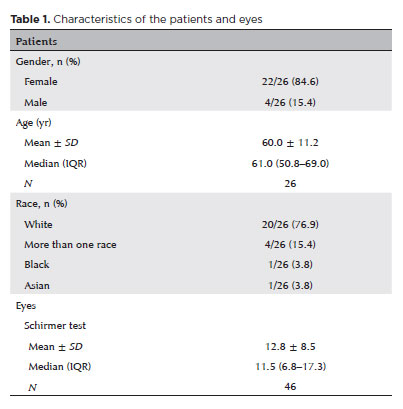
METHODS: This was a prospective, single-arm interventional study involving 30 participants (52 eyes) diagnosed with dry eye disease. Participants self-administered the investigational eye drops twice daily for 28 consecutive days. Primary and secondary outcomes included changes in the Ocular Surface Disease Index, tear break-up time, and corneal staining scores. Adverse events were documented throughout the study period.
RESULTS: Significant improvements in Ocular Surface Disease Index scores were observed, reflecting a reduction in dry eye disease symptoms. Tear break-up time increased notably between baseline and follow-up assessments, with the proportion of eyes exhibiting tear break-up time ≥10 srising from 25.0% to 63.5%. Additionally, the percentage of eyes with a corneal staining score of zero improved from 23.1% to 69.2%. Conjunctival staining also decreased, with the proportion of eyes with scores of 2 and 3 dropping from 11.5% to 3.8% and 5.8% to 0%, respectively.
CONCLUSIONS: The findings suggest that povidone and propylene glycol-based artificial tears significantly enhance tear-film stability and alleviate symptoms in patients with mild to moderate dry eye disease, with minimal adverse effects. This formulation represents a safe and effective short-term treatment option for dry eye disease management.
Keywords: Artificial tears; Dry eye disease; Tear-film stability; Propylene glycol; Povidone; Visual acuity; Surveys and questionnaires
Abstract
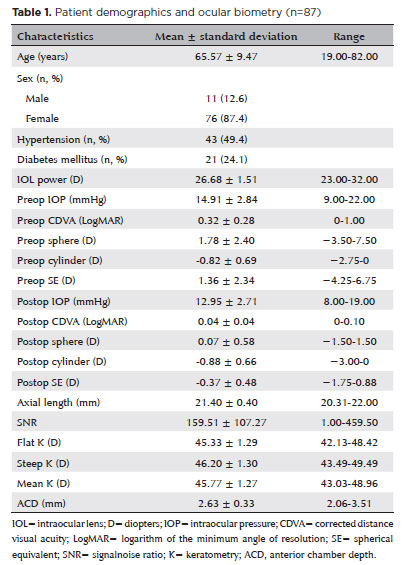
PURPOSE: To compare the refractive prediction error of Hill-radial basis function 3.0 with those of 3 conventional formulas and 11 combination methods in eyes with short axial lengths.
METHODS: The refractive prediction error was calculated using 4 formulas (Hoffer Q, SRK-T, Haigis, and Hill-RBF) and 11 combination methods (average of two or more methods). The absolute error was determined, and the proportion of eyes within 0.25-diopter (D) increments of absolute error was analyzed. Furthermore, the intraclass correlation coefficients of each method were computed to evaluate the agreement between target refractive error and postoperative spherical equivalent.
RESULTS: This study included 87 eyes. Based on the refractive prediction error findings, Hoffer Q formula exhibited the highest myopic errors, followed by SRK-T, Hill-RBF, and Haigis. Among all the methods, the Haigis and Hill-RBF combination yielded a mean refractive prediction error closest to zero. The SRK-T and Hill-RBF combination showed the lowest mean absolute error, whereas the Hoffer Q, SRK-T, and Haigis combination had the lowest median absolute error. Hill-radial basis function exhibited the highest intraclass correlation coefficient, whereas SRK-T showed the lowest. Haigis and Hill-RBF, as well as the combination of both, demonstrated the lowest proportion of refractive surprises (absolute error >1.00 D). Among the individual formulas, Hill-RBF had the highest success rate (absolute error ≤0.50 D). Moreover, among all the methods, the SRK-T and Hill-RBF combination exhibited the highest success rate.
CONCLUSIONS: Hill-radial basis function showed accuracy comparable to or surpassing that of conventional formulas in eyes with short axial lengths. The use and integration of various formulas in cataract surgery for eyes with short axial lengths may help reduce the incidence of refractive surprises.
Keywords: Cataract; Lenses, intraocular; Axial length, eye; Refractive errors; Artificial intelligence
11-tab01.jpg)
Abstract
OBJETIVO: Associar os resultados refrativos a longo prazo da cirurgia de catarata e a função visual autorreferida pelo questionário Catquest-9SF.
MÉTODOS: Paciente recrutados no ambulatório de catarata da VER MAIS Oftalmologia, foram submetidos a exame oftalmológico completo. Após diagnóstico de catarata com indicação de tratamento cirúrgico com facoemulsificação e implante de lente intraocular, o questionário foi aplicado antes da intervenção, 30 dias após cirurgia e 1 ano após, novamente.
RESULTADOS: Foram recrutados 133 pacientes. No decorrer do seguimento, 32 pacientes foram perdidos e ao final foram analisados os dados de 101 pacientes, dos quais 48 foram homens e 53 foram mulheres. A variância bruta explicada por dados foi de 69,9% e a inexplicada em primeiro contraste por 2,39 eigenvalores, sendo maior que 2, o que nos mostra que são resultados diferentes dos esperados de dados aleatórios. O índice de separação de pessoas foi de 2.95 (>2) e o valor de confiança de pessoas foi de 0,9 (>0,8). Estes índices são os valores mínimos aceitáveis na diferenciação de níveis de habilidade. Acuidade visual foi a principal variável correlacionada com o score do Catquest.
CONCLUSÕES: O Catquest-9SF traduzido para o português se demonstrou unidimensional e uma ferramenta psicometricamente válida para avaliar disfunção visual em pacientes com catarata, além de ter tido sucesso para quantificar objetivamente melhoras após a intervenção cirúrgica. Essa ferramenta pode ser utilizada como preditiva e concordante da melhora da acuidade visual.
Keywords: Extração de catarata; Acuidade visual; Inquéritos e questionários; Qualidade de vida; Medidas de resultados relatados pelo paciente
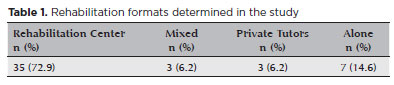
Abstract
PURPOSE: To evaluate the current scenario of rehabilitation services for people with retinal diseases in Brazil.
METHODS: An exploratory study was conducted between February 2023 and June 2023 using a Google Forms questionnaire that was distributed by patient associations.
RESULTS: A total of 142 patients, aged 18-80 were included in the study. Forty-eight participants (33.8%) were undergoing rehabilitation, while 94 (66.2%) were not. The main reason for not undergoing rehabilitation was a lack of knowledge about the service (n=41, 43.6%). Healthcare professionals made the most referrals (n=20, 41.7%). Rehabilitation improved the quality of life in 38 (80.9%) participants, and 28 (62.2%) participants were satisfied with the process. There was a statistically significant disparity between patient satisfaction and the locale of rehabilitation implementation. Twenty-three (69.7%) participants who underwent rehabilitation at a specialized center reported satisfaction.
CONCLUSION: The rehabilitation process directly increases the quality of life of individuals with retinal diseases. However, despite the availability of rehabilitation centers in large parts of Brazil, most patients with retinal diseases are not acquainted with the rehabilitation process and do not receive referrals for it. Thus, healthcare providers should increase referrals to rehabilitation centers, and public policies should be formulated to raise awareness among the population regarding the availability of rehabilitation services.
Keywords: Rehabilitation; Quality of life; Retinal diseases; Personal satisfaction; Patient care team; Public policy; Surveys and questionnaires; Brazil
Abstract
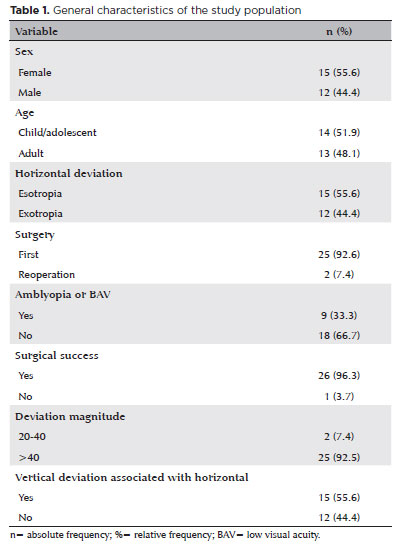
PURPOSE: To determine the influence of strabismus and its surgical correction on the preoperative and postoperative functional and psychosocial aspects of patients being treated at the CEROF/UFG Strabismus Outpatient Clinic.
METHODS: This prospective cross-sectional study included 27 patients, aged >7 years that were divided into two groups (<18 years and >18 years). The AS 20 questionnaire is composed of two domains (psychosocial and functional). Each domain includes 10 questions, which should be answered using a 5-point Likert scale. The questionnaire was administered preoperatively and 3 months postoperatively. In patients aged
<18 years, the questionnaire was concurrently administered to their parents and/or guardians.
RESULTS: Preoperatively, the average psychosocial and functional scores were 55 (p=0.01) and 57.5 (p=0.025), respectively, in adults, 70 (p=0.03) and 78.7 (p=0.16), respectively, in children and adolescents, and 46.2 (p=0.002) and 57.5 (p=0.003), respectively, in the parents and/or guardians. Postoperatively, the average psychosocial and functional scores were 80 (p=0.01) and 82.5 (p=0.025), respectively, in adults, 81.2 (p=0.03) and 85 (p=0.16), respectively, in children and adolescents, and 83.7 (p=0.002) and 86.2 (p=0.003), respectively, in parents and/or guardians.
CONCLUSION: The postoperative scores in the psychosocial (p=0.001), functional (p=0.001) and general (p<0.001) domains had increased in all the patients, demonstrating an improvement in the quality of life following strabismus correction surgery.
Keywords: Quality of life; Strabismus; Surveys and questionnaires; Psychosocial domain; Functional domain
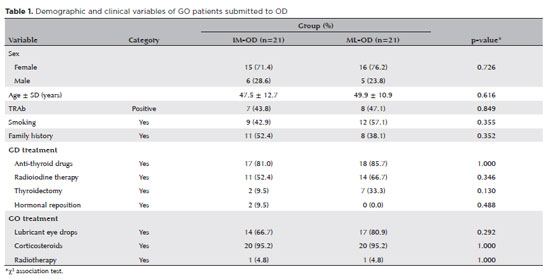
Abstract
PURPOSE: To compare inferomedial wall orbital decompression to balanced medial plus lateral wall orbital decompression in patients with Graves’ orbitopathy in the inactive phase with regard to exophthalmos reduction and the effects on quality of life.
METHODS: Forty-two patients with inactive Graves’ orbitopathy were randomly divided into two groups and submitted to one of two orbital decompression techniques: inferomedial wall orbital decompression or medial plus lateral wall orbital decompression. Preoperative and postoperative assessments included Hertel’s exophthalmometry and a validated Graves’ orbitopathy quality of life questionnaire. The results of the two groups were compared.
RESULTS: Compared to preoperative measurement, exophthalmos reduction was statistically significant in both groups (p<0.001) but more so in patients undergoing medial plus lateral wall orbital decompression (p=0.010). Neither orbital decompression techniques increased the visual functioning subscale score on the Graves’ orbitopathy quality of life questionnaire (inferomedial wall orbital decompression p=0.362 and medial plus lateral wall orbital decompression p=0.727), but a statistically significant difference was observed in the score of the appearance subscale in patients submitted to medial plus lateral wall orbital decompression (p=0.006).
CONCLUSIONS: Inferomedial wall orbital decompression is a good alternative for patients who do not require large exophthalmos reduction. However, medial plus lateral wall orbital decompression offers greater exophthalmos reduction and greater improvement in appearance (higher Graves’ orbitopathy quality of life questionnaire scores), making it a suitable option for esthetic-functional rehabilitation.
Keywords: Graves’ ophthalmopathy; Quality of life; Exophthalmos; Strabismus; Diplopia; Decompression, surgical
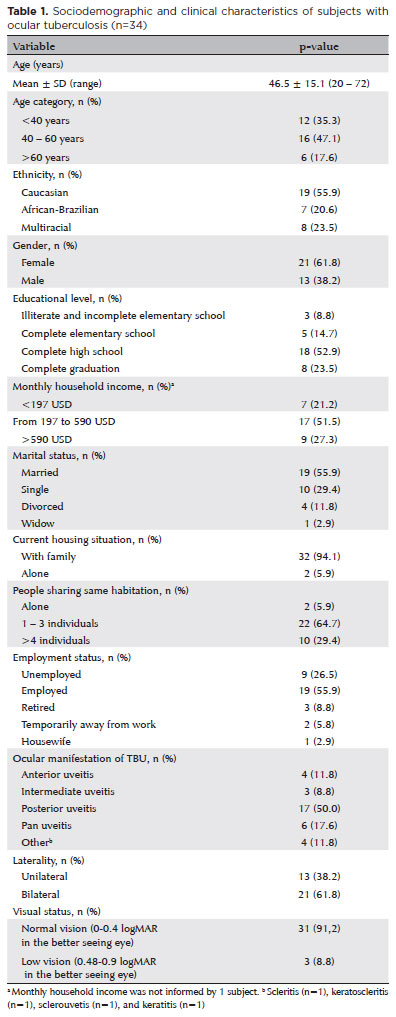
Abstract
PURPOSE: To assess the quality of life in patients diagnosed as having tuberculous uveitis and its association with sociodemographic, clinical, and psychosocial aspects.
METHOD: By conducting standardized interviews, clinical and demographic data were collected using a measure developed in this study. This measure was applied in addition to other measures, namely SF-12, Hospital Anxiety and Depression Scale, and NEI-VFQ-39, which were used to assess health-related quality of life, anxiety and depression symptoms, and visual functioning.
RESULTS: The study included 34 patients [mean age: 46.5 ± 15.1 years, female patients: 21 (61.8%)]. The mean of the VFQ-39 score was 74.5 ± 16.6 and that of SF-12 physical and mental component scores were 45.8 ± 10.1 and 51.6 ± 7.5, respectively, for the health-related quality of life. Anxiety symptoms were the most prevalent compared with depression symptoms and were found in 35.3% of the participants.
CONCLUSION: Tuberculous uveitis affects several scales of quality of life, thereby affecting a population economically active with a social, psychological, and economic burden.
Keywords: Tuberculosis, ocular; Quality of life; Uveitis; Anxiety; Depression; Surveys and questionnaires
Abstract
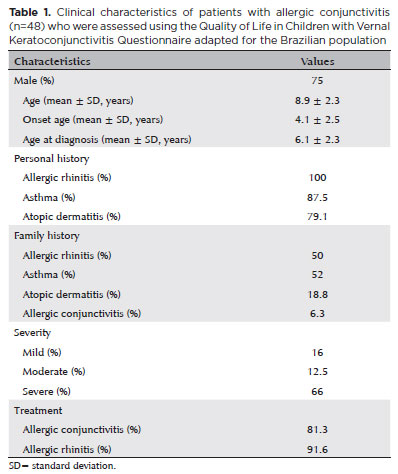
PURPOSE: The prevalence of ocular allergy varies according to the population and location of the study. Severe forms of ocular allergy are associated with compromised quality of life. In this study, we aimed to evaluate the application of the Brazilian-Portuguese version of the Quality of Life in Children with Keratoconjunctivitis questionnaire to children and adolescents with different subtypes of allergic conjunctivitis.
METHOD: A total of 48 patients (aged 5-12 years) with allergic conjunctivitis were included in this study. They were enrolled and monitored at a specialized center. After the clinical appointment, the children responded to the questionnaire on two occasions at an interval of 30 days. Individual scores (ranging from 0 to 3) of the 16 items were added.
RESULTS: The Brazilian-Portuguese version of the Quality of Life in Children with Keratoconjunctivitis questionnaire demonstrated good translation, adaptation, and intellectual properties, with substantial internal consistency (Cronbach's α coefficient = 0.702). There was no significant difference between the responses of the two interviews, revealing good reproducibility. The moderate/severe forms of allergic conjunctivitis had significantly higher quality of life scores (indicating a poorer quality of life) than the mild forms.
CONCLUSIONS: The Brazilian-Portuguese version of the Quality of Life in Children with Keratoconjunctivitis proved to be quick, reliable, and reproducible for assessing the quality of life in children with allergic conjunctivitis. However, its ability to detect changes resulting from symptom aggravation or treatment needs to be further evaluated.
Keywords: Conjunctivitis, allergic; Keratoconjunctivitis; Hypersensitivity; Quality of life; Child; Surveys and questionnaires
Abstract
Objetivos: Avaliar a segurança e eficácia a longo prazo da vitreólise com Nd:YAG laser para moscas volantes sintomáticas, uma vez que permanece como um procedimento controverso devido a falta de evidência científica robusta sobre a manutenção dos resultados e ocorrência de efeitos adversos.
Métodos: Este estudo é uma extensão observacional de um ensaio clínico prospectivo, randomizado, duplo cego, previamente publicado. Oito de treze pacientes que foram submetidos a vitreólise com YAG laser foram acompanhados para uma reavaliação tardia, dezoito meses após o procedimento, para avaliar a eficácia e segurança do procedimento.
Resultados: Todos os pacientes mantiveram a melhora na sintomatologia notada ao final do procedimento original, com 25% dos casos apresentando melhora completa, e uma proporção semelhante (37,5%) demonstrando melhora significativa ou parcial. A melhora objetiva na opacidade foi similar ao achado no seguimento original de 6 meses. O questionário de qualidade de vida NEI-VFQ 25 não demonstrou diferença estatisticamente significativa nas respostas entre o sexto e o décimo oitavo mês de acompanhamento. Nenhum efeito adverso foi notado no exame clínico ou reportado pelos pacientes.
Conclusão: A eficácia da vitreólise observada ao sexto mês do acompanhamento foi mantida até o décimo oitavo mês, com todos os pacientes notando algum grau de melhora quando comparado ao estado pré procedimento. Nenhum efeito adverso tardio foi notado. Um ensaio clínico randomizado maior é necessário para confirmar a segurança do procedimento.
Keywords: Terapia a laser; Lasers de estado sólido; Vitrectomia; Corpo vítreo; Cirurgia vitreorretiniana; Acuidade visual; Doenças oculares; Qualidade de vida; Inquéritos e questionários
 ABO is licensed under a Creative Commons Attribution-NonComercial 4.0 Internacional.
About
Issues
Editorial Board
Submission

Arquivos Brasileiros de Oftalmologia
Official publication of Brazilian Council of Ophthalmology - Conselho Brasileiro de Oftalmologia (CBO)
Rua Casa do Ator, 1.117 - 2nd floor - Zip Code: 04546-004
São Paulo - SP, Brazil
TEL: +55 11 3266-4000
E-mail: [email protected]