Arq. Bras. Oftalmol. 2021;84 (1 )
:11-16
| DOI: 10.5935/0004-2749.20210002
Abstract
OBJETIVO: Determinar o efeito da blefaroplastia superior na topografia corneana e no cálculo do poder das lentes intraoculares usando Galilei e IOLMaster.
MÉTODOS: Trinta pacientes submetidos a blefaroplastia superior de maio de 2014 a março de 2017 no Hospital Oftalmológico de Sorocaba, São Paulo, Brasil foram incluídos neste estudo de série de casos observacional. Todos os pacientes foram submetidos a sessões de imagem com Galilei e IOLMaster antes da cirurgia (exame de base) e no 1º e 6º mês pós-operatório. Os resultados primários utilizando os dois aparelhos incluíram ceratometria, astigmatismo corenano e astigmatismo corneano induzido pela blefaroplastia. O comprimento axial e o cálculo do poder da lente intraocular foram realizados unicamente com o IOLMaster (fórmula de Holladay). Teste-t pareado e análise vetorial foram usados na análise estatística.
RESULTADOS: Sessenta olhos de 30 pacientes foram incluídos prospectivamente. A análise vectorial mostrou que após 6 meses da cirurgia, a blefaroplastia superior induziu na média 0,39 D de astigmatismo corneano medido com o Galilei e 0,31 D com IOLMaster. As medidas com o IOLMaster mostraram que a ceratometria média (44,56 vs 44,64 D, p=0,01), ceratometria máxima (45,17 vs 45,31, p=0,01) e o astigmatismo corneano (1,22 vs 1,34, p=0,03) foram maiores após 6 meses da blefaroplastia. As medidas com IOLMaster mostraram que o poder da lente intraocular foi significativamente menor 6 meses após a blefaroplastia (22,07 vs 21,93, p=0,004). Todos os outros parâmetros não mostraram mudanças entre o pré-operatório e o 6º mês da cirurgia (p>0,05 para todas as comparações).
CONCLUSÕES: A blefaroplastia superior influenciou o cálculo da lente intraocular utilizando o IOLMaster. Contudo, a influência não foi clinicamente significativa. Não foram encontradas mudanças topográficas com o Galilei.
Keywords: Blefaroplastia; Lentes intraoculares; Ceratometria; Topografia da córnea; Biometria
Arq. Bras. Oftalmol. 2024;87 (3 )
:1-6
| DOI: 10.5935/0004-2749.2022-0220
Abstract
PURPOSE: This study aimed to investigate the effect of upper eyelid blepharoplasty with the removal of the skin and a strip of orbicularis oculi muscle on the ocular surface, tear film, and dry eye-related symptoms.
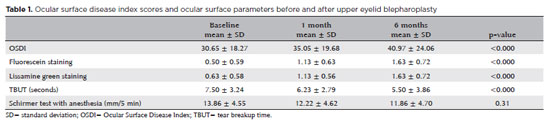
METHODS: Twenty-two eyes of 22 consecutive patients operated by a single surgeon (21 females; mean age, 61 years; age range, 41-75 years) were included. All subjects completed the Ocular Surface Disease Index questionnaire, underwent in vivo confocal microscopy, tear film breakup time measurements, the Schirmer test with anesthesia, and fluorescein and lissamine green staining measurements before, 1 month, and 6 months after upper blepharoplasty alone with preseptal orbicularis excision.
RESULTS: A significant increase in Ocular Surface Disease Index, and corneal fluorescein and lissamine green staining and a significant decrease in tear film breakup time were observed after 1 month (p=0.003, p=0.004, p=0.029, and p=0.024 respectively) and 6 months (p=0.001 for all findings). No significant difference in the Schirmer test score was observed during the follow-up. None of the in vivo confocal microscopy parameters showed significant changes during the study.
CONCLUSIONS: An increase in dry eye symptoms and a decrease in tear film stability along with ocular surface staining were observed in patients undergoing upper eyelid blepharoplasty.
Keywords: Blepharoplasty; Intravital microscopy; Lissamine green dyes; Fluorescein; Severity of illness index; Dry eye syndromes


 ABO is licensed under a Creative Commons Attribution-NonComercial 4.0 Internacional.


02-fig01.jpg)