Arq. Bras. Oftalmol. 2026;89 (5 )
:1-8
| DOI: 10.5935/0004-2749.2025-0337
Abstract
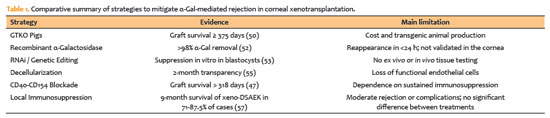
Corneal blindness affects more than 12 million individuals worldwide; however, the availability of human donor corneas meets only a small fraction of the demand. Porcine corneal xenotransplantation represents a promising alternative because of the cornea's immune privilege and the anatomical similarities between human and porcine corneas. However, the galactose-α1,3-galactose antigen expressed on porcine cells induces hyperacute rejection through the activation of human anti-Gal antibodies, complement pathways, and innate immune cell infiltration. This review summarizes the mechanisms underlying corneal immune privilege and contrasts them with galactose-α1,3-galactose-mediated rejection pathways. In addition, it evaluates five major mitigation strategies: GGTA1-knockout pigs, enzymatic α-galactosidase treatment, RNA interference, decellularization, and immunosuppressive approaches, including CD40-CD154 blockade and topical tacrolimus. Preclinical studies have demonstrated that GTKO corneas can maintain transparency for longer than 1 year, whereas decellularized matrices preserve corneal architecture while exhibiting low antigenicity. These findings support the future clinical translation of porcine corneal xenotransplantation.
Keywords: Corneal transplantation; Xenotransplantation; Graft rejection; Galactose; Immunosuppressive agents.


 ABO is licensed under a Creative Commons Attribution-NonComercial 4.0 Internacional.